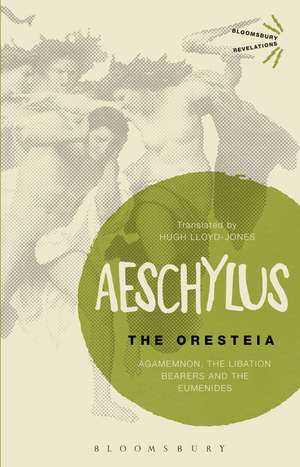
The Oresteia: Agamemnon, The Libation Bearers and The Eumenides: Bloomsbury Revelations
Autor Aeschylus Traducere de Sir Hugh Lloyd-Jonesen Limba Engleză Paperback – 24 apr 2014
Găsim în această ediție a trilogiei The Oresteia o abordare remarcabil de practică a textului antic, concepută special pentru a fi jucată și înțeleasă în context contemporan. Structura volumului este riguros organizată pentru a sprijini atât lectura, cât și punerea în scenă: succesiunea celor trei piese — Agamemnon, Coeforele și Eumenidele — este precedată de o introducere istorică și un ghid esențial de pronunție. Considerăm că marea calitate a acestei versiuni din seria Drama Classics este fluiditatea dialogului; traducătorii J. Michael Walton și Marianne McDonald au reușit să păstreze gravitatea lui Aeschylus fără a sacrifica ritmul narativ.
Progresia conținutului este susținută de un aparat de anexe care transformă volumul dintr-o simplă piesă de teatru într-un instrument de studiu complet. De la analizele asupra stagecraft-ului grecesc până la explorarea metricii și a contextului politic ateniene, cuprinsul indică o acoperire exhaustivă a operei. Față de alte lucrări ale autorului, precum The Persians and Other Plays, unde accentul cade pe evenimente istorice contemporane poetului, The Oresteia explorează tranziția de la legea talionului la justiția civică. Această ediție completează excelent volumul Aeschylus: The Oresteia de Simon Goldhill, oferind textul propriu-zis adaptat pentru performanță acolo unde Goldhill oferă analiza critică și socială. În timp ce The Complete Aeschylus urmărește o fidelitate poetică arhaizantă, ediția de față optează pentru un stil direct, „truncated colloquial”, care face ca tragedia sângeroasă a lui Agamemnon și Orestes să rezoneze surprinzător de modern.
Din seria Bloomsbury Revelations
- 24%
 Preț: 193.25 lei
 - 19%
 Preț: 172.26 lei
 - 17%
 Preț: 161.17 lei
 - 25%
 Preț: 173.62 lei
 - 21%
 Preț: 211.80 lei
 - 21%
 Preț: 145.07 lei
 - 22%
 Preț: 201.55 lei
 - 13%
 Preț: 171.37 lei
 - 22%
 Preț: 150.47 lei
 - 19%
 Preț: 169.96 lei
 - 19%
 Preț: 161.97 lei
 - 23%
 Preț: 187.41 lei
 - 21%
 Preț: 130.18 lei
 - 18%
 Preț: 187.71 lei
 - 23%
 Preț: 148.23 lei
 - 24%
 Preț: 192.68 lei
 - 18%
 Preț: 187.53 lei
 - 23%
 Preț: 197.19 lei
 - 26%
 Preț: 188.61 lei
 - 19%
 Preț: 184.26 lei
 - 24%
 Preț: 179.63 lei
 - 17%
 Preț: 200.20 lei
 - 20%
 Preț: 161.11 lei
 - 16%
 Preț: 168.38 lei
 - 23%
 Preț: 180.35 lei
 - 18%
 Preț: 176.90 lei
 - 23%
 Preț: 188.72 lei
 - 23%
 Preț: 188.76 lei
 - 14%
 Preț: 119.74 lei
 - 14%
 Preț: 146.96 lei
 - 20%
 Preț: 159.71 lei
 - 38%
 Preț: 174.38 lei
 - 23%
 Preț: 198.09 lei
 - 20%
 Preț: 131.90 lei
 - 24%
 Preț: 189.48 lei
 - 19%
 Preț: 171.54 lei
 - 24%
 Preț: 195.50 lei
 - 24%
 Preț: 178.02 lei
 - 25%
 Preț: 187.49 lei
 - 24%
 Preț: 145.14 lei
 - 24%
 Preț: 190.86 lei
 - 22%
 Preț: 114.34 lei
 - 18%
 Preț: 177.90 lei
 - 24%
 Preț: 177.92 lei
 - 22%
 Preț: 185.44 lei
 - 24%
 Preț: 180.76 lei
 - 18%
 Preț: 194.29 lei
 - 25%
 Preț: 191.11 lei
 - 8%
 Preț: 121.19 lei
 - 8%
 Preț: 119.59 lei
Preț: 137.54 lei
Preț vechi: 175.90 lei
-22%
Carte tipărită la comandă
Livrare economică 08-22 decembrie
Specificații
ISBN-10: 1472526791
Pagini: 248
Dimensiuni: 138 x 214 x 14 mm
Greutate: 0.32 kg
Editura: Bloomsbury Publishing
Colecția Bloomsbury Academic
Seria Bloomsbury Revelations
Locul publicării:London, United Kingdom
V-ar putea interesa
-
 Voltaire in LoveNancy Mitford-37%Preț: 58.20 lei92.60 lei
 -
 The Theban PlaysSophocles-20%Preț: 57.13 lei71.10 lei
 -
 The Oresteian TrilogyAeschylus-32%Preț: 62.94 lei92.17 lei
 -
 MetamorphosesOvid-20%Preț: 66.18 lei83.02 lei
 -
 Oxford Textbook of Obstetrics and GynaecologySabaratnam Arulkumaran-5%Preț: 1934.35 lei2036.16 lei
 -
 AeneidVirgil-16%Preț: 62.08 lei74.03 lei
 -
 Preț: 115.66 lei
 -
 Preț: 127.77 lei
 -
 Preț: 123.53 lei
 -
 Oedipus the King, Second EditionSophoclesPreț: 65.45 lei
 -
 Preț: 176.89 lei
 -
 Oresteia of AeschylusAeschylusPreț: 101.39 lei
 -
 Too Much and Not the MoodDurga Chew-BosePreț: 100.41 lei
 -
 The MothersBrit BennettPreț: 94.34 lei
 -
 Preț: 234.91 lei
 -
 Three PlaysEugene O'NeillPreț: 102.65 lei
 -
 Honeybee DemocracyThomas D. SeeleyPreț: 229.77 lei
 -
 The Lives of BeesThomas D. SeeleyPreț: 309.91 lei
 -
 Following the Wild BeesThomas D. SeeleyPreț: 112.31 lei
 -
 Dark SummitNick Heil-44%Preț: 75.64 lei134.47 lei
 -
 An OresteiaAeschylusPreț: 105.55 lei
 -
 Medea and Other PlaysEuripidesPreț: 43.30 lei
 -
 The Three Theban PlaysSophoclesPreț: 45.74 lei
 -
 AgamemnonAeschylusPreț: 38.67 lei
 -
 Everest 1953Mick ConefreyPreț: 113.00 lei
 -
 Preț: 173.14 lei
 -
 8000 metresAlan HinkesPreț: 243.42 lei
De ce să citești această carte
Recomandăm această ediție studenților la teatru și cititorilor pasionați de beletristică clasică care își doresc o traducere clară și dinamică. Veți câștiga nu doar acces la singura trilogie greacă păstrată integral, ci și un context istoric și tehnic bogat prin cele șapte anexe incluse. Este alegerea ideală pentru cei care vor să înțeleagă bazele dramei occidentale printr-un text adaptat pentru ritmul scenei moderne.
Despre autor
Aeschylus (c. 525–456 î.Hr.) este recunoscut drept părintele tragediei grecești, fiind cel care a transformat teatrul prin introducerea celui de-al doilea actor, permițând astfel conflictul direct între personaje. Deși a scris între 70 și 90 de piese, doar șapte au supraviețuit timpului, The Oresteia fiind singura trilogie antică păstrată în întregime. Opera sa este marcată de teme profunde precum dreptatea divină, destinul și evoluția societății civile. Importanța sa a fost atât de mare încât epitaf-ul său menționează participarea la bătălia de la Maraton, nu succesul său literar, subliniind legătura strânsă dintre arta sa și cetatea ateniană.
Descriere
Now available in the Bloomsbury Revelations series in this classic and authoritative translation by Hugh Lloyd-Jones, this book contains the text of all three plays - Agamemnon, The Libation Bearers and The Eumenides - with extensive scholarly annotation throughout.
Cuprins
1. Agamemnon Bibliography 2. The Choephoroe ('The Libation Bearer') Bibliography 3. Eumenides ('The Kindly Ones') Bibliography Appendix