
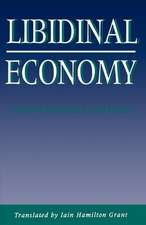
Libidinal Economy: Bloomsbury Revelations
Autor Jean-Francois Lyotard Traducere de Iain Hamilton Granten Limba Engleză Paperback – 22 oct 2015
Găsim în Libidinal Economy o lucrare fundamentală a filosofiei continentale din secolul XX, care forțează limitele dintre economie, psihanaliză și politică. Reținem abordarea interdisciplinară radicală a lui Jean-François Lyotard, care propune conceptul de „economii libidinale” — fluxuri de intensități ce traversează atât corpul uman, cât și evenimentele sociale sau structurile de putere. Publicat inițial în limba franceză în 1974, acest volum marchează o ruptură de marxismul tradițional și de semiotică, explorând modul în care dorința alimentează mecanismele capitaliste. Credem că forța acestui text rezidă în critica sa extinsă asupra filosofiilor dorinței, unde Lyotard intră într-un dialog tensionat cu gânditori precum Deleuze, Guattari, Bataille și Foucault. Cititorii familiarizați cu Living Currency de Pierre Klossowski vor aprecia modul în care acest volum dezvoltă analiza producției economice ca mecanism psihic, oferind însă o perspectivă mai sistemică asupra „energiilor” care guvernează societatea. Față de abordările din Eros and Economy de Barbara Jenkins, care utilizează psihologia lui Jung, Lyotard rămâne ancorat într-o critică politică mai agresivă și experimentală. În contextul operei sale, Libidinal Economy reprezintă puntea necesară între primele sale preocupări politice radicale și turnura sa ulterioară către estetică și sublim, vizibilă în Lessons on the Analytic of the Sublime. Este o lectură densă, cu un ton provocator, esențială pentru înțelegerea fundamentelor postmodernismului.
Din seria Bloomsbury Revelations
- 24%
 Preț: 192.71 lei
 - 19%
 Preț: 171.18 lei
 - 18%
 Preț: 159.73 lei
 - 25%
 Preț: 173.62 lei
 - 21%
 Preț: 211.80 lei
 - 21%
 Preț: 145.07 lei
 - 23%
 Preț: 198.80 lei
 - 14%
 Preț: 169.83 lei
 - 23%
 Preț: 149.11 lei
 - 19%
 Preț: 169.96 lei
 - 20%
 Preț: 160.25 lei
 - 23%
 Preț: 187.41 lei
 - 21%
 Preț: 130.18 lei
 - 18%
 Preț: 187.71 lei
 - 25%
 Preț: 142.27 lei
 - 25%
 Preț: 187.63 lei
 - 19%
 Preț: 185.68 lei
 - 24%
 Preț: 193.66 lei
 - 26%
 Preț: 188.61 lei
 - 25%
 Preț: 174.34 lei
 - 18%
 Preț: 198.21 lei
 - 20%
 Preț: 161.11 lei
 - 17%
 Preț: 166.71 lei
 - 23%
 Preț: 180.35 lei
 - 18%
 Preț: 176.90 lei
 - 23%
 Preț: 188.72 lei
 - 24%
 Preț: 186.77 lei
 - 15%
 Preț: 118.66 lei
 - 15%
 Preț: 145.69 lei
 - 21%
 Preț: 158.13 lei
 - 39%
 Preț: 168.51 lei
 - 24%
 Preț: 191.92 lei
 - 21%
 Preț: 130.36 lei
 - 24%
 Preț: 189.48 lei
 - 19%
 Preț: 172.53 lei
 - 24%
 Preț: 195.50 lei
 - 25%
 Preț: 175.18 lei
 - 25%
 Preț: 187.49 lei
 - 24%
 Preț: 145.14 lei
 - 24%
 Preț: 190.86 lei
 - 22%
 Preț: 114.34 lei
 - 18%
 Preț: 177.90 lei
 - 25%
 Preț: 171.92 lei
 - 22%
 Preț: 185.44 lei
 - 24%
 Preț: 180.76 lei
 - 19%
 Preț: 192.37 lei
 - 25%
 Preț: 191.11 lei
 - 9%
 Preț: 117.99 lei
 - 9%
 Preț: 117.99 lei
Preț: 178.03 lei
Preț vechi: 223.03 lei
-20%
Carte disponibilă
Livrare economică 11-25 noiembrie
Livrare express 28 octombrie-03 noiembrie pentru 68.96 lei
Specificații
ISBN-10: 1474241123
Pagini: 304
Dimensiuni: 134 x 212 x 22 mm
Greutate: 0.28 kg
Editura: Bloomsbury Publishing
Colecția Bloomsbury Academic
Seria Bloomsbury Revelations
Locul publicării:London, United Kingdom
V-ar putea interesa
-
 Libidinal EconomyJean-Francois LyotardPreț: 254.90 lei
 -
 Idealism: The History of a PhilosophyJeremy Dunham-18%Preț: 992.14 lei1209.93 lei
 -
 Idealism: The History of a PhilosophyJeremy DunhamPreț: 424.92 lei
 -
 Des compensations dans les destinées humaines (5e éd.)Hyacinthe AzaïsPreț: 254.31 lei
 -
 Preț: 177.78 lei
 -
 La Volonté de MétamorphoseJoseph BaruziPreț: 131.41 lei
 -
 Preț: 216.32 lei
 -
 Turgot Philosophe, Économiste Et AdministrateurAnselme BatbiePreț: 215.00 lei
 -
 Preț: 131.80 lei
 -
 Le Pyrrhonisme raisonnableLouis de BeausobrePreț: 176.92 lei
 -
 Preț: 145.67 lei
 -
 Science et philosophieMarcellin BerthelotPreț: 231.32 lei
 -
 L'InfaillibilitéAntoine Blanc De Saint-BonnetPreț: 239.28 lei
 -
 Foucault und die klassische AntikeWolfgang DetelPreț: 157.03 lei
De ce să citești această carte
Această ediție din seria Bloomsbury Revelations este indispensabilă pentru studenții și cercetătorii din domeniul filosofiei și științelor politice. Cititorul câștigă o înțelegere profundă a legăturii dintre dorință și capital, dincolo de clișeele ideologice. Este o oportunitate de a studia un text care a redefinit critica socială în Franța anilor '70, oferind instrumente conceptuale pentru a analiza fluxurile de putere și energie din societatea contemporană.
Despre autor
Jean-François Lyotard (1924–1998) a fost profesor de filosofie la Universitatea Paris VIII și la Universitatea Emory, fiind considerat unul dintre arhitecții postmodernismului. Fost membru al grupului radical „Socialisme ou Barbarie”, gândirea sa a evoluat de la marxism către o analiză critică a „marilor narațiuni”. Opera sa este vastă, incluzând titluri de referință precum „Condiția postmodernă” și Lessons on the Analytic of the Sublime, având un impact major în sociologie, teoria artei și politică.
Descriere
First published in 1974, Libidinal Economy is a major work of twentieth century continental philosophy. In it, Lyotard develops the idea of economies driven by libidinal 'energies' or 'intensities' which he claims flow through all structures, such as the human body and political or social events. He uses this idea to interpret a diverse range of subjects including political economy, Marxism, sexual politics, semiotics and psychoanalysis. Lyotard also carries out a broad critique of philosophies of desire, as expounded by Deleuze and Guattari, Nietzsche, Bataille, Foucault and de Sade.
Notă biografică
Jean-François Lyotard (1924-1998) was Professor of Philosophy at several institutes of higher learning in Paris and at the University of California. A member of the radical group Socialisme ou Barbarie, he later went on to become one of the founding figures of postmodernism with his work The Postmodern Condition.