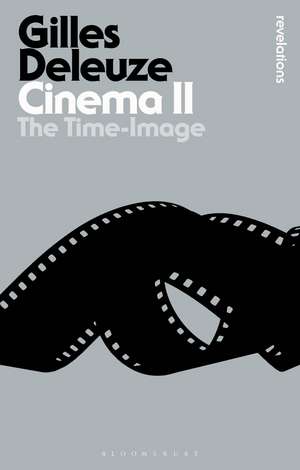
Cinema II: The Time-Image: Bloomsbury Revelations
Autor Gilles Deleuzeen Limba Engleză Paperback – 24 oct 2013
Cinema II is Deleuze's second work on cinema, completing the reassessment of the art form begun in Cinema I. Influenced by the philosophy of Henri Bergson, Deleuze here offers a compelling analysis of the cinematic treatment of time and memory, thought and speech. The work draws on examples from major film makers, including Federico Fellini, Alfred Hitchcock and Orson Welles, among many others.
Din seria Bloomsbury Revelations
- 24%
 Preț: 193.25 lei
 - 19%
 Preț: 172.26 lei
 - 18%
 Preț: 159.93 lei
 - 25%
 Preț: 173.62 lei
 - 21%
 Preț: 211.80 lei
 - 21%
 Preț: 145.07 lei
 - 23%
 Preț: 198.80 lei
 - 14%
 Preț: 170.05 lei
 - 23%
 Preț: 149.11 lei
 - 19%
 Preț: 169.96 lei
 - 20%
 Preț: 161.25 lei
 - 23%
 Preț: 187.41 lei
 - 21%
 Preț: 130.18 lei
 - 18%
 Preț: 187.71 lei
 - 23%
 Preț: 148.23 lei
 - 24%
 Preț: 192.68 lei
 - 19%
 Preț: 185.68 lei
 - 24%
 Preț: 193.66 lei
 - 26%
 Preț: 188.61 lei
 - 20%
 Preț: 178.03 lei
 - 24%
 Preț: 179.63 lei
 - 18%
 Preț: 198.21 lei
 - 20%
 Preț: 161.11 lei
 - 17%
 Preț: 166.71 lei
 - 23%
 Preț: 180.35 lei
 - 18%
 Preț: 176.90 lei
 - 23%
 Preț: 188.72 lei
 - 24%
 Preț: 186.77 lei
 - 15%
 Preț: 118.66 lei
 - 15%
 Preț: 146.58 lei
 - 21%
 Preț: 158.13 lei
 - 39%
 Preț: 168.51 lei
 - 24%
 Preț: 192.36 lei
 - 21%
 Preț: 130.36 lei
 - 24%
 Preț: 189.48 lei
 - 24%
 Preț: 195.50 lei
 - 24%
 Preț: 177.23 lei
 - 25%
 Preț: 187.49 lei
 - 24%
 Preț: 145.14 lei
 - 24%
 Preț: 190.86 lei
 - 22%
 Preț: 114.34 lei
 - 18%
 Preț: 177.90 lei
 - 25%
 Preț: 171.92 lei
 - 22%
 Preț: 185.44 lei
 - 24%
 Preț: 180.76 lei
 - 19%
 Preț: 192.37 lei
 - 25%
 Preț: 191.11 lei
 - 9%
 Preț: 117.99 lei
 - 9%
 Preț: 117.99 lei
Preț: 172.53 lei
Preț vechi: 212.61 lei
-19%
Puncte Express: 259
Carte disponibilă
Livrare economică 12-26 noiembrie
Livrare express 29 octombrie-04 noiembrie pentru 68.22 lei
Livrare prin curier în România Termenul estimat este afișat lângă disponibilitate.
Transport gratuit de la 400.00 lei Plată online sau ramburs, în funcție de opțiunile comenzii.
Retur gratuit în 14 zile Comandă securizată și suport în română.
Specificații
ISBN-13: 9781472512604
ISBN-10: 147251260X
Pagini: 376
Dimensiuni: 138 x 214 x 28 mm
Greutate: 0.48 kg
Editura: Bloomsbury Publishing
Colecția Bloomsbury Academic
Seria Bloomsbury Revelations
Locul publicării:London, United Kingdom
ISBN-10: 147251260X
Pagini: 376
Dimensiuni: 138 x 214 x 28 mm
Greutate: 0.48 kg
Editura: Bloomsbury Publishing
Colecția Bloomsbury Academic
Seria Bloomsbury Revelations
Locul publicării:London, United Kingdom
V-ar putea interesa
-
 Sculpting in Time: Reflections on the CinemaAndrey TarkovskyPreț: 245.90 lei
 -
 The Principles of Psychology, Vol. 1William James-23%Preț: 163.78 lei212.79 lei
 -
 The World as Will and Representation, Vol. 2Arthur Schopenhauer-34%Preț: 153.68 lei232.97 lei
 -
 MeditationsMarcus AureliusPreț: 34.00 lei
 -
 Cinema 1: The Movement-ImageGilles DeleuzePreț: 185.64 lei
 -
 BergsonismGilles DeleuzePreț: 159.09 lei
 -
 -32%Preț: 552.03 lei817.57 lei
 -
 -32%Preț: 551.67 lei816.67 lei
 -
 Cinema I: The Movement-ImageGilles Deleuze-19%Preț: 171.63 lei211.51 lei
 -
 Difference and RepetitionGilles Deleuze-19%Preț: 178.29 lei219.86 lei
 -
 Deleuze's Cinema BooksDavid Deamer-9%Preț: 170.68 lei188.17 lei
 -
 50 Film Ideas You Really Need to KnowHelen O’Hara-28%Preț: 50.70 lei70.25 lei
 -
 Two Regimes of Madness, revised editionGilles Deleuze-14%Preț: 108.41 lei125.49 lei
 -
 -31%Preț: 450.53 lei657.11 lei
 -
 Signs and Meaning in the CinemaPeter Wollen-24%Preț: 186.06 lei244.80 lei
 -
 Deleuze and Cinema: The Film ConceptsFelicity Colman-23%Preț: 242.98 lei317.23 lei
 -
 In the Blink of An Eye: New EditionWalter MurchPreț: 79.33 lei
 -
 The Time MachineH. G. WellsPreț: 33.23 lei
 -
 A Cinematic Mode of Existence: Perspectival Analytic of the ImageHalbe Hessel Kuipers-32%Preț: 628.64 lei926.98 lei
 -
 Read Frame Type FilmCatherine De Smet-17%Preț: 296.70 lei356.80 lei
Cuprins
Preface to the English Edition \ Translator's Introduction \1. Beyond the Movement-Image \ 2. Recapitulation of Images and Signs \ 3. FromRecollections to Dreams: Third Commentary on Bergson \ 4. The Crystals of Time\ 5. Peaks of Present and Sheets of Past: Fourth Commentary on Bergson \ 6. ThePowers of the False \ 7. Thought and Cinema \ 8. Cinema, Body and Brain,Thought \ 9. The Components of the Image \ 10. Conclusions \ Notes \ Glossary \Index.
Recenzii
"Cinema I and Cinema II must be understood as works of philosophy, not of film criticism. They are Deleuze's reflection on the new ways the cinema enables us to think about time and movement, opening up insights into semiotics and our ideological construction of a world increasingly experienced through representational media.... The main purpose of these books is to identify and explore the implications of a vital shift from classical, pre-World War II cinema of the movement-image to post-World War II cinema of the time-imaging.... "Cinema 1 and Cinema 2 perhaps ultimately have more to teach us about philosophy, conceptions of subjectivity, and hermeneutics than to say something about any specific film. These books are challenging because they develop their own vocabulary in dialogue with the history of philosophy, and they assume a wide knowledge of films from the Soviet, European and Hollywood traditions. They reward the effort required to read them, however, for the original tools with which they provide us to understand cinema and semiotics more generally. Deleuze concludes that it is important to think of cinema not as a language, but as a way of bringing to light 'intelligible content' which is a condition through which language constructs its objects (Cinema 2, p.251). Thus, purely optical and sound images which do not extend into action might be one way in which aesthetics might help us break outside of the determining structure of linguistic systems, enabling us to imagine the world otherwise. Deleuze helps us to see cinema as more than just a collection of texts but as additionally 'a new practice of images and signs, whose theory philosophy must produce as conceptual practice' (Cinema 2, p. 269)."- Sherryl Vint, Film International, Issue 27