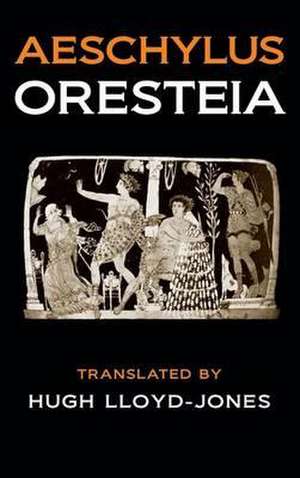
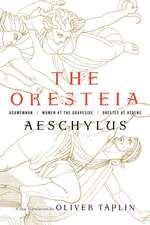
The Oresteia
Autor Aeschylusen Limba Engleză Paperback – apr 2013
Găsim în această ediție a trilogiei The Oresteia o abordare remarcabil de practică a textului antic, concepută special pentru a fi jucată și înțeleasă în context contemporan. Structura volumului este riguros organizată pentru a sprijini atât lectura, cât și punerea în scenă: succesiunea celor trei piese — Agamemnon, Coeforele și Eumenidele — este precedată de o introducere istorică și un ghid esențial de pronunție. Considerăm că marea calitate a acestei versiuni din seria Drama Classics este fluiditatea dialogului; traducătorii J. Michael Walton și Marianne McDonald au reușit să păstreze gravitatea lui Aeschylus fără a sacrifica ritmul narativ. Progresia conținutului este susținută de un aparat de anexe care transformă volumul dintr-o simplă piesă de teatru într-un instrument de studiu complet. De la analizele asupra stagecraft-ului grecesc până la explorarea metricii și a contextului politic ateniene, cuprinsul indică o acoperire exhaustivă a operei. Față de alte lucrări ale autorului, precum The Persians and Other Plays, unde accentul cade pe evenimente istorice contemporane poetului, The Oresteia explorează tranziția de la legea talionului la justiția civică. Această ediție completează excelent volumul Aeschylus: The Oresteia de Simon Goldhill, oferind textul propriu-zis adaptat pentru performanță acolo unde Goldhill oferă analiza critică și socială. În timp ce The Complete Aeschylus urmărește o fidelitate poetică arhaizantă, ediția de față optează pentru un stil direct, „truncated colloquial”, care face ca tragedia sângeroasă a lui Agamemnon și Orestes să rezoneze surprinzător de modern.
Preț: 185.65 lei
Preț vechi: 205.71 lei
-10%
Carte tipărită la comandă
Livrare economică 28 noiembrie-12 decembrie
Specificații
ISBN-10: 0715616838
Pagini: 282
Dimensiuni: 135 x 215 x 15 mm
Greutate: 0.32 kg
Editura: Bloomsbury Publishing
Locul publicării:United Kingdom
V-ar putea interesa
-
 Voltaire in LoveNancy Mitford-37%Preț: 58.20 lei92.60 lei
 -
 The Theban PlaysSophocles-20%Preț: 57.10 lei71.10 lei
 -
 The Oresteian TrilogyAeschylus-32%Preț: 62.94 lei92.17 lei
 -
 MetamorphosesOvid-21%Preț: 65.49 lei83.02 lei
 -
 Oxford Textbook of Obstetrics and GynaecologySabaratnam Arulkumaran-5%Preț: 1934.35 lei2036.16 lei
 -
 AeneidVirgil-16%Preț: 62.08 lei74.03 lei
 -
 Preț: 115.66 lei
 -
 Preț: 123.61 lei
 -
 Preț: 130.26 lei
 -
 Oedipus the King, Second EditionSophoclesPreț: 65.45 lei
 -
 Preț: 176.89 lei
 -
 Oresteia of AeschylusAeschylusPreț: 101.39 lei
 -
 Too Much and Not the MoodDurga Chew-BosePreț: 100.41 lei
 -
 The MothersBrit BennettPreț: 94.34 lei
 -
 Preț: 231.01 lei
 -
 Three PlaysEugene O'NeillPreț: 102.65 lei
 -
 Honeybee DemocracyThomas D. SeeleyPreț: 229.77 lei
 -
 The Lives of BeesThomas D. SeeleyPreț: 309.91 lei
 -
 Following the Wild BeesThomas D. SeeleyPreț: 108.96 lei
 -
 Dark SummitNick Heil-45%Preț: 74.27 lei134.24 lei
 -
 An OresteiaAeschylusPreț: 105.55 lei
 -
 Medea and Other PlaysEuripidesPreț: 43.30 lei
 -
 The Three Theban PlaysSophoclesPreț: 45.74 lei
 -
 AgamemnonAeschylusPreț: 38.67 lei
 -
 Everest 1953Mick ConefreyPreț: 113.00 lei
 -
 Preț: 173.14 lei
 -
 8000 metresAlan HinkesPreț: 239.49 lei
De ce să citești această carte
Recomandăm această ediție studenților la teatru și cititorilor pasionați de beletristică clasică care își doresc o traducere clară și dinamică. Veți câștiga nu doar acces la singura trilogie greacă păstrată integral, ci și un context istoric și tehnic bogat prin cele șapte anexe incluse. Este alegerea ideală pentru cei care vor să înțeleagă bazele dramei occidentale printr-un text adaptat pentru ritmul scenei moderne.
Despre autor
Aeschylus (c. 525–456 î.Hr.) este recunoscut drept părintele tragediei grecești, fiind cel care a transformat teatrul prin introducerea celui de-al doilea actor, permițând astfel conflictul direct între personaje. Deși a scris între 70 și 90 de piese, doar șapte au supraviețuit timpului, The Oresteia fiind singura trilogie antică păstrată în întregime. Opera sa este marcată de teme profunde precum dreptatea divină, destinul și evoluția societății civile. Importanța sa a fost atât de mare încât epitaf-ul său menționează participarea la bătălia de la Maraton, nu succesul său literar, subliniind legătura strânsă dintre arta sa și cetatea ateniană.
Descriere scurtă
Textul de pe ultima copertă
Descriere
Aeschylus' famed plays Agamemnon, The Libation Bearers, and The Eumenides comprise the Oresteia, which uses the dark and convoluted story of a family curse, and a long history of murder and revenge, to raise haunting questions about the nature and the price of justice. In Agamemnon , the Argive king reaches home following his victory in the Trojan War, only to meet his death at the hand of his wife, Clytemnestra. Horrible as this deed is shown to be, we also come to understand in the course of the play how justice has been satisfied by Agamemnon's murder. The second play in the trilogy, The Libation Bearers (Choephoroe), portrays the vengeance of Agamemnon's son Orestes, who returns from exile to exact the price of his father's murder. With the aid of his sister Electra, Orestes kills Clytemnestra, and her lover, Aegisthus. By spilling his mother's blood, however, he invites the wrath of the ancient Erinyes, or Furies, and they begin to pursue him. The Eumenides shows the Furies' pursuit of Orestes, who is protected by the younger god Apollo. Orestes is ultimately tried for his crime in Athens, and Athena, goddess of wisdom, casts the deciding vote on his behalf, and releases him from the ancient familial blood-guilt. Athena persuades the Furies to accept the new legal justice and a new role in the polis, as Kindly Ones, who will bless the city of Athens and its land. In this exciting new translation, at once faithful to the original and as fully alive as a poem in English, Alan Shapiro and Peter Burian showcase the complexity and intricate imagery of this great work of Athenian tragic poetry.
Notă biografică
Cuprins
The Oresteia: Introduction
DAVID GRENE
The Oresteia: the Theatrical Perspective
NICHOLAS RUDALL
Translating for the Stage and from the Stage
WENDY DONIGER O'FLAHERTY
Part One: Unabridged Translation
Agamemnon
The Libation Bearers
The Eumenides
Part Two: Acting Version
Agamemnon
The Libation Bearers
The Eumenides