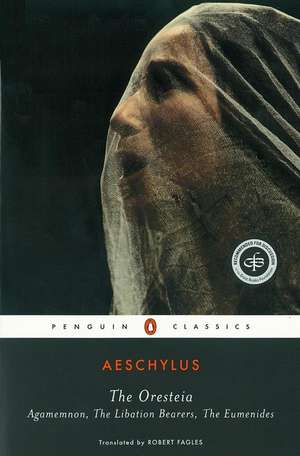
The Oresteia: Agamemnon, The Libation Bearers, The Eumenides
Autor Aeschylus Editat de W. Stanford Traducere de Robert Faglesen Limba Engleză Paperback – 28 sep 1977
In theOresteiaAeschylus addressed the bloody chain of murder and revenge within the royal family of Argos. As they move from darkness to light, from rage to self-governance, from primitive ritual to civilized institution, their spirit of struggle and regeneration becomes an everlasting song of celebration. InAgamemnon, a king's decision to sacrifice his daughter and turn the tide of war inflicts lasting damage on his family, culminating in a terrible act of retribution;The Libation Bearersdeals with the aftermath of Clytemnestra's regicide, as her son Orestes sets out to avenge his father's death; and inThe Eumenides, Orestes is tormented by supernatural powers that can never be appeased. Forming an elegant and subtle discourse on the emergence of Athenian democracy out of a period of chaos and destruction,The Oresteiais a compelling tragedy of the tensions between our obligations to our families and the laws that bind us together as a society.
Aeschylus (525-456 BC) was born near Athens. He wrote more than seventy plays, of which seven have survived, all translated for Penguin Classics:The Supplicants, The Persians, Seven Against Thebes, Prometheus Bound, Agamemnon, The Libation BearersandThe Eumenides.
If you enjoyedThe Oresteia, you might like Euripides'Medea and Other Plays, also available in Penguin Classics.
'Conveys more vividly and powerfully than any of the ten competitors I have consulted the eternal power of this masterpiece ... a triumph'
Bernard Levin
'How satisfying to read at last a modern translation which is rooted in Greek feeling and Greek thought ... both the stature and the profound instinctive genius of Aeschylus are recognised'
Mary Renault, author ofThe King Must Die
| Toate formatele și edițiile | Preț | Express |
|---|---|---|
| Paperback (13) | 27.76 lei 3-5 săpt. | +5.05 lei 4-10 zile |
| NICK HERN BOOKS – 31 mar 2008 | 27.76 lei 3-5 săpt. | +5.05 lei 4-10 zile |
| Oxford University Press – 13 noi 2008 | 50.13 lei 23-29 zile | +22.71 lei 4-10 zile |
| Bloomsbury Publishing – 6 apr 2022 | 74.37 lei 3-5 săpt. | +32.50 lei 4-10 zile |
| CREATESPACE – | 74.47 lei 3-5 săpt. | |
| Penguin Books – 28 sep 1977 | 87.78 lei 3-5 săpt. | +11.50 lei 4-10 zile |
| Hackett Publishing Company – 14 sep 1998 | 103.66 lei 3-5 săpt. | |
| Digireads.com – 15 iun 2015 | 64.81 lei 6-8 săpt. | |
| Bloomsbury Publishing – 28 aug 2015 | 81.21 lei 6-8 săpt. | |
| Oxford University Press – 16 sep 2004 | 90.23 lei 44-50 zile | |
| Broadway Play Publishing – | 121.09 lei 6-8 săpt. | |
| Bloomsbury Publishing – 23 apr 2014 | 137.07 lei 6-8 săpt. | |
| Bloomsbury Publishing – apr 2013 | 176.89 lei 6-8 săpt. | |
| University of Chicago Press – 15 mar 1989 | 197.08 lei 6-8 săpt. | |
| Hardback (1) | 207.16 lei 3-5 săpt. | +34.31 lei 4-10 zile |
| Harvard University Press – 2009 | 207.16 lei 3-5 săpt. | +34.31 lei 4-10 zile |
Preț: 87.78 lei
Nou
Puncte Express: 132
Preț estimativ în valută:
15.53€ • 18.21$ • 13.64£
15.53€ • 18.21$ • 13.64£
Carte disponibilă
Livrare economică 20 ianuarie-03 februarie 26
Livrare express 03-09 ianuarie 26 pentru 21.49 lei
Preluare comenzi: 021 569.72.76
Specificații
ISBN-13: 9780140443332
ISBN-10: 0140443339
Pagini: 336
Dimensiuni: 131 x 198 x 14 mm
Greutate: 0.24 kg
Editura: Penguin Books
Colecția Penguin Classics
Locul publicării:London, United Kingdom
ISBN-10: 0140443339
Pagini: 336
Dimensiuni: 131 x 198 x 14 mm
Greutate: 0.24 kg
Editura: Penguin Books
Colecția Penguin Classics
Locul publicării:London, United Kingdom
V-ar putea interesa
-
 Time BitesDoris LessingPreț: 55.66 lei
 -
 Mitford, N: Voltaire in LoveNancy Mitford-21%Preț: 54.16 lei68.32 lei
 -
 MetamorphosesOvid-16%Preț: 60.95 lei72.44 lei
 -
 Persians and Other PlaysAeschylus-20%Preț: 61.05 lei76.05 lei
 -
 Oxford Textbook of Obstetrics and GynaecologySabaratnam Arulkumaran-5%Preț: 1754.87 lei1847.23 lei
 -
 AeneidVirgil-18%Preț: 57.73 lei70.49 lei
 -
 The Trojan Women and Other PlaysEuripides-21%Preț: 58.66 lei74.59 lei
 -
 Complete LettersPliny the Younger-20%Preț: 66.46 lei82.88 lei
 -
 Collected Maxims and Other ReflectionsFrançois de La Rochefoucauld-19%Preț: 61.42 lei76.26 lei
 -
 Major WorksJonathan Swift-18%Preț: 76.08 lei92.26 lei
 -
 Tales of the Elders of IrelandAnn Dooley-21%Preț: 64.89 lei81.93 lei
 -
 Orestes and Other PlaysEuripidesPreț: 63.36 lei
 -
 Heracles and Other PlaysEuripidesPreț: 57.81 lei
 -
 Too Much and Not the MoodDurga Chew-BosePreț: 95.50 lei
 -
 The MothersBrit BennettPreț: 87.38 lei
 -
 Self-Reliance, and Other EssaysRalph Waldo Emerson-36%Preț: 21.96 lei34.11 lei
 -
 Preț: 284.38 lei
 -
 Johnny Panic and the Bible of DreamsSylvia PlathPreț: 69.18 lei
 -
 Preț: 223.67 lei
 -
 Honeybee DemocracyThomas D. SeeleyPreț: 203.12 lei
 -
 The Lives of Bees – The Untold Story of the Honey Bee in the WildThomas D. SeeleyPreț: 272.88 lei
 -
 Following the Wild Bees – The Craft and Science of Bee HuntingThomas D. SeeleyPreț: 103.81 lei
 -
 Dark SummitNick Heil-39%Preț: 69.64 lei114.79 lei
 -
 Everest 1953Mick ConefreyPreț: 109.48 lei
 -
 Preț: 196.38 lei
Notă biografică
Aeschylus
was
born
of
noble
family
near
Athens
in
525
BC.
He
took
part
in
the
Persian
Wars,
adn
his
epitahp
represents
him
as
fighting
at
Marathon.
He
wrote
more
than
seventy
plays,
of
which
only
seven
have
survived.
Cuprins
The Oresteia - Aeschylus Foreword
Acknowledgments
A Reading of "The Oresteia": The Serpent and the Eagle
AESCHYLUS: THE ORESTEIA
Agamemnon The Libation Bearers The Eumenides The Geneaology of Orestes Select Bibliography Notes: Agamemnon The Libation Bearers The Eumenides Glossary
Descriere
Descriere de la o altă ediție sau format:
Aeschylus' famed plays Agamemnon, The Libation Bearers, and The Eumenides comprise the Oresteia, which uses the dark and convoluted story of a family curse, and a long history of murder and revenge, to raise haunting questions about the nature and the price of justice. In Agamemnon , the Argive king reaches home following his victory in the Trojan War, only to meet his death at the hand of his wife, Clytemnestra. Horrible as this deed is shown to be, we also come to understand in the course of the play how justice has been satisfied by Agamemnon's murder. The second play in the trilogy, The Libation Bearers (Choephoroe), portrays the vengeance of Agamemnon's son Orestes, who returns from exile to exact the price of his father's murder. With the aid of his sister Electra, Orestes kills Clytemnestra, and her lover, Aegisthus. By spilling his mother's blood, however, he invites the wrath of the ancient Erinyes, or Furies, and they begin to pursue him. The Eumenides shows the Furies' pursuit of Orestes, who is protected by the younger god Apollo. Orestes is ultimately tried for his crime in Athens, and Athena, goddess of wisdom, casts the deciding vote on his behalf, and releases him from the ancient familial blood-guilt. Athena persuades the Furies to accept the new legal justice and a new role in the polis, as Kindly Ones, who will bless the city of Athens and its land. In this exciting new translation, at once faithful to the original and as fully alive as a poem in English, Alan Shapiro and Peter Burian showcase the complexity and intricate imagery of this great work of Athenian tragic poetry.
Aeschylus' famed plays Agamemnon, The Libation Bearers, and The Eumenides comprise the Oresteia, which uses the dark and convoluted story of a family curse, and a long history of murder and revenge, to raise haunting questions about the nature and the price of justice. In Agamemnon , the Argive king reaches home following his victory in the Trojan War, only to meet his death at the hand of his wife, Clytemnestra. Horrible as this deed is shown to be, we also come to understand in the course of the play how justice has been satisfied by Agamemnon's murder. The second play in the trilogy, The Libation Bearers (Choephoroe), portrays the vengeance of Agamemnon's son Orestes, who returns from exile to exact the price of his father's murder. With the aid of his sister Electra, Orestes kills Clytemnestra, and her lover, Aegisthus. By spilling his mother's blood, however, he invites the wrath of the ancient Erinyes, or Furies, and they begin to pursue him. The Eumenides shows the Furies' pursuit of Orestes, who is protected by the younger god Apollo. Orestes is ultimately tried for his crime in Athens, and Athena, goddess of wisdom, casts the deciding vote on his behalf, and releases him from the ancient familial blood-guilt. Athena persuades the Furies to accept the new legal justice and a new role in the polis, as Kindly Ones, who will bless the city of Athens and its land. In this exciting new translation, at once faithful to the original and as fully alive as a poem in English, Alan Shapiro and Peter Burian showcase the complexity and intricate imagery of this great work of Athenian tragic poetry.
Recenzii
Rory Mullarkey's adaptation of these three Aeschylus plays . . . is undertaken with a spirit it would be hard to trump. . . . Mullarkey has adapted Aeschylus in a way that never fudges, conceals or distances.
Witty, brash and steeped in blood . . . this is a big and boisterous account packed with sly wit and the sort of brash lines that wouldn't be out of place in a gangster film.
brilliantly evokes the sheer strangeness and horror of the play. Rory Mullarkey's translation follows the Aeschylean original faithfully and his lyrics make some attempts to evoke the percussive muscularity of the choruses. . . . I haven't seen anything quite as sickening or as stately as this version of these plays.
The verse rhythms are fluid and flexible, allowing for passages of lyric song, and the language is pithy and vivid . . . shows how "justice" - the word that resounds through Mullarkey's text like a drumbeat - easily transmutes into blood-soaked revenge.
Rory Mullarkey's new translation can't be accused of lacking scholastic commitment, or ear-enticing poetic carry-on. . . . the phrasing is pungent
Mullarkey's vibrant translation slithers from the poetic to the colloquial
Rory Mullarkey's poetical, darkly funny but never murky adaptation proves stimulating and surprising . . . makes you laugh one moment and shudder the next.
Witty, brash and steeped in blood . . . this is a big and boisterous account packed with sly wit and the sort of brash lines that wouldn't be out of place in a gangster film.
brilliantly evokes the sheer strangeness and horror of the play. Rory Mullarkey's translation follows the Aeschylean original faithfully and his lyrics make some attempts to evoke the percussive muscularity of the choruses. . . . I haven't seen anything quite as sickening or as stately as this version of these plays.
The verse rhythms are fluid and flexible, allowing for passages of lyric song, and the language is pithy and vivid . . . shows how "justice" - the word that resounds through Mullarkey's text like a drumbeat - easily transmutes into blood-soaked revenge.
Rory Mullarkey's new translation can't be accused of lacking scholastic commitment, or ear-enticing poetic carry-on. . . . the phrasing is pungent
Mullarkey's vibrant translation slithers from the poetic to the colloquial
Rory Mullarkey's poetical, darkly funny but never murky adaptation proves stimulating and surprising . . . makes you laugh one moment and shudder the next.
Caracteristici
This fresh translation of Aeschylus's classic trilogy is by Rory Mullarkey, an award-winning playwright and translator who in 2014 garnered the James Tait Black Prize for Drama, the Harold Pinter Playwriting Award and the George Devine Award (the latter jointly won with Alice Birch)
Textul de pe ultima copertă
"By far the best translation. Faithful to the original Greek text and eminently readable. The notes constitute a commentary in their own right."--Albert Henrichs, Harvard University
"Hugh Lloyd-Jones's translation stands out very much from any other. The notes are first class and scholarly."--Jeffrey Rusten, Cornell University