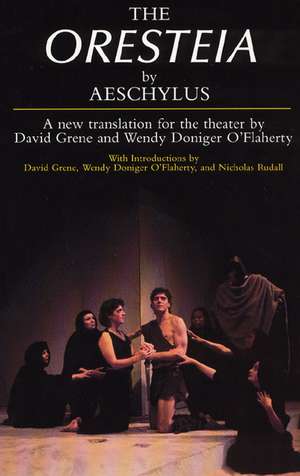
The Oresteia
Autor Aeschylus Traducere de David Grene, Wendy Doniger O'Flahertyen Limba Engleză Paperback – 15 mar 1989
Highly acclaimed as translators of Greek and Sanskrit classics, respectively, David Grene and Wendy Doniger O'Flaherty here present a complete modern translation of the three plays comprising Aeschylus' Oresteia and, with the assistance of director Nicholas Rudall, an abridged stage adaptation. This balanced and highly successful collaboration of scholars with a theater director solves the contemporary problems of translating and staging the Oresteia, which originally was written to be performed in Athens in the first half of the fifth century B.C.
While remaining faithful to the original Greek, Grene and O'Flaherty embrace a strong and adventurous English style, vivid and visceral. The language of this extraordinary translation, immediately accessible to a theater audience, speaks across the centuries. Premiered at Chicago's Court Theater in 1986 under Rudall's direction, the stage adaptation of the Oresteia proved eminently playable.
This new adaptation of the Oresteia offers a brilliant demonstration of how clearly defined goals (here, the actor's needs) can inspire translators to produce fresh, genuine, accessible dramatic texts. The resulting work provides complete and accurate texts for those who cannot read the original Greek, and it transforms the Oresteia into an effective modern stage play. With interpretive introductions written by the translators and director, this new version will be welcomed by teachers of translation courses, by students of Greek and world drama in general, and by theater professionals.
| Toate formatele și edițiile | Preț | Express |
|---|---|---|
| Paperback (13) | 49.93 lei 22-28 zile | +22.79 lei 7-13 zile |
| Oxford University Press – 13 noi 2008 | 49.93 lei 22-28 zile | +22.79 lei 7-13 zile |
| CREATESPACE – | 74.47 lei 3-5 săpt. | |
| Bloomsbury Publishing – 7 apr 2022 | 74.67 lei 3-5 săpt. | +33.54 lei 7-13 zile |
| Penguin Books – 28 sep 1977 | 87.78 lei 3-5 săpt. | +11.43 lei 7-13 zile |
| Hackett Publishing Company – 14 sep 1998 | 103.33 lei 3-5 săpt. | |
| W. W. Norton & Company – 15 mar 2018 | 109.01 lei 3-5 săpt. | +11.30 lei 7-13 zile |
| Digireads.com – 15 iun 2015 | 64.81 lei 6-8 săpt. | |
| Bloomsbury Publishing – 29 aug 2015 | 80.93 lei 6-8 săpt. | |
| Oxford University Press – 16 sep 2004 | 89.93 lei 43-49 zile | |
| Broadway Play Publishing – | 121.09 lei 6-8 săpt. | |
| Bloomsbury Publishing – 24 apr 2014 | 137.13 lei 6-8 săpt. | |
| Bloomsbury Publishing – apr 2013 | 176.30 lei 6-8 săpt. | |
| University of Chicago Press – 15 mar 1989 | 197.08 lei 6-8 săpt. | |
| Hardback (1) | 207.16 lei 3-5 săpt. | +34.11 lei 7-13 zile |
| Harvard University Press – 2009 | 207.16 lei 3-5 săpt. | +34.11 lei 7-13 zile |
Preț: 197.08 lei
Puncte Express: 296
Preț estimativ în valută:
34.88€ • 40.76$ • 30.28£
34.88€ • 40.76$ • 30.28£
Carte tipărită la comandă
Livrare economică 25 februarie-11 martie
Preluare comenzi: 021 569.72.76
Specificații
ISBN-13: 9780226007724
ISBN-10: 0226007723
Pagini: 257
Dimensiuni: 140 x 216 x 5 mm
Greutate: 0.31 kg
Ediția:Prescurtată
Editura: University of Chicago Press
Colecția University of Chicago Press
ISBN-10: 0226007723
Pagini: 257
Dimensiuni: 140 x 216 x 5 mm
Greutate: 0.31 kg
Ediția:Prescurtată
Editura: University of Chicago Press
Colecția University of Chicago Press
V-ar putea interesa
-
 Time BitesDoris LessingPreț: 55.46 lei
 -
 Mitford, N: Voltaire in LoveNancy Mitford-21%Preț: 53.98 lei68.28 lei
 -
 MetamorphosesOvid-16%Preț: 60.87 lei72.37 lei
 -
 Persians and Other PlaysAeschylus-20%Preț: 60.89 lei76.02 lei
 -
 Oxford Textbook of Obstetrics and GynaecologySabaratnam Arulkumaran-5%Preț: 1749.05 lei1841.10 lei
 -
 AeneidVirgil-18%Preț: 57.31 lei70.29 lei
 -
 The Trojan Women and Other PlaysEuripides-22%Preț: 58.46 lei74.55 lei
 -
 Complete LettersPliny the Younger-20%Preț: 66.32 lei82.86 lei
 -
 Collected Maxims and Other ReflectionsFrançois de La Rochefoucauld-20%Preț: 60.79 lei75.96 lei
 -
 Major WorksJonathan Swift-18%Preț: 75.77 lei92.15 lei
 -
 Tales of the Elders of IrelandAnn Dooley-21%Preț: 64.58 lei81.80 lei
 -
 Orestes and Other PlaysEuripidesPreț: 63.92 lei
 -
 Heracles and Other PlaysEuripidesPreț: 57.38 lei
 -
 Too Much and Not the MoodDurga Chew-BosePreț: 95.50 lei
 -
 The MothersBrit BennettPreț: 87.86 lei
 -
 Self-Reliance, and Other EssaysRalph Waldo Emerson-36%Preț: 21.89 lei34.09 lei
 -
 Preț: 284.17 lei
 -
 Johnny Panic and the Bible of DreamsSylvia PlathPreț: 69.12 lei
 -
 Honeybee DemocracyThomas D. SeeleyPreț: 203.12 lei
 -
 The Lives of Bees – The Untold Story of the Honey Bee in the WildThomas D. SeeleyPreț: 273.91 lei
 -
 Following the Wild BeesThomas D. SeeleyPreț: 103.81 lei
 -
 Dark SummitNick Heil-39%Preț: 69.41 lei114.71 lei
 -
 Everest 1953Mick ConefreyPreț: 109.48 lei
 -
 8000 MetresAlan HinkesPreț: 196.37 lei
Cuprins
Note
The Oresteia: Introduction
DAVID GRENE
The Oresteia: the Theatrical Perspective
NICHOLAS RUDALL
Translating for the Stage and from the Stage
WENDY DONIGER O'FLAHERTY
Part One: Unabridged Translation
Agamemnon
The Libation Bearers
The Eumenides
Part Two: Acting Version
Agamemnon
The Libation Bearers
The Eumenides
The Oresteia: Introduction
DAVID GRENE
The Oresteia: the Theatrical Perspective
NICHOLAS RUDALL
Translating for the Stage and from the Stage
WENDY DONIGER O'FLAHERTY
Part One: Unabridged Translation
Agamemnon
The Libation Bearers
The Eumenides
Part Two: Acting Version
Agamemnon
The Libation Bearers
The Eumenides
Descriere
Descriere de la o altă ediție sau format:
Aeschylus' famed plays Agamemnon, The Libation Bearers, and The Eumenides comprise the Oresteia, which uses the dark and convoluted story of a family curse, and a long history of murder and revenge, to raise haunting questions about the nature and the price of justice. In Agamemnon , the Argive king reaches home following his victory in the Trojan War, only to meet his death at the hand of his wife, Clytemnestra. Horrible as this deed is shown to be, we also come to understand in the course of the play how justice has been satisfied by Agamemnon's murder. The second play in the trilogy, The Libation Bearers (Choephoroe), portrays the vengeance of Agamemnon's son Orestes, who returns from exile to exact the price of his father's murder. With the aid of his sister Electra, Orestes kills Clytemnestra, and her lover, Aegisthus. By spilling his mother's blood, however, he invites the wrath of the ancient Erinyes, or Furies, and they begin to pursue him. The Eumenides shows the Furies' pursuit of Orestes, who is protected by the younger god Apollo. Orestes is ultimately tried for his crime in Athens, and Athena, goddess of wisdom, casts the deciding vote on his behalf, and releases him from the ancient familial blood-guilt. Athena persuades the Furies to accept the new legal justice and a new role in the polis, as Kindly Ones, who will bless the city of Athens and its land. In this exciting new translation, at once faithful to the original and as fully alive as a poem in English, Alan Shapiro and Peter Burian showcase the complexity and intricate imagery of this great work of Athenian tragic poetry.
Aeschylus' famed plays Agamemnon, The Libation Bearers, and The Eumenides comprise the Oresteia, which uses the dark and convoluted story of a family curse, and a long history of murder and revenge, to raise haunting questions about the nature and the price of justice. In Agamemnon , the Argive king reaches home following his victory in the Trojan War, only to meet his death at the hand of his wife, Clytemnestra. Horrible as this deed is shown to be, we also come to understand in the course of the play how justice has been satisfied by Agamemnon's murder. The second play in the trilogy, The Libation Bearers (Choephoroe), portrays the vengeance of Agamemnon's son Orestes, who returns from exile to exact the price of his father's murder. With the aid of his sister Electra, Orestes kills Clytemnestra, and her lover, Aegisthus. By spilling his mother's blood, however, he invites the wrath of the ancient Erinyes, or Furies, and they begin to pursue him. The Eumenides shows the Furies' pursuit of Orestes, who is protected by the younger god Apollo. Orestes is ultimately tried for his crime in Athens, and Athena, goddess of wisdom, casts the deciding vote on his behalf, and releases him from the ancient familial blood-guilt. Athena persuades the Furies to accept the new legal justice and a new role in the polis, as Kindly Ones, who will bless the city of Athens and its land. In this exciting new translation, at once faithful to the original and as fully alive as a poem in English, Alan Shapiro and Peter Burian showcase the complexity and intricate imagery of this great work of Athenian tragic poetry.
Notă biografică
Alan Shapiro is Professor of English at the University of North Carolina at Chapel Hill and the author of a number of prize-winning volumes of poetry and prose, including The Dead Alive and Busy, winner of the 2001 Kingsley Tufts Award. Peter Burian is Professor of Classics at Duke University. Together, they act as the general editors for Oxford's Greek Tragedy in New Translations series.
Recenzii
Rory Mullarkey's adaptation of these three Aeschylus plays . . . is undertaken with a spirit it would be hard to trump. . . . Mullarkey has adapted Aeschylus in a way that never fudges, conceals or distances.
Witty, brash and steeped in blood . . . this is a big and boisterous account packed with sly wit and the sort of brash lines that wouldn't be out of place in a gangster film.
brilliantly evokes the sheer strangeness and horror of the play. Rory Mullarkey's translation follows the Aeschylean original faithfully and his lyrics make some attempts to evoke the percussive muscularity of the choruses. . . . I haven't seen anything quite as sickening or as stately as this version of these plays.
The verse rhythms are fluid and flexible, allowing for passages of lyric song, and the language is pithy and vivid . . . shows how "justice" - the word that resounds through Mullarkey's text like a drumbeat - easily transmutes into blood-soaked revenge.
Rory Mullarkey's new translation can't be accused of lacking scholastic commitment, or ear-enticing poetic carry-on. . . . the phrasing is pungent
Mullarkey's vibrant translation slithers from the poetic to the colloquial
Rory Mullarkey's poetical, darkly funny but never murky adaptation proves stimulating and surprising . . . makes you laugh one moment and shudder the next.
Witty, brash and steeped in blood . . . this is a big and boisterous account packed with sly wit and the sort of brash lines that wouldn't be out of place in a gangster film.
brilliantly evokes the sheer strangeness and horror of the play. Rory Mullarkey's translation follows the Aeschylean original faithfully and his lyrics make some attempts to evoke the percussive muscularity of the choruses. . . . I haven't seen anything quite as sickening or as stately as this version of these plays.
The verse rhythms are fluid and flexible, allowing for passages of lyric song, and the language is pithy and vivid . . . shows how "justice" - the word that resounds through Mullarkey's text like a drumbeat - easily transmutes into blood-soaked revenge.
Rory Mullarkey's new translation can't be accused of lacking scholastic commitment, or ear-enticing poetic carry-on. . . . the phrasing is pungent
Mullarkey's vibrant translation slithers from the poetic to the colloquial
Rory Mullarkey's poetical, darkly funny but never murky adaptation proves stimulating and surprising . . . makes you laugh one moment and shudder the next.
Textul de pe ultima copertă
"By far the best translation. Faithful to the original Greek text and eminently readable. The notes constitute a commentary in their own right."--Albert Henrichs, Harvard University
"Hugh Lloyd-Jones's translation stands out very much from any other. The notes are first class and scholarly."--Jeffrey Rusten, Cornell University