
Curves and Surfaces: UNITEXT
Autor M. Abate, F. Tovenaen Limba Engleză Paperback – 6 oct 2011
În literatura academică dedicată geometriei diferențiale, se resimte adesea o falie între manualele introductive și rigoarea necesară cercetării avansate. Volumul Curves and Surfaces, semnat de M. Abate și F. Tovena, vine să completeze exact această lacună, oferind o tranziție solidă de la intuiția geometrică la formalismul matematic modern. Publicată în prestigioasa serie UNITEXT a editurii Springer, lucrarea se distinge prin modul în care tratează obiectele geometrice: de exemplu, vectorii tangenți sunt prezentați dual, atât ca viteze ale curbelor, cât și ca derivări, o metodologie pe care autorii o mențin consecvent pe parcursul celor peste 400 de pagini.
Ne-a atras atenția structura riguroasă a cursului, care pornește de la clasificarea varietăților unidimensionale și avansează spre teoria globală a curbelor plane, incluzând demonstrații complete pentru teorema Jordan și teorema lui Hopf. În ceea ce privește suprafețele, textul nu se limitează la exemple clasice, ci explorează în profunzime curbura Gauss, câmpurile vectoriale și geodezicele, culminând cu aplicații precum teorema Poincaré-Hopf. Această abordare este o evoluție naturală a lucrării anterioare a autorilor, Curve e superfici, rafinând conceptele pentru un public internațional de cercetători și studenți avansați.
Comparativ cu titluri precum Differential Geometry of Curves and Surfaces de Shoshichi Kobayashi, care păstrează o linie clasică și concisă, volumul de față este mult mai analitic și detaliat în demonstrații. Dacă lucrarea lui Kobayashi este ideală pentru o introducere rapidă, Curves and Surfaces oferă un aparat matematic mai dens, fiind mai degrabă comparabilă cu Differential Geometry de Paulo Ventura Araújo, însă cu un accent mai pronunțat pe rigoarea topologică și pe aspectele de varietate diferențiabilă.
Din seria UNITEXT
-
 Preț: 238.45 lei
 -
 Preț: 458.33 lei
 - 15%
 Preț: 555.43 lei
 - 15%
 Preț: 541.90 lei
 -
 Preț: 270.12 lei
 -
 Preț: 319.42 lei
 -
 Preț: 439.72 lei
 -
 Preț: 278.98 lei
 -
 Preț: 416.13 lei
 -
 Preț: 359.43 lei
 - 15%
 Preț: 483.79 lei
 -
 Preț: 366.70 lei
 -
 Preț: 347.97 lei
 - 15%
 Preț: 499.54 lei
 - 17%
 Preț: 406.65 lei
 -
 Preț: 445.50 lei
 - 17%
 Preț: 522.35 lei
 -
 Preț: 458.75 lei
 -
 Preț: 452.04 lei
 -
 Preț: 435.62 lei
 -
 Preț: 383.53 lei
 -
 Preț: 470.50 lei
 -
 Preț: 390.48 lei
 -
 Preț: 391.62 lei
 -
 Preț: 375.74 lei
 - 15%
 Preț: 628.20 lei
 -
 Preț: 391.31 lei
 -
 Preț: 457.65 lei
 -
 Preț: 310.87 lei
 -
 Preț: 464.54 lei
 -
 Preț: 469.92 lei
 -
 Preț: 265.02 lei
 -
 Preț: 208.13 lei
 -
 Preț: 381.54 lei
 -
 Preț: 237.44 lei
 -
 Preț: 384.50 lei
 -
 Preț: 317.49 lei
 - 17%
 Preț: 385.91 lei
 -
 Preț: 315.82 lei
 -
 Preț: 262.80 lei
 -
 Preț: 477.36 lei
 -
 Preț: 320.60 lei
 -
 Preț: 240.15 lei
 -
 Preț: 354.31 lei
 -
 Preț: 136.47 lei
 -
 Preț: 474.26 lei
 -
 Preț: 334.76 lei
 -
 Preț: 318.93 lei
 -
 Preț: 273.23 lei
Preț: 498.10 lei
Carte tipărită la comandă
Livrare economică 21 noiembrie-05 decembrie
Specificații
ISBN-10: 8847019400
Pagini: 412
Ilustrații: XIII, 396 p.
Dimensiuni: 155 x 235 x 23 mm
Greutate: 0.62 kg
Ediția:2012
Editura: Springer
Colecția UNITEXT
Seria UNITEXT
Locul publicării:Milano, Italy
V-ar putea interesa
-
 Geometry Ancient and ModernJohn R. Silvester-28%Preț: 399.90 lei557.35 lei
 -
 Flips for 3-folds and 4-foldsAlessio Corti-33%Preț: 676.51 lei1005.19 lei
 -
 The Many Facets of Geometry: A Tribute to Nigel HitchinOscar Garcia-Prada-31%Preț: 793.84 lei1149.31 lei
 -
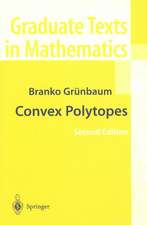 Convex PolytopesBranko Grünbaum-15%Preț: 488.08 lei574.21 lei
 -
 Curves and Fractal DimensionClaude TricotPreț: 411.88 lei
 -
 Algebraic GeometryJoe Harris-15%Preț: 497.27 lei585.03 lei
 -
 -9%Preț: 1284.69 lei1411.75 lei
 -
 MatroidsGary GordonPreț: 422.50 lei
 -
 Elliptic CurvesHenry Mckean-11%Preț: 417.77 lei469.41 lei
 -
 -19%Preț: 671.13 lei828.55 lei
 -
 Classical Algebraic GeometryIgor V. Dolgachev-14%Preț: 976.82 lei1135.84 lei
 -
 A First Course in Computational Algebraic GeometryWolfram DeckerPreț: 142.70 lei
 -
 Vectors, Pure and AppliedT. W. KörnerPreț: 450.98 lei
 -
 Complex Abelian VarietiesChristina Birkenhake-18%Preț: 930.44 lei1134.68 lei
 -
 Introduction to Étale CohomologyGünter Tamme-15%Preț: 559.96 lei658.77 lei
 -
 The Red Book of Varieties and SchemesDavid Mumford-15%Preț: 474.05 lei557.71 lei
 -
 Convex and Discrete GeometryPeter M. Gruber-18%Preț: 1170.16 lei1427.03 lei
 -
 TriangulationsJesus De Loera-23%Preț: 784.23 lei1018.47 lei
Public țintă
ResearchDe ce să citești această carte
Recomandăm această carte studenților la matematică și fizică care doresc o înțelegere profundă a geometriei diferențiale. Cititorul câștigă acces la demonstrații complete și riguroase ale unor teoreme fundamentale (Gauss-Bonnet, Jordan), beneficiind de o structură pedagogică ce îmbină metodele algebrice cu cele analitice. Este un instrument esențial pentru pregătirea în cercetare, oferind rigoarea necesară pentru a trece la studiul varietăților complexe.
Descriere scurtă
Recenzii
“The authors’ goal in writing this book is to present the theory of curves and surfaces from the viewpoint of contemporary mathematics. … New concepts and new definitions are fully motivated, and illustrated by numerous examples. … the book is beautifully written, very well organized, and most of all it may serve as both a less advanced text and a more advanced text for readers interested in the theory of curves and surfaces.” (Andrew Bucki, Mathematical Reviews, June, 2013)
“It is dedicated to the study of curves and surfaces both from a local and global viewpoint. It is written and organised in such a way that it can be used by a large scope of students, not only for beginning, intermediate or advanced undergraduate courses in mathematics or physics, but also for engineering or computer science students. … the book can be useful for post-graduate students, too. The book is well written and includes many examples and figures.” (Raúl Oset Sinha, Zentralblatt MATH, Vol. 1238, 2012)