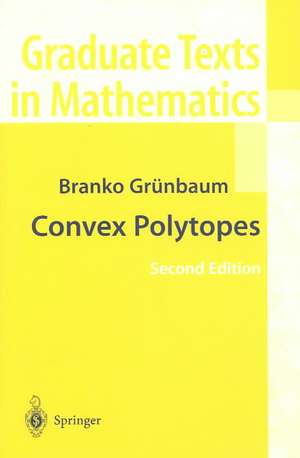
Convex Polytopes: Graduate Texts in Mathematics, cartea 221
Autor Branko Grünbaum Editat de Günter M. Ziegleren Limba Engleză Paperback – oct 2003
Ne-a atras atenția această a doua ediție a lucrării Convex Polytopes, o piesă de rezistență în literatura matematică, adresată studenților de la nivel masteral, doctoranzilor și cercetătorilor în geometrie analitică și combinatorică. Aceștia vor găsi aici nu doar o retrospectivă istorică, ci un instrument de lucru actualizat sub îndrumarea lui Günter M. Ziegler, care păstrează spiritul original al lui Branko Grünbaum integrând în același timp progresele majore din ultimele decenii. Observăm o structură progresivă, menită să fundamenteze riguros conceptele. Primele capitole stabilesc cadrul necesar prin noțiuni de algebră și topologie, trecând rapid către studiul mulțimilor convexe, al suportului și separării. Un element distinctiv al cărții este capitolul dedicat exemplelor, unde sunt analizate detaliat structuri precum d-simplexul, piramidele, prismele și politoapele ciclice, oferind cititorului o bază concretă pentru înțelegerea teoremelor abstracte. Această abordare echilibrează teoria pură cu intuiția geometrică, facilitând tranziția către proprietățile fundamentale de dualitate și reprezentările prin secțiuni sau proiecții. În contextul operei lui Branko Grünbaum, Convex Polytopes se distinge prin rigoarea sa academică formală. Dacă în lucrări precum The Mathematical Coloring Book autorul explorează matematica printr-o lentilă aproape narativă și filosofică, aici ne aflăm în fața unei monografii tehnice de o precizie chirurgicală. Comparativ cu An Introduction to Convex Polytopes de Arne Brondsted, care se concentrează pe teoremele de bază precum Relațiile Dehn-Sommerville, volumul de față oferă o acoperire mult mai vastă și enciclopedică, servind mai degrabă ca resursă definitivă decât ca simplu manual introductiv. Este o lucrare esențială pentru oricine dorește să înțeleagă evoluția și stadiul actual al teoriei politoapelor.
Din seria Graduate Texts in Mathematics
- 13%
 Preț: 407.97 lei
 -
 Preț: 401.21 lei
 -
 Preț: 508.82 lei
 - 15%
 Preț: 414.37 lei
 - 15%
 Preț: 552.46 lei
 - 15%
 Preț: 403.03 lei
 - 15%
 Preț: 407.56 lei
 - 15%
 Preț: 530.03 lei
 - 15%
 Preț: 448.00 lei
 - 15%
 Preț: 412.20 lei
 - 15%
 Preț: 413.35 lei
 - 15%
 Preț: 450.20 lei
 - 15%
 Preț: 449.14 lei
 - 15%
 Preț: 530.66 lei
 - 15%
 Preț: 412.82 lei
 - 15%
 Preț: 486.50 lei
 - 15%
 Preț: 526.92 lei
 -
 Preț: 446.38 lei
 - 15%
 Preț: 579.99 lei
 -
 Preț: 381.34 lei
 - 15%
 Preț: 455.36 lei
 - 15%
 Preț: 560.82 lei
 - 17%
 Preț: 445.95 lei
 - 15%
 Preț: 590.39 lei
 -
 Preț: 500.30 lei
 -
 Preț: 451.05 lei
 -
 Preț: 386.90 lei
 - 15%
 Preț: 614.52 lei
 - 15%
 Preț: 477.57 lei
 -
 Preț: 460.05 lei
 - 15%
 Preț: 498.36 lei
 -
 Preț: 504.56 lei
 - 18%
 Preț: 808.24 lei
 -
 Preț: 472.04 lei
 - 15%
 Preț: 621.81 lei
 -
 Preț: 398.40 lei
 - 15%
 Preț: 656.51 lei
Preț: 488.08 lei
Preț vechi: 574.21 lei
-15%
Carte tipărită la comandă
Livrare economică 28 noiembrie-12 decembrie
Specificații
ISBN-10: 0387404090
Pagini: 564
Ilustrații: XVI, 471 p.
Dimensiuni: 156 x 234 x 31 mm
Greutate: 0.85 kg
Ediția:Second Edition 2003
Editura: Springer
Colecția Graduate Texts in Mathematics
Seria Graduate Texts in Mathematics
Locul publicării:New York, NY, United States
V-ar putea interesa
-
 Lectures on PolytopesGünter M. ZieglerPreț: 364.46 lei
 -
 Intersection TheoryWilliam Fulton-18%Preț: 739.95 lei902.37 lei
 -
 Emerging Applications of Algebraic GeometryMihai Putinar-15%Preț: 648.75 lei763.24 lei
 -
 Conics and CubicsRobert BixPreț: 376.27 lei
 -
 Algebraic GeometryS. Iitaka-15%Preț: 568.69 lei669.04 lei
 -
 Nonlinear Computational GeometryIoannis Z. Emiris-18%Preț: 946.33 lei1154.07 lei
 -
 -15%Preț: 453.71 lei533.78 lei
 -
 Spectra of GraphsAndries E. BrouwerPreț: 435.53 lei
 -
 -18%Preț: 1127.49 lei1374.99 lei
 -
 Recent Trends in Lorentzian GeometryMiguel Sánchez-18%Preț: 952.24 lei1161.26 lei
 -
 The Grassmannian VarietyV. Lakshmibai-15%Preț: 604.91 lei711.65 lei
 -
 Convexity and ConcentrationEric Carlen-15%Preț: 741.00 lei871.77 lei
 -
 -18%Preț: 861.43 lei1050.53 lei
 -
 Discrete Differential GeometryAlexander I. Bobenko Tu BerlinPreț: 431.21 lei
Public țintă
GraduateDe ce să citești această carte
Studenții și cercetătorii vor găsi în această ediție actualizată a Convex Polytopes resursa supremă pentru geometria combinatorie. Cartea oferă o bază teoretică solidă și o documentare exhaustivă a proprietăților politoapelor, fiind indispensabilă pentru proiecte de cercetare avansată. Cititorul câștigă acces la decenii de progres matematic sintetizate clar, transformând un text clasic într-un instrument de lucru modern și relevant pentru curriculumul academic actual.
Descriere scurtă
"The original book of Grünbaum has provided the central reference for work in this active area of mathematics for the past 35 years...I first consulted this book as a graduate student in 1967; yet, even today, I am surprised again and again by what I find there. It is an amazingly complete reference for work on this subject up to that time and continues to be a major influence on research to this day." (Louis J. Billera, Cornell University)
"The original edition of Convex Polytopes inspired a whole generation of grateful workers in polytope theory. Without it, it is doubtful whether many of the subsequent advances in the subject would have been made. The many seeds it sowed have since grown into healthy trees, with vigorous branches and luxuriant foliage. It is good to see it in print once again." (Peter McMullen, University College London)
Cuprins
Recenzii
"The original book of Grünbaum has provided the central reference for work in this active area of mathematics for the past 35 years...I first consulted this book as a graduate student in 1967; yet, even today, I am surprised again and again by what I find there. It is an amazingly complete reference for work on this subject up to that time and continues to be a major influence on research to this day." (Louis J. Billera, Cornell University)
"The original edition of Convex Polytopes inspired a whole generation of grateful workers in polytope theory. Without it, it is doubtful whether many of the subsequent advances in the subject would have been made. The many seeds it sowed have since grown into healthy trees, with vigorous branches and luxuriant foliage. It is good to see it in print once again." (Peter McMullen, University College London)
From the reviews of the second edition:
"Branko Grünbaum’s book is a classical monograph on convex polytopes … . As was noted by many researchers, for many years the book provided a central reference for work in the field and inspired a whole generation of specialists in polytope theory. … Every chapter of the book is supplied with a section entitled ‘Additional notes and comments’ … these notes summarize the most important developments with respectto the topics treated by Grünbaum. … The new edition … is an excellent gift for all geometry lovers." (Alexander Zvonkin, Mathematical Reviews, 2004b)