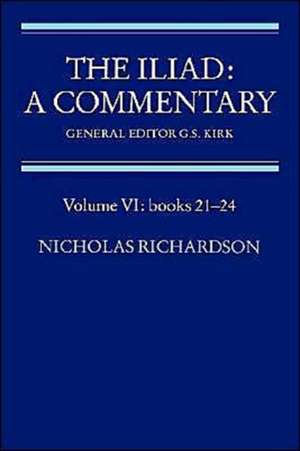
The Iliad
Autor Homer Editat de Nicholas Richardson, G. S. Kirken Limba Engleză Paperback – 21 mai 2003
Preț: 466.59 lei
Preț vechi: 524.25 lei
-11%
Puncte Express: 700
Carte tipărită la comandă
Livrare economică 07-21 decembrie
Livrare prin curier în România Termenul estimat este afișat lângă disponibilitate.
Transport gratuit pentru acest produs Plată online sau ramburs, în funcție de opțiunile comenzii.
Retur gratuit în 14 zile Comandă securizată și suport în română.
Specificații
ISBN-13: 9780521312097
ISBN-10: 0521312094
Pagini: 408
Dimensiuni: 152 x 229 x 24 mm
Greutate: 0.62 kg
Editura: Cambridge University Press
Locul publicării:Cambridge, United Kingdom
ISBN-10: 0521312094
Pagini: 408
Dimensiuni: 152 x 229 x 24 mm
Greutate: 0.62 kg
Editura: Cambridge University Press
Locul publicării:Cambridge, United Kingdom
V-ar putea interesa
-
 InfernoDante AlighieriPreț: 28.01 lei
 -
 CLASSICS PARADISE LOST AND PAJohn MiltonPreț: 28.01 lei
 -
 Lady Chatterley's LoverD. H. LawrencePreț: 28.01 lei
 -
 Six Wives of Henry VIIIAlison Weir-27%Preț: 79.82 lei109.82 lei
 -
 Frederick the GreatNancy Mitford-36%Preț: 59.03 lei92.74 lei
 -
 The Sun KingNancy Mitford-31%Preț: 63.87 lei92.71 lei
 -
 The OdysseyHomer-17%Preț: 61.09 lei73.45 lei
 -
 -32%Preț: 63.10 lei92.24 lei
 -
 The OdysseyHomer-17%Preț: 54.01 lei65.33 lei
 -
 Candide and Other StoriesVoltairePreț: 47.32 lei
 -
 The OdysseyHomer-17%Preț: 60.45 lei72.86 lei
 -
 MetamorphosesOvid-14%Preț: 57.72 lei67.39 lei
 -
 Medea and Other PlaysEuripidesPreț: 58.52 lei
 -
 The Love PoemsOvid-18%Preț: 70.37 lei86.16 lei
 -
 Selected PoetryJohn Keats-19%Preț: 52.70 lei64.76 lei
 -
 -39%Preț: 17.40 lei28.34 lei
 -
 ZamiAudre Lorde-25%Preț: 59.63 lei79.32 lei
 -
 The Black UnicornAudre Lorde-27%Preț: 51.78 lei70.85 lei
 -
 The Cancer JournalsAudre Lorde-36%Preț: 45.08 lei70.40 lei
 -
 When I Dare to Be PowerfulAudre Lorde-20%Preț: 45.02 lei56.59 lei
 -
 The SilmarillionJ. R. R. TolkienPreț: 65.60 lei
 -
 Faust 1Johann Wolfgang von GoethePreț: 54.31 lei
 -
 Cognitive Psychology For DummiesMichael PakePreț: 154.97 lei
 -
 -35%Preț: 109.81 lei167.83 lei
 -
 PLUTARCHPlutarchPreț: 310.39 lei
 -
 -19%Preț: 57.30 lei71.11 lei
 -
 Helen of TroyBettany Hughes-23%Preț: 147.53 lei191.52 lei
Cuprins
Preface; Abbreviations; Introduction; 1. Structure and themes; 2. Two special problems; 3. Homer and his ancient critics; Commentary; Book 21; Book 22; Book 23; Book 24; General index to Volume VI; Index of Greek words for all volumes.
Recenzii
"...a welcome contribution to Homeric studies, and the series as a whole should remain a basic research tool well into the next century....remains a very useful book and an absolute 'must buy'...." S. Douglas Olson, Bryn Mawr Classical Review
Descriere
This is the sixth and final volume of the major Commentary on Homer's Iliad issued under the General Editorship of Professor G. S. Kirk.
Notă biografică
Homer was probably born around 725BC on the Coast of Asia Minor, now the coast of Turkey, but then really a part of Greece. Homer was the first Greek writer whose work survives. He was one of a long line of bards, or poets, who worked in the oral tradition. Homer and other bards of the time could recite, or chant, long epic poems. Both works attributed to Homer – the Iliad and the Odyssey – are over ten thousand lines long in the original. Homer must have had an amazing memory but was helped by the formulaic poetry style of the time.In the Iliad Homer sang of death and glory, of a few days in the struggle between the Greeks and the Trojans. Mortal men played out their fate under the gaze of the gods. The Odyssey is the original collection of tall traveller’s tales. Odysseus, on his way home from the Trojan War, encounters all kinds of marvels from one-eyed giants to witches and beautiful temptresses. His adventures are many and memorable before he gets back to Ithaca and his faithful wife Penelope.
We can never be certain that both these stories belonged to Homer. In fact ‘Homer’ may not be a real name but a kind of nickname meaning perhaps ‘the hostage’ or ‘the blind one’. Whatever the truth of their origin, the two stories, developed around three thousand years ago, may well still be read in three thousand years’ time.
Robert Fagles (1933-2008) was Arthur W. Marks ’19 Professor of Comparative Literature, Emeritus, at Princeton University. He was the recipient of the 1997 PEN/Ralph Manheim Medal for Translation and a 1996 Award in Literature from the American Academy of Arts and Letters. His translations include Sophocles’s Three Theban Plays, Aeschylus’s Oresteia (nominated for a National Book Award), Homer’s Iliad (winner of the 1991 Harold Morton Landon Translation Award by The Academy of American Poets), Homer’s Odyssey, and Virgil's Aeneid.
Bernard Knox (1914-2010) was Director Emeritus of Harvard’s Center for Hellenic Studies in Washington, D.C. He taught at Yale University for many years. Among his numerous honors are awards from the National Institute of Arts and Letters and the National Endowment for the Humanities. His works include The Heroic Temper: Studies in Sophoclean Tragedy, Oedipus at Thebes: Sophocles’ Tragic Hero and His Time and Essays Ancient and Modern (awarded the 1989 PEN/Spielvogel-Diamonstein Award).
We can never be certain that both these stories belonged to Homer. In fact ‘Homer’ may not be a real name but a kind of nickname meaning perhaps ‘the hostage’ or ‘the blind one’. Whatever the truth of their origin, the two stories, developed around three thousand years ago, may well still be read in three thousand years’ time.
Robert Fagles (1933-2008) was Arthur W. Marks ’19 Professor of Comparative Literature, Emeritus, at Princeton University. He was the recipient of the 1997 PEN/Ralph Manheim Medal for Translation and a 1996 Award in Literature from the American Academy of Arts and Letters. His translations include Sophocles’s Three Theban Plays, Aeschylus’s Oresteia (nominated for a National Book Award), Homer’s Iliad (winner of the 1991 Harold Morton Landon Translation Award by The Academy of American Poets), Homer’s Odyssey, and Virgil's Aeneid.
Bernard Knox (1914-2010) was Director Emeritus of Harvard’s Center for Hellenic Studies in Washington, D.C. He taught at Yale University for many years. Among his numerous honors are awards from the National Institute of Arts and Letters and the National Endowment for the Humanities. His works include The Heroic Temper: Studies in Sophoclean Tragedy, Oedipus at Thebes: Sophocles’ Tragic Hero and His Time and Essays Ancient and Modern (awarded the 1989 PEN/Spielvogel-Diamonstein Award).