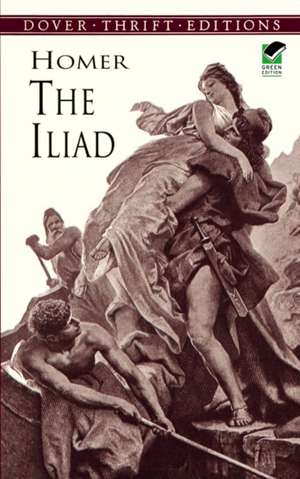
The Iliad
Autor Homeren Limba Engleză Paperback – 25 iun 1999 – vârsta de la 14 ani
Vast in scope, possessing extraordinary lyricism and poignancy, this time-honored masterpiece brilliantly conveys the inconsistencies of gods and men, the tumultuous intensity of conflict, and, ultimately, the enormous waste of life that results from war.
This inexpensive edition reproduces the celebrated Samuel Butler prose translation, admired for its simple, unadorned style, clarity, and readability.
Preț: 70.77 lei
Puncte Express: 106
Carte disponibilă
Livrare economică 16-30 noiembrie
Livrare prin curier în România Termenul estimat este afișat lângă disponibilitate.
Transport gratuit de la 400.00 lei Plată online sau ramburs, în funcție de opțiunile comenzii.
Retur gratuit în 14 zile Comandă securizată și suport în română.
Specificații
ISBN-13: 9780486408835
ISBN-10: 0486408833
Pagini: 320
Dimensiuni: 133 x 210 x 20 mm
Greutate: 0.25 kg
Ediția:Unabridged
Editura: Dover Publications
ISBN-10: 0486408833
Pagini: 320
Dimensiuni: 133 x 210 x 20 mm
Greutate: 0.25 kg
Ediția:Unabridged
Editura: Dover Publications
V-ar putea interesa
-
 InfernoDante AlighieriPreț: 28.01 lei
 -
 CLASSICS PARADISE LOST AND PAJohn MiltonPreț: 28.01 lei
 -
 Lady Chatterley's LoverD. H. LawrencePreț: 28.01 lei
 -
 Six Wives of Henry VIIIAlison Weir-27%Preț: 79.82 lei109.82 lei
 -
 Frederick the GreatNancy Mitford-36%Preț: 59.09 lei92.74 lei
 -
 The Sun KingNancy Mitford-31%Preț: 63.87 lei92.71 lei
 -
 The OdysseyHomer-17%Preț: 61.09 lei73.45 lei
 -
 -32%Preț: 63.10 lei92.24 lei
 -
 The OdysseyHomer-17%Preț: 54.01 lei65.33 lei
 -
 Candide and Other StoriesVoltairePreț: 47.32 lei
 -
 The OdysseyHomer-17%Preț: 60.45 lei72.86 lei
 -
 MetamorphosesOvid-14%Preț: 57.72 lei67.39 lei
 -
 Medea and Other PlaysEuripidesPreț: 58.52 lei
 -
 The Love PoemsOvid-18%Preț: 70.37 lei86.16 lei
 -
 Selected PoetryJohn Keats-19%Preț: 52.70 lei64.76 lei
 -
 -39%Preț: 17.40 lei28.34 lei
 -
 ZamiAudre Lorde-25%Preț: 59.63 lei79.32 lei
 -
 The Black UnicornAudre Lorde-27%Preț: 51.78 lei70.85 lei
 -
 The Cancer JournalsAudre Lorde-36%Preț: 45.08 lei70.40 lei
 -
 When I Dare to Be PowerfulAudre Lorde-19%Preț: 45.65 lei56.59 lei
 -
 The SilmarillionJ. R. R. TolkienPreț: 65.60 lei
 -
 Faust 1Johann Wolfgang von GoethePreț: 54.31 lei
 -
 Cognitive Psychology For DummiesMichael PakePreț: 154.97 lei
 -
 -35%Preț: 109.81 lei167.83 lei
 -
 PLUTARCHPlutarchPreț: 310.39 lei
 -
 -18%Preț: 59.31 lei72.36 lei
 -
 Helen of TroyBettany Hughes-23%Preț: 147.53 lei191.52 lei
Descriere
Epic masterpiece chronicles last days of the Trojan War -- quarrel of Achilles and Agamemnon, the battle for Helen of Troy, Greek siege of the city, Trojan counterattack, stratagem of the Trojan Horse, many other events. Vast in scope, fresh and noble in literary style. This edition reproduces the celebrated Samuel Butler prose translation.
Notă biografică
Homer was probably born around 725BC on the Coast of Asia Minor, now the coast of Turkey, but then really a part of Greece. Homer was the first Greek writer whose work survives. He was one of a long line of bards, or poets, who worked in the oral tradition. Homer and other bards of the time could recite, or chant, long epic poems. Both works attributed to Homer – the Iliad and the Odyssey – are over ten thousand lines long in the original. Homer must have had an amazing memory but was helped by the formulaic poetry style of the time.In the Iliad Homer sang of death and glory, of a few days in the struggle between the Greeks and the Trojans. Mortal men played out their fate under the gaze of the gods. The Odyssey is the original collection of tall traveller’s tales. Odysseus, on his way home from the Trojan War, encounters all kinds of marvels from one-eyed giants to witches and beautiful temptresses. His adventures are many and memorable before he gets back to Ithaca and his faithful wife Penelope.
We can never be certain that both these stories belonged to Homer. In fact ‘Homer’ may not be a real name but a kind of nickname meaning perhaps ‘the hostage’ or ‘the blind one’. Whatever the truth of their origin, the two stories, developed around three thousand years ago, may well still be read in three thousand years’ time.
Robert Fagles (1933-2008) was Arthur W. Marks ’19 Professor of Comparative Literature, Emeritus, at Princeton University. He was the recipient of the 1997 PEN/Ralph Manheim Medal for Translation and a 1996 Award in Literature from the American Academy of Arts and Letters. His translations include Sophocles’s Three Theban Plays, Aeschylus’s Oresteia (nominated for a National Book Award), Homer’s Iliad (winner of the 1991 Harold Morton Landon Translation Award by The Academy of American Poets), Homer’s Odyssey, and Virgil's Aeneid.
Bernard Knox (1914-2010) was Director Emeritus of Harvard’s Center for Hellenic Studies in Washington, D.C. He taught at Yale University for many years. Among his numerous honors are awards from the National Institute of Arts and Letters and the National Endowment for the Humanities. His works include The Heroic Temper: Studies in Sophoclean Tragedy, Oedipus at Thebes: Sophocles’ Tragic Hero and His Time and Essays Ancient and Modern (awarded the 1989 PEN/Spielvogel-Diamonstein Award).
We can never be certain that both these stories belonged to Homer. In fact ‘Homer’ may not be a real name but a kind of nickname meaning perhaps ‘the hostage’ or ‘the blind one’. Whatever the truth of their origin, the two stories, developed around three thousand years ago, may well still be read in three thousand years’ time.
Robert Fagles (1933-2008) was Arthur W. Marks ’19 Professor of Comparative Literature, Emeritus, at Princeton University. He was the recipient of the 1997 PEN/Ralph Manheim Medal for Translation and a 1996 Award in Literature from the American Academy of Arts and Letters. His translations include Sophocles’s Three Theban Plays, Aeschylus’s Oresteia (nominated for a National Book Award), Homer’s Iliad (winner of the 1991 Harold Morton Landon Translation Award by The Academy of American Poets), Homer’s Odyssey, and Virgil's Aeneid.
Bernard Knox (1914-2010) was Director Emeritus of Harvard’s Center for Hellenic Studies in Washington, D.C. He taught at Yale University for many years. Among his numerous honors are awards from the National Institute of Arts and Letters and the National Endowment for the Humanities. His works include The Heroic Temper: Studies in Sophoclean Tragedy, Oedipus at Thebes: Sophocles’ Tragic Hero and His Time and Essays Ancient and Modern (awarded the 1989 PEN/Spielvogel-Diamonstein Award).
Recenzii
"From the very first lines of Joe Sachss translation of the Iliad, you will feel yourself transported directly to the scene of a tumultuous war, landed on the Dardanian shores along with the long-suffering Achaeans, and invited inside the great walls of Troy, with occasional glimpses of the heights of Olympus. There you will not be a distant, isolated and wary spectator observing events told from and of a distinct century about strangers whose lives in no way coincide with ours, but a fellow world-citizen who happens to be wandering on the same soil and under the same blazing sun, where you will gain a deeper grasp of the ties that span that distance and reveal what it always was and is to be a human being. The translation shows a rare sensitivity to the fact that the language of Homer is one that nurtured the thinking of Plato and Aristotle."Lale Levin Basut, Yeditepe University
Cuprins
The IliadTranslator's Preface
Introduction
Introduction
The Spelling and Pronunciation of Homeric Names
Maps
1. Homeric Geography: Mainland Greece
2. Homeric Geography: The Peloponnese
3. Homeric Geography: The Aegean and Asia Minor
Inset: Troy and Vicinity
Homer: The Iliad
Book 1: The Rage of Achilles
Book 2: The Great Gathering of Armies
Book 3: Helen Reviews the Champions
Book 4: The Truce Erupts in War
Book 5: Diomedes Fights the Gods
Book 6: Hector Returns to Troy
Book 7: Ajax Duels with Hector
Book 8: The Tide of Battle Turns
Book 9: The Embassy to Achilles
Book 10: Marauding Through the Night
Book 11: Agamemnon's Day of Glory
Book 12: The Trojans Storm the Rampart
Book 13: Battling for the Ships
Book 14: Hera Outflanks Zeus
Book 15: The Achaean Armies at Bay
Book 16: Patroclus Fights and Dies
Book 17: Menelaus' Finest Hour
Book 18: The Shield of Achilles
Book 19: The Champion Arms for Battle
Book 20: Olympian Gods in Arms
Book 21: Achilles Fights the River
Book 22: The Death of Hector
Book 23: Funeral Games for Patroclus
Book 24: Achilles and Priam
Notes
The Genealogy of the Royal House of Troy
Textual Variants from the Oxford Classical Text
Notes on the Translation
Suggestions for Further Reading
Pronouncing Glossary
Introduction
Introduction
The Spelling and Pronunciation of Homeric Names
Maps
1. Homeric Geography: Mainland Greece
2. Homeric Geography: The Peloponnese
3. Homeric Geography: The Aegean and Asia Minor
Inset: Troy and Vicinity
Homer: The Iliad
Book 1: The Rage of Achilles
Book 2: The Great Gathering of Armies
Book 3: Helen Reviews the Champions
Book 4: The Truce Erupts in War
Book 5: Diomedes Fights the Gods
Book 6: Hector Returns to Troy
Book 7: Ajax Duels with Hector
Book 8: The Tide of Battle Turns
Book 9: The Embassy to Achilles
Book 10: Marauding Through the Night
Book 11: Agamemnon's Day of Glory
Book 12: The Trojans Storm the Rampart
Book 13: Battling for the Ships
Book 14: Hera Outflanks Zeus
Book 15: The Achaean Armies at Bay
Book 16: Patroclus Fights and Dies
Book 17: Menelaus' Finest Hour
Book 18: The Shield of Achilles
Book 19: The Champion Arms for Battle
Book 20: Olympian Gods in Arms
Book 21: Achilles Fights the River
Book 22: The Death of Hector
Book 23: Funeral Games for Patroclus
Book 24: Achilles and Priam
Notes
The Genealogy of the Royal House of Troy
Textual Variants from the Oxford Classical Text
Notes on the Translation
Suggestions for Further Reading
Pronouncing Glossary