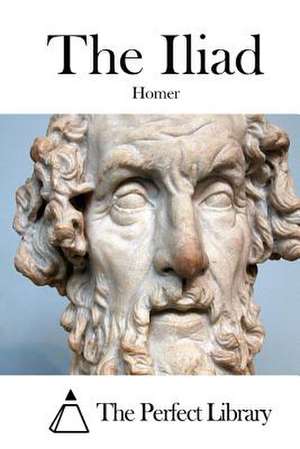
The Iliad
Autor Homer Editat de The Perfect Libraryen Limba Engleză Paperback
Preț: 182.94 lei
Carte disponibilă
Livrare economică 30 octombrie-13 noiembrie
Specificații
ISBN-10: 1511974710
Pagini: 514
Dimensiuni: 152 x 229 x 26 mm
Greutate: 0.68 kg
Editura: CREATESPACE
V-ar putea interesa
-
 InfernoDante AlighieriPreț: 28.01 lei
 -
 CLASSICS PARADISE LOST AND PAJohn MiltonPreț: 28.01 lei
 -
 Six Wives of Henry VIIIAlison Weir-27%Preț: 79.82 lei109.82 lei
 -
 Frederick the GreatNancy Mitford-37%Preț: 58.03 lei92.61 lei
 -
 The Sun KingNancy Mitford-32%Preț: 62.34 lei91.10 lei
 -
 The OdysseyHomer-17%Preț: 61.06 lei73.45 lei
 -
 The OdysseyHomer-17%Preț: 54.46 lei65.80 lei
 -
 Candide and Other StoriesVoltairePreț: 47.10 lei
 -
 The OdysseyHomerPreț: 58.65 lei
 -
 Medea and Other PlaysEuripidesPreț: 58.52 lei
 -
 The Love PoemsOvid-19%Preț: 69.94 lei86.16 lei
 -
 Selected PoetryJohn Keats-19%Preț: 51.43 lei63.86 lei
 -
 The SilmarillionJ. R. R. TolkienPreț: 65.60 lei
 -
 Faust 1Johann Wolfgang von GoethePreț: 53.38 lei
 -
 Iliad and the OdysseyHomerPreț: 49.83 lei
 -
 CapitalKarl MarxPreț: 49.36 lei
 -
 The General Theory of Employment, Interest and MoneyJohn Maynard KeynesPreț: 46.92 lei
 -
 -19%Preț: 57.30 lei71.11 lei
 -
 Helen of TroyBettany Hughes-23%Preț: 147.53 lei191.52 lei
 -
 HistoriesHerodotusPreț: 47.64 lei
 -
 Pilgrim''s ProgressJohn BunyanPreț: 43.15 lei
 -
 Seven Pillars of WisdomT. E. LawrencePreț: 47.36 lei
 -
 RepublicPlatoPreț: 44.09 lei
 -
 ProphetKahlil GibranPreț: 41.51 lei
 -
 PrinceNiccolò MachiavelliPreț: 42.81 lei
 -
 Origin of SpeciesCharles DarwinPreț: 45.05 lei
 -
 InfernoDante AlighieriPreț: 43.40 lei
Notă biografică
We can never be certain that both these stories belonged to Homer. In fact ‘Homer’ may not be a real name but a kind of nickname meaning perhaps ‘the hostage’ or ‘the blind one’. Whatever the truth of their origin, the two stories, developed around three thousand years ago, may well still be read in three thousand years’ time.
Robert Fagles (1933-2008) was Arthur W. Marks ’19 Professor of Comparative Literature, Emeritus, at Princeton University. He was the recipient of the 1997 PEN/Ralph Manheim Medal for Translation and a 1996 Award in Literature from the American Academy of Arts and Letters. His translations include Sophocles’s Three Theban Plays, Aeschylus’s Oresteia (nominated for a National Book Award), Homer’s Iliad (winner of the 1991 Harold Morton Landon Translation Award by The Academy of American Poets), Homer’s Odyssey, and Virgil's Aeneid.
Bernard Knox (1914-2010) was Director Emeritus of Harvard’s Center for Hellenic Studies in Washington, D.C. He taught at Yale University for many years. Among his numerous honors are awards from the National Institute of Arts and Letters and the National Endowment for the Humanities. His works include The Heroic Temper: Studies in Sophoclean Tragedy, Oedipus at Thebes: Sophocles’ Tragic Hero and His Time and Essays Ancient and Modern (awarded the 1989 PEN/Spielvogel-Diamonstein Award).
Descriere
An ancient Greek epic which underpins the whole of western literature, Homer's The Iliad is a timeless evocation of the struggle to retain a sense of honour and virtue amidst the horrors of war. This Penguin Classics edition is translated with an introduction by Martin Hammond.
The Iliad is the greatest literary achievement of Greek civilization. The story centres on the critical events in four days of the tenth and final year of the war between the Greeks and the Trojans. It describes how the quarrel of Agamemnon and Achilleus sets in motion a tragic sequence of events, which leads to Achilleus' killing of Hektor and determines the ultimate fate of Troy. But Homer's theme is not simply war or heroism. With compassion and humanity he presents a universal and tragic view of the world, of human life lived under the shadow of suffering and death, set against a vast and largely unpitying divine background. The Iliad is the first of the world's great tragedies.
Martin Hammond's acclaimed translation is accompanied by a full introduction and a comprehensive index.
Seven Greek cities claim the honour of being the birthplace of Homer (c. 8th-7th century BC), the poet to whom the composition of the Iliad and Odyssey are attributed. The Iliad is the oldest surviving work of Western literature, but the identity - or even the existence - of Homer himself is a complete mystery, with no reliable biographical information having survived.
If you enjoyed the Iliad, you might like Homer's Odyssey, also available in Penguin Classics.
'Martin Hammond's modern prose version is the best and most accurate there has ever been'
Peter Levi, Independent
'A fine Iliad for our times'
Philip Howard, The Times
Recenzii
Cuprins
Introduction
Introduction
The Spelling and Pronunciation of Homeric Names
Maps
1. Homeric Geography: Mainland Greece
2. Homeric Geography: The Peloponnese
3. Homeric Geography: The Aegean and Asia Minor
Inset: Troy and Vicinity
Homer: The Iliad
Book 1: The Rage of Achilles
Book 2: The Great Gathering of Armies
Book 3: Helen Reviews the Champions
Book 4: The Truce Erupts in War
Book 5: Diomedes Fights the Gods
Book 6: Hector Returns to Troy
Book 7: Ajax Duels with Hector
Book 8: The Tide of Battle Turns
Book 9: The Embassy to Achilles
Book 10: Marauding Through the Night
Book 11: Agamemnon's Day of Glory
Book 12: The Trojans Storm the Rampart
Book 13: Battling for the Ships
Book 14: Hera Outflanks Zeus
Book 15: The Achaean Armies at Bay
Book 16: Patroclus Fights and Dies
Book 17: Menelaus' Finest Hour
Book 18: The Shield of Achilles
Book 19: The Champion Arms for Battle
Book 20: Olympian Gods in Arms
Book 21: Achilles Fights the River
Book 22: The Death of Hector
Book 23: Funeral Games for Patroclus
Book 24: Achilles and Priam
Notes
The Genealogy of the Royal House of Troy
Textual Variants from the Oxford Classical Text
Notes on the Translation
Suggestions for Further Reading
Pronouncing Glossary