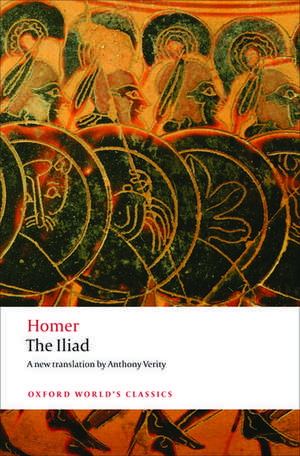
The Iliad
Autor Homer Traducere de Anthony Verity Introducere și note de Barbara Graziosien Limba Engleză Paperback – 9 aug 2012
Preț: 62.38 lei
Preț vechi: 73.85 lei
-16%
Puncte Express: 94
Carte disponibilă
Livrare economică 19-25 noiembrie
Livrare express 31 octombrie-06 noiembrie pentru 37.81 lei
Livrare prin curier în România Termenul estimat este afișat lângă disponibilitate.
Transport gratuit de la 400.00 lei Plată online sau ramburs, în funcție de opțiunile comenzii.
Retur gratuit în 14 zile Comandă securizată și suport în română.
Specificații
ISBN-13: 9780199645213
ISBN-10: 0199645213
Pagini: 512
Ilustrații: 2 maps
Dimensiuni: 131 x 196 x 24 mm
Greutate: 0.35 kg
Editura: Oxford University Press
Colecția OUP Oxford
Locul publicării:Oxford, United Kingdom
ISBN-10: 0199645213
Pagini: 512
Ilustrații: 2 maps
Dimensiuni: 131 x 196 x 24 mm
Greutate: 0.35 kg
Editura: Oxford University Press
Colecția OUP Oxford
Locul publicării:Oxford, United Kingdom
V-ar putea interesa
-
 InfernoDante AlighieriPreț: 28.01 lei
 -
 CLASSICS PARADISE LOST AND PAJohn MiltonPreț: 28.01 lei
 -
 Lady Chatterley's LoverD. H. LawrencePreț: 28.01 lei
 -
 Six Wives of Henry VIIIAlison Weir-27%Preț: 79.82 lei109.82 lei
 -
 Frederick the GreatNancy Mitford-36%Preț: 59.09 lei92.74 lei
 -
 The Sun KingNancy Mitford-31%Preț: 63.87 lei92.71 lei
 -
 The OdysseyHomer-16%Preț: 61.73 lei73.45 lei
 -
 -32%Preț: 63.10 lei92.24 lei
 -
 The OdysseyHomer-17%Preț: 54.01 lei65.33 lei
 -
 Candide and Other StoriesVoltairePreț: 47.32 lei
 -
 The OdysseyHomer-17%Preț: 60.71 lei72.86 lei
 -
 MetamorphosesOvid-14%Preț: 57.78 lei67.40 lei
 -
 Medea and Other PlaysEuripidesPreț: 58.52 lei
 -
 The Love PoemsOvid-18%Preț: 70.37 lei86.16 lei
 -
 Selected PoetryJohn Keats-19%Preț: 52.70 lei64.76 lei
 -
 -39%Preț: 17.40 lei28.34 lei
 -
 ZamiAudre Lorde-25%Preț: 59.63 lei79.32 lei
 -
 The Black UnicornAudre Lorde-27%Preț: 51.78 lei70.85 lei
 -
 The Cancer JournalsAudre Lorde-36%Preț: 45.08 lei70.40 lei
 -
 When I Dare to Be PowerfulAudre Lorde-19%Preț: 45.65 lei56.59 lei
 -
 The SilmarillionJ. R. R. TolkienPreț: 65.60 lei
 -
 Faust 1Johann Wolfgang von GoethePreț: 54.31 lei
 -
 Cognitive Psychology For DummiesMichael PakePreț: 154.97 lei
 -
 -35%Preț: 109.81 lei167.83 lei
 -
 PLUTARCHPlutarchPreț: 310.39 lei
 -
 -18%Preț: 59.31 lei72.36 lei
 -
 Helen of TroyBettany Hughes-23%Preț: 147.53 lei191.52 lei
Recenzii
Homer's epic [is] unpredictably and achingly beautiful.
Notă biografică
Homer, former Master of Dulwich College Anthony Verity is a classical scholar and educationalist whose appointments include Head of Classics at Bristol Grammar School, Headmaster of Leeds Grammar School, and Master of Dulwich College from 1986 to 1995. His translations for Oxford World's Classics include Theocritus, Idylls, Pindar, The Complete Odes, and the Odyssey. Barbara Graziosi's research focuses on ancient Greek literature and its readers, both ancient and modern. Her books include Inventing Homer: The Early Reception of Epic (CUP, 2002), Homer: The Resonance of Epic, (Duckworth, 2005, jointly written with Johannes Haubold), Homer in the Twentieth Century: Between World Literature and the Western Canon (OUP, 2007, jointly edited with Emily Greenwood), The Oxford Handbook of Hellenic Studies (2009, jointly edited with G. R. Boys-Stones and P. Vasunia), Homer: A Very Short Introduction (OUP, 2019), and a commentary on Iliad 6, co-written with Johannes Haubold. Her latest work is Classics, Love, Revolution: The Legacies of Luigi Settembrini (OUP, 2024, jointly written with Andrea Capra).
Cuprins
The IliadTranslator's Preface
Introduction
Introduction
The Spelling and Pronunciation of Homeric Names
Maps
1. Homeric Geography: Mainland Greece
2. Homeric Geography: The Peloponnese
3. Homeric Geography: The Aegean and Asia Minor
Inset: Troy and Vicinity
Homer: The Iliad
Book 1: The Rage of Achilles
Book 2: The Great Gathering of Armies
Book 3: Helen Reviews the Champions
Book 4: The Truce Erupts in War
Book 5: Diomedes Fights the Gods
Book 6: Hector Returns to Troy
Book 7: Ajax Duels with Hector
Book 8: The Tide of Battle Turns
Book 9: The Embassy to Achilles
Book 10: Marauding Through the Night
Book 11: Agamemnon's Day of Glory
Book 12: The Trojans Storm the Rampart
Book 13: Battling for the Ships
Book 14: Hera Outflanks Zeus
Book 15: The Achaean Armies at Bay
Book 16: Patroclus Fights and Dies
Book 17: Menelaus' Finest Hour
Book 18: The Shield of Achilles
Book 19: The Champion Arms for Battle
Book 20: Olympian Gods in Arms
Book 21: Achilles Fights the River
Book 22: The Death of Hector
Book 23: Funeral Games for Patroclus
Book 24: Achilles and Priam
Notes
The Genealogy of the Royal House of Troy
Textual Variants from the Oxford Classical Text
Notes on the Translation
Suggestions for Further Reading
Pronouncing Glossary
Introduction
Introduction
The Spelling and Pronunciation of Homeric Names
Maps
1. Homeric Geography: Mainland Greece
2. Homeric Geography: The Peloponnese
3. Homeric Geography: The Aegean and Asia Minor
Inset: Troy and Vicinity
Homer: The Iliad
Book 1: The Rage of Achilles
Book 2: The Great Gathering of Armies
Book 3: Helen Reviews the Champions
Book 4: The Truce Erupts in War
Book 5: Diomedes Fights the Gods
Book 6: Hector Returns to Troy
Book 7: Ajax Duels with Hector
Book 8: The Tide of Battle Turns
Book 9: The Embassy to Achilles
Book 10: Marauding Through the Night
Book 11: Agamemnon's Day of Glory
Book 12: The Trojans Storm the Rampart
Book 13: Battling for the Ships
Book 14: Hera Outflanks Zeus
Book 15: The Achaean Armies at Bay
Book 16: Patroclus Fights and Dies
Book 17: Menelaus' Finest Hour
Book 18: The Shield of Achilles
Book 19: The Champion Arms for Battle
Book 20: Olympian Gods in Arms
Book 21: Achilles Fights the River
Book 22: The Death of Hector
Book 23: Funeral Games for Patroclus
Book 24: Achilles and Priam
Notes
The Genealogy of the Royal House of Troy
Textual Variants from the Oxford Classical Text
Notes on the Translation
Suggestions for Further Reading
Pronouncing Glossary