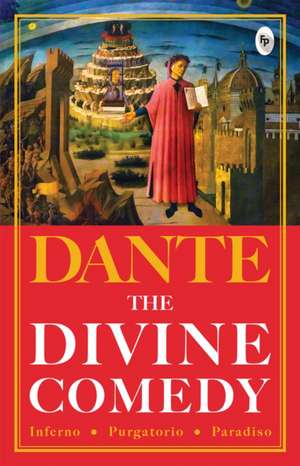
The Divine Comedy
Autor Dante Alighierien Limba Engleză Paperback – 28 mar 2024
- A Masterpiece of World Literature: Journey through Dante's unforgettable vision of Hell, Purgatory, and Paradise in one of literature's greatest epic poems.
- Profound Spiritual & Philosophical Insight: Explore timeless questions about morality, free will, justice, redemption, faith, and the nature of the divine.
- Essential Medieval Classic: Ideal for students, scholars, literature lovers, and readers interested in theology, philosophy, history, and classic epic poetry.
Key Themes
- Sin, Justice & Redemption: Examine the consequences of human choices and the possibility of repentance, forgiveness, and spiritual renewal.
- Faith, Love & the Divine: Explore the role of divine love, spiritual guidance, and faith in the soul's journey toward enlightenment.
- Human Nature & Moral Choice: Reflect on free will, responsibility, virtue, temptation, and the moral struggles that shape human existence.
Preț: 80.72 lei
Puncte Express: 121
Carte disponibilă
Livrare economică 19 decembrie 26 - 02 ianuarie 27
Livrare express 05-11 decembrie pentru 28.34 lei
Livrare prin curier în România Termenul estimat este afișat lângă disponibilitate.
Transport gratuit de la 400.00 lei Plată online sau ramburs, în funcție de opțiunile comenzii.
Retur gratuit în 14 zile Comandă securizată și suport în română.
Specificații
ISBN-13: 9789358565140
ISBN-10: 9358565144
Pagini: 628
Dimensiuni: 127 x 193 x 41 mm
Greutate: 0.39 kg
Editura: Fingerprint! Publishing
V-ar putea interesa
-
 Wuthering HeightsEmily BrontëPreț: 28.01 lei
-
 The LeopardJo Nesbo-12%Preț: 54.07 lei61.38 leiRecomandat
-
 CockroachesJo NesboPreț: 59.29 leiRecomandat
-
 The Gods Will Have BloodAnatole France-36%Preț: 59.09 lei92.60 lei
-
 The Master and MargaritaMikhail Bulgakov-23%Preț: 56.49 lei73.45 lei
-
 -15%Preț: 69.31 lei81.46 lei
-
 Mystical Poems of RumiJalal al-Din RumiPreț: 141.80 lei
-
 Preț: 35.14 lei
-
 Complete Dramatic WorksSamuel BeckettPreț: 144.12 lei
-
 The Selected Poems of Emily DickinsonEmily DickinsonPreț: 82.60 lei
-
 -25%Preț: 58.91 lei78.92 lei
-
 MolloySamuel BeckettPreț: 102.99 lei
-
 Five Nights at Freddy's The Silver Eyes 1Kira Breed-WrisleyPreț: 65.52 lei
-
 Five Nights at Freddy's: The Twisted OnesScott CawthonPreț: 61.15 lei
-
 Five Nights at Freddy's The Fourth Closet 3Scott CawthonPreț: 62.88 lei
-
 The Silk Roads: A New History of the WorldPeter Frankopan-22%Preț: 97.68 lei125.85 lei
-
 The Romanovs: The Story of Russia and its Empire 1613-1918Simon Sebag Montefiore-22%Preț: 87.29 lei111.69 lei
-
 Of The NightDavid BlairPreț: 37.50 lei
-
 The Whisperer in DarknessH. P. LovecraftPreț: 37.85 lei
-
 Wuthering HeightsEmily BrontePreț: 36.99 lei
-
 InfernoDante AlighieriPreț: 43.46 lei
-
 AmoriscoKhaled MattawaPreț: 76.58 lei
-
 FaustJohann Wolfgang GoethePreț: 68.08 lei
Notă biografică
Often considered as the Father of the Italian language, Dante Alighieri is best known for his epic poem the Divine Comedy. Born in 1265 in Florence, Republic of Florence, which is present-day Italy, Dante was an eminent Italian poet, prose writer, political thinker, and philosopher. The Alighieri family was involved in Florentine politics with loyalties towards the political alliance supporting Papacy. Dante was involved in the Guelph-Ghibelline conflict, and in the year 1289, he fought the Battle of Campaldino. He held numerous significant public offices at the time of political unrest but accomplished little as a politician. In the year 1302, Dante was exiled for life. Dante travelled and wrote during his exile. The Divine Comedy was conceived during this period. Divided into three parts--Inferno, Purgatorio, and Paradiso, it describes Dante's journey through Hell, Purgatory, and Paradise. A pre-eminent work of Italian literature, this fourteenth-century classic helped establish the Tuscan language. Some of Dante's other works include Convivio (The Banquet), De Monarchia, Le Rime (The Rhymes), and De vulgari eloquentia (On Eloquence in the Vernacular). Dante died on his way back to Ravenna in the year 1321, aged fifty-six.
Descriere
Descriere de la o altă ediție sau format:
Described variously as the greatest poem of the European Middle Ages and, because of the author's evangelical purpose, the `fifth Gospel', the Divine Comedy is central to the culture of the west. The poem is a spiritual autobiography in the form of a journey - the poet travels from the dark circles of the Inferno, up the mountain of Purgatory, where Virgil, his guide leaves him to encounter Beatrice in the Earthly Paradise. Dante conceived the poem as the new epic of Christendom, and he creates a world in which reason and faith have transformed moral and social chaos into order.Charles Sisson's blank verse translation is remarkable for its lucidity and vigour, and the Introduction, diagrams, maps, and notes by David Higgins provide the reader with invaluable guidance. ABOUT THE SERIES: For over 100 years Oxford World's Classics has made available the widest range of literature from around the globe. Each affordable volume reflects Oxford's commitment to scholarship, providing the most accurate text plus a wealth of other valuable features, including expert introductions by leading authorities, helpful notes to clarify the text, up-to-date bibliographies for further study, and much more.
Recenzii
"The perfect balance of tightness and colloquialism . . . Likely to be the best modern version of Dante."
"Kirkpatrick brings a more nuanced sense of the Italian and a more mediated appreciation of the poem's construction than nearly all of his competitors."
"We gain much from Kirkpatrick's fidelity to syntax and nuance. . . . His introduction . . . tells you, very readable indeed, pretty much all you need for a heightened appreciation of the work."
Cuprins
The Divine Comedy How to Read Dante
Translator's Note
The Inferno
Introduction
Cantos
The Purgatorio
Introduction
Cantos
The Paradiso
Introduction
Cantos