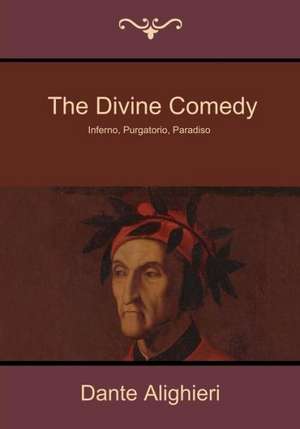
The Divine Comedy: Inferno, Purgatorio, Paradiso
Autor Dante Alighieri Traducere de H. F. Caryen Limba Engleză Paperback – 22 ian 2014
Preț: 155.63 lei
Puncte Express: 233
Carte tipărită la comandă
Livrare economică 03-17 decembrie
Livrare prin curier în România Termenul estimat este afișat lângă disponibilitate.
Transport gratuit de la 400.00 lei Plată online sau ramburs, în funcție de opțiunile comenzii.
Retur gratuit în 14 zile Comandă securizată și suport în română.
Specificații
ISBN-13: 9781618951625
ISBN-10: 1618951629
Pagini: 300
Dimensiuni: 178 x 254 x 16 mm
Greutate: 0.52 kg
Editura: Bibliotech Press
ISBN-10: 1618951629
Pagini: 300
Dimensiuni: 178 x 254 x 16 mm
Greutate: 0.52 kg
Editura: Bibliotech Press
V-ar putea interesa
-
 Wuthering HeightsEmily BrontëPreț: 28.01 lei
 -
 The LeopardJo Nesbo-13%Preț: 53.26 lei61.38 leiRecomandat
 -
 CockroachesJo NesboPreț: 58.46 leiRecomandat
 -
 The Gods Will Have BloodAnatole France-37%Preț: 58.20 lei92.60 lei
 -
 The Master and MargaritaMikhail Bulgakov-24%Preț: 55.47 lei73.45 lei
 -
 -15%Preț: 69.38 lei81.85 lei
 -
 Mystical Poems of RumiJalal al-Din RumiPreț: 138.98 lei
 -
 Complete Dramatic WorksSamuel BeckettPreț: 144.12 lei
 -
 The Selected Poems of Emily DickinsonEmily DickinsonPreț: 80.85 lei
 -
 -26%Preț: 58.21 lei79.02 lei
 -
 MolloySamuel BeckettPreț: 98.83 lei
 -
 Five Nights at Freddy's The Silver Eyes 1Kira Breed-WrisleyPreț: 62.36 lei
 -
 Five Nights at Freddy's: The Twisted OnesScott CawthonPreț: 59.62 lei
 -
 Five Nights at Freddy's The Fourth Closet 3Scott CawthonPreț: 61.55 lei
 -
 The Silk Roads: A New History of the WorldProfessor Peter Frankopan-23%Preț: 96.84 lei125.85 lei
 -
 The Romanovs: The Story of Russia and its Empire 1613-1918Simon Sebag Montefiore-23%Preț: 85.99 lei111.69 lei
 -
 Of The NightDavid BlairPreț: 31.49 lei
 -
 The Whisperer in DarknessH. P. LovecraftPreț: 31.80 lei
 -
 Wuthering HeightsEmily BrontePreț: 30.97 lei
 -
 InfernoDante AlighieriPreț: 43.46 lei
 -
 AmoriscoKhaled MattawaPreț: 73.62 lei
 -
 FaustJohann Wolfgang GoethePreț: 68.08 lei
Descriere
Descriere de la o altă ediție sau format:
Described variously as the greatest poem of the European Middle Ages and, because of the author's evangelical purpose, the `fifth Gospel', the Divine Comedy is central to the culture of the west. The poem is a spiritual autobiography in the form of a journey - the poet travels from the dark circles of the Inferno, up the mountain of Purgatory, where Virgil, his guide leaves him to encounter Beatrice in the Earthly Paradise. Dante conceived the poem as the new epic of Christendom, and he creates a world in which reason and faith have transformed moral and social chaos into order.Charles Sisson's blank verse translation is remarkable for its lucidity and vigour, and the Introduction, diagrams, maps, and notes by David Higgins provide the reader with invaluable guidance. ABOUT THE SERIES: For over 100 years Oxford World's Classics has made available the widest range of literature from around the globe. Each affordable volume reflects Oxford's commitment to scholarship, providing the most accurate text plus a wealth of other valuable features, including expert introductions by leading authorities, helpful notes to clarify the text, up-to-date bibliographies for further study, and much more.
Described variously as the greatest poem of the European Middle Ages and, because of the author's evangelical purpose, the `fifth Gospel', the Divine Comedy is central to the culture of the west. The poem is a spiritual autobiography in the form of a journey - the poet travels from the dark circles of the Inferno, up the mountain of Purgatory, where Virgil, his guide leaves him to encounter Beatrice in the Earthly Paradise. Dante conceived the poem as the new epic of Christendom, and he creates a world in which reason and faith have transformed moral and social chaos into order.Charles Sisson's blank verse translation is remarkable for its lucidity and vigour, and the Introduction, diagrams, maps, and notes by David Higgins provide the reader with invaluable guidance. ABOUT THE SERIES: For over 100 years Oxford World's Classics has made available the widest range of literature from around the globe. Each affordable volume reflects Oxford's commitment to scholarship, providing the most accurate text plus a wealth of other valuable features, including expert introductions by leading authorities, helpful notes to clarify the text, up-to-date bibliographies for further study, and much more.
Recenzii
"The perfect balance of tightness and colloquialism . . . Likely to be the best modern version of Dante."
"Kirkpatrick brings a more nuanced sense of the Italian and a more mediated appreciation of the poem's construction than nearly all of his competitors."
"We gain much from Kirkpatrick's fidelity to syntax and nuance. . . . His introduction . . . tells you, very readable indeed, pretty much all you need for a heightened appreciation of the work."
Cuprins
The Divine Comedy How to Read Dante
Translator's Note
The Inferno
Introduction
Cantos
The Purgatorio
Introduction
Cantos
The Paradiso
Introduction
Cantos
Translator's Note
The Inferno
Introduction
Cantos
The Purgatorio
Introduction
Cantos
The Paradiso
Introduction
Cantos