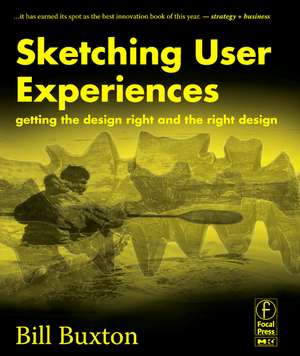
Sketching User Experiences: Getting the Design Right and the Right Design: Interactive Technologies
Autor Bill Buxtonen Limba Engleză Paperback – 31 mai 2007
Suntem de părere că Bill Buxton, prin vasta sa experiență în cercetare și contribuțiile sale majore la ecosistemul Microsoft, redefinește în această lucrare rolul schiței în procesul creativ. Autorul nu tratează schițarea doar ca pe o abilitate artistică, ci ca pe o unealtă critică de gândire necesară pentru a naviga între ingineria riguroasă și inovația conceptuală. Remarcăm cum volumul reușește să echilibreze nevoia de excelență tehnică — obținerea unui design corect — cu investiția timpurie în ideare, pentru a găsi, de fapt, designul cel mai potrivit pentru contextul social actual.
Abordarea prezentată de Buxton diferă de cea din Five Design-Sheets: Creative Design and Sketching for Computing and Visualisation prin faptul că este mai puțin axată pe o metodologie strict structurată în pași de bifat și mult mai ancorată în filosofia experienței de utilizare holistice. Dacă în Auditory Interfaces autorul explora dimensiunea senzorială a sunetului în interacțiune, aici extinde spectrul către interacțiunea dinamică și sistemele integrate. Structura cărții este elocventă: prima parte, intitulată sugestiv „Design as Dreamcatcher”, stabilește fundamentele teoretice și anatomia schițării, în timp ce partea a doua introduce cititorul în „Stories of Methods and Madness”. Această progresie de la teorie la studii de caz practice, precum analiza succesului Apple sau tehnica „Wizard of Oz”, transformă lectura într-un ghid aplicabil.
Cu peste 150 de ilustrații și acces la resurse video, lucrarea demonstrează cum prototipurile de experiență pot fi construite rapid, fără efortul imens cerut de prototipurile de inginerie care sunt, de multe ori, greu de abandonat. Este o resursă care forțează limitele designului de interfață tradițional, propunând o viziune ecologică asupra tehnologiei.
Din seria Interactive Technologies
- 41%
 Preț: 367.85 lei
 - 41%
 Preț: 252.18 lei
 - 39%
 Preț: 273.66 lei
 - 34%
 Preț: 316.77 lei
 - 20%
 Preț: 356.74 lei
 - 39%
 Preț: 235.86 lei
 - 38%
 Preț: 284.93 lei
 - 39%
 Preț: 372.34 lei
 - 12%
 Preț: 235.79 lei
 - 31%
 Preț: 427.09 lei
 - 31%
 Preț: 261.02 lei
 - 30%
 Preț: 267.71 lei
 - 31%
 Preț: 217.49 lei
 - 39%
 Preț: 256.21 lei
 - 42%
 Preț: 325.47 lei
Preț: 236.60 lei
Preț vechi: 389.20 lei
-39%
Carte tipărită la comandă
Livrare economică 30 mai-13 iunie
Specificații
ISBN-10: 0123740371
Pagini: 448
Ilustrații: Approx. 150 illustrations
Dimensiuni: 191 x 235 x 27 mm
Greutate: 0.87 kg
Editura: ELSEVIER SCIENCE
Seria Interactive Technologies
V-ar putea interesa
-
 Sketching User Experiences: The WorkbookSaul Greenberg-19%Preț: 115.23 lei141.95 lei
 -
 -41%Preț: 451.68 lei760.81 lei
 -
 The Design of Everyday ThingsDon NormanPreț: 105.71 lei
 -
 Notes on the Synthesis of FormChristopher AlexanderPreț: 219.06 lei
 -
 Universal Principles of UXIrene Pereyra-38%Preț: 139.04 lei224.20 lei
 -
 Preț: 220.52 lei
 -
 About FaceAlan Cooper-20%Preț: 298.89 lei373.61 lei
 -
 User Experience ResearchMarty Gage-20%Preț: 168.21 lei210.26 lei
 -
 User FriendlyCliff KuangPreț: 110.25 lei
 -
 User Experience Design: A Practical IntroductionGavin Allanwood-20%Preț: 173.07 lei217.52 lei
 -
 This Is Service Design MethodsAdam Lawrence-20%Preț: 248.77 lei310.97 lei
 -
 -32%Preț: 219.28 lei320.19 lei
 -
 -37%Preț: 147.75 lei234.33 lei
 -
 Drawing for Product DesignersKevin Henry-31%Preț: 153.44 lei222.24 lei
 -
 -20%Preț: 354.56 lei443.20 lei
 -
 This is Service Design Thinking: Basics, Tools, CasesMarc Stickdorn-21%Preț: 175.59 lei222.79 lei
 -
 Sketching Product Design PresentationRoselien Steur-18%Preț: 198.32 lei240.65 lei
 -
 Sketching: the BasicsKoos EissenPreț: 110.43 lei
 -
 Rethinking Users: The Design Guide to User Ecosystem ThinkingBenjamin J. Chesluk-28%Preț: 158.66 lei219.23 lei
Public țintă
HCI professionals, interaction designers, product/industrial designers, and graphic designers, and students studying those subjects.De ce să citești această carte
Recomandăm această carte profesioniștilor care doresc să depășească bariera simplului desen tehnic. Veți câștiga o metodologie clară pentru a explora rapid idei complexe, economisind resurse prețioase de dezvoltare. Este esențială pentru designeri și manageri de produs care vor să înțeleagă de ce o schiță rapidă este mai valoroasă decât un prototip software rigid în fazele incipiente ale unui proiect, oferind instrumente concrete pentru a modela tehnologia în serviciul valorilor umane.
Descriere scurtă
Grounded in both practice and scientific research, Bill Buxton’s engaging work aims to spark the imagination while encouraging the use of new techniques, breathing new life into user experience design.
- Covers sketching and early prototyping design methods suitable for dynamic product capabilities: cell phones that communicate with each other and other embedded systems, "smart" appliances, and things you only imagine in your dreams
- Thorough coverage of the design sketching method which helps easily build experience prototypes—without the effort of engineering prototypes which are difficult to abandon
- Reaches out to a range of designers, including user interface designers, industrial designers, software engineers, usability engineers, product managers, and others
- Full of case studies, examples, exercises, and projects, and access to video clips that demonstrate the principles and methods
Cuprins
Recenzii
"Design is explained, with the means and manner for successes and failures illuminated by engaging stories, true examples and personal anecdotes. In Sketching User Experiences, Bill Buxton clarifies the processes and skills of design from sketching to experience modeling, in a lively and informative style that is rich with stories and full of his own heart and enthusiasm. At the start we are lost in mountain snows and northern seas, but by the end we are equipped with a deep understanding of the tools of creative design." --Bill Moggridge, Cofounder of IDEO and author of Designing Interactions
"I love this book. There are very few resources available that see across and through all of the disciplines involved in developing great experiences. This is complex stuff and Buxton's work is both informed and insightful. He shares the work in an intimate manner that engages the reader and you will find yourself nodding with agreement, and smiling at the poignant relevance of his examples." --Alistair Hamilton, Symbol Technologies, NY
"Like any secret society, the design community has its strange rituals and initiation procedures. Bill opens up the mysteries of the magical process of design, taking us through a land in which story telling, orange squeezers, the Wizard of oOz, I-pods, avalanche avoidance, bicycle suspension sketching, and faking it are all points on the design pilgrim’s journey. There are lots of ideas and techniques in this book to feed good design and transform the way we think about creating useful stuff." --Peter Gabriel