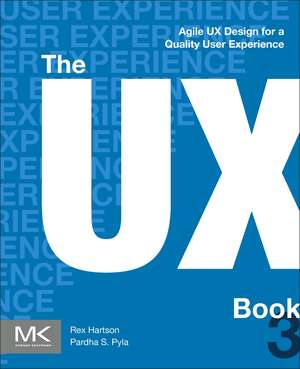
The UX Book: Agile UX Design for a Quality User Experience
Autor Rex Hartson, Pardha S. Pylaen Limba Engleză Paperback – 15 iul 2025
În industria dezvoltării de software și a sistemelor interactive, tranziția către metodologii de lucru rapide a creat adesea un conflict între rigoarea designului și viteza de execuție. Descoperim în The UX Book o resursă tehnică esențială care reconciliază aceste două lumi, oferind un cadru practic pentru Agile UX. Scrisă de Rex Hartson și Pardha S. Pyla, această a treia ediție se distanțează de abordările pur teoretice, concentrându-se pe aplicabilitate imediată în proiecte complexe unde resursele și timpul sunt limitate.
Reținem organizarea riguroasă a volumului, care ghidează cititorul prin întreg ciclul de viață al unui produs. Primele secțiuni pun bazele cercetării de utilizare, de la colectarea datelor la modelarea acestora sub formă de user stories. Progresia continuă firesc spre zona creativă, unde sunt explorate arhitectura informației și designul interacțiunii, culminând cu secțiuni dedicate prototipării și metodelor de evaluare. Un element distinctiv este atenția acordată designului generativ și impactului emoțional, demonstrând că un produs de succes trebuie să rezoneze cu utilizatorul dincolo de simpla utilitate.
Cititorul care a explorat deja fundamentele în UX Simplified sau a studiat integrarea echipei în User-Centered Agile Methods va găsi aici o aprofundare metodologică mult mai vastă. În timp ce alte titluri se concentrează pe strategii punctuale, The UX Book oferă un ecosistem complet, fiind în același timp un manual academic și un ghid de teren pentru profesioniști. Tonul este pragmatic, integrând povești din industrie care ilustrează modul în care principiile HCI (Interacțiunea om-mașină) se aplică în mediile de producție contemporane.
Preț: 485.75 lei
Preț vechi: 798.37 lei
-39%
Carte disponibilă
Livrare economică 09-23 noiembrie
Livrare express 30 octombrie-05 noiembrie pentru 232.66 lei
Specificații
ISBN-10: 044313443X
Pagini: 744
Dimensiuni: 191 x 235 x 32 mm
Greutate: 1.54 kg
Ediția:3
Editura: ELSEVIER SCIENCE
Colecția Morgan Kaufmann
V-ar putea interesa
-
 Sketching User Experiences: The WorkbookSaul Greenberg-17%Preț: 123.24 lei149.00 lei
 -
 -40%Preț: 270.23 lei450.65 lei
 -
 Applying UML and PatternsCraig Larman-15%Preț: 605.79 lei712.70 lei
 -
 -20%Preț: 641.11 lei801.39 lei
 -
 The Art and Science of UX DesignAnthony ContaPreț: 334.93 lei
 -
 A Project Guide to UX DesignCarolyn Chandler-20%Preț: 260.87 lei326.08 lei
 -
 Introduction to Human-Computer InteractionKasper Hornbæk-27%Preț: 423.29 lei579.30 lei
 -
 Universal Principles of UXIrene Pereyra-21%Preț: 174.36 lei221.50 lei
 -
 The Pocket Universal Principles of UXIrene Pereyra-19%Preț: 81.25 lei100.20 lei
 -
 Lean UX, 3e (hardcover)Jeff Gothelf-20%Preț: 248.04 lei310.05 lei
 -
 About FaceAlan Cooper-20%Preț: 310.92 lei388.66 lei
 -
 User Experience DesignSatyam Kantamneni-20%Preț: 171.74 lei214.67 lei
 -
 User Experience ResearchMarty Gage-20%Preț: 176.58 lei220.72 lei
 -
 User Experience Design: A Practical IntroductionGavin Allanwood-7%Preț: 179.72 lei192.43 lei
 -
 The Principles and Processes of Interactive DesignJamie Steane-38%Preț: 190.02 lei304.41 lei
 -
 -20%Preț: 200.27 lei250.34 lei
 -
 -36%Preț: 131.55 lei204.93 lei
 -
 Universal Methods of Design, Expanded and RevisedBruce Hanington-20%Preț: 163.75 lei205.92 lei
 -
 User-Centered Agile MethodsHugh Beyer-20%Preț: 135.22 lei169.03 lei
De ce să citești această carte
Recomandăm această carte profesioniștilor UX și studenților la informatică care doresc să stăpânească designul centrat pe utilizator în contextul metodologiilor Agile. Cititorul câștigă o metodologie clară de lucru (The Wheel) și instrumente practice pentru a crea interfețe care echilibrează eficiența tehnică cu satisfacția emoțională a utilizatorului, totul susținut de exerciții și studii de caz reale.
Descriere scurtă
Designed as a textbook for aspiring students and a how-to handbook and field guide for UX professionals, the book is accompanied by in-class exercises and team projects.
The approach is practical rather than formal or theoretical. The primary goal is to imbue an understanding of what a good user experience is and how to achieve it. To better serve this, processes, methods, and techniques are introduced early to establish process-related concepts as context for discussion in later chapters.
- A comprehensive textbook for UX/human–computer interaction (HCI) design students readymade for the classroom, complete with instructors’ manual, dedicated website, sample syllabus, examples, exercises, and lecture slides
- Features HCI theory, process, practice, and a host of real-world stories and contributions from industry luminaries to prepare students for working in the field
- The only HCI textbook to cover agile methodology, design approaches, and a full, modern suite of classroom material (stemming from tried and tested classroom use by the authors)
Cuprins
1. What is UX and UX design?
2. The Wheel: UX processes, lifecycles, methods, and technique
3. Scope, rigor, complexity, and project perspectives
4. Agile lifecycle processes and the Funnel Model of Agile UX
5. Prelude to the process chapters
6. Background: Introduction
PART 2. UNDERSTAND NEEDS
7. Usage research data elicitation
8. Usage research data analysis
9. Usage research data modeling
10. UX design requirements: User stories and requirements
11. Background: Understand Needs
PART 3. DESIGN SOLUTIONS
12. The nature of UX design
13. Bottom-up vs. top-down design
14. Generative design: Ideation, sketching, and critiquing
15. Mental models and conceptual design
16. Designing the ecology and a pervasive information architecture
17. Designing the interaction
18. Designing for emotional impact
19. Background: Design
PART 4. PROTOTYPE CANDIDATES
20. Prototyping
PART 5. EVALUATE UX
21. UX evaluation methods and techniques
22. UX evaluation: UX goals, metrics, and targets
23. Preparation for empirical UX evaluation
24. Empirical data collection methods and techniques
25. Analytical data collection methods and techniques
26. UX Evaluation: Data analysis
27. UX evaluation: Reporting results
28. Background: UX evaluation
PART 6. AGILE UX AND CONNECTIONS TO AGILE SE
29. Connecting agile UX with agile software development
30. Background: Agile connections
PART 7. AFFORDANCES AND DESIGN GUIDELINES
31. Affordances in UX design
32. The interaction cycle
33. UX design guidelines
34. Background: Affordances and UX design principles