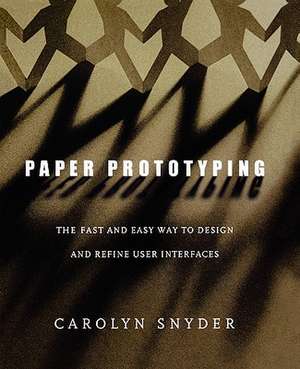
Paper Prototyping: The Fast and Easy Way to Design and Refine User Interfaces: Interactive Technologies
Autor Carolyn Snyderen Limba Engleză Paperback – 12 mai 2003
*Enables designers to solve design problems before implementation begins *Five case studies provide real world examples of paper prototyping at work *Delves into the specifics of what types of projects paper prototyping is and isn't good for.
Din seria Interactive Technologies
- 40%
 Preț: 393.10 lei
 - 40%
 Preț: 270.23 lei
 - 38%
 Preț: 292.53 lei
 - 33%
 Preț: 338.66 lei
 - 20%
 Preț: 356.74 lei
 - 38%
 Preț: 247.11 lei
 - 38%
 Preț: 252.25 lei
 - 37%
 Preț: 297.38 lei
 - 37%
 Preț: 397.89 lei
 - 29%
 Preț: 456.72 lei
 - 29%
 Preț: 279.01 lei
 - 28%
 Preț: 286.17 lei
 - 30%
 Preț: 232.74 lei
 - 39%
 Preț: 267.40 lei
 - 41%
 Preț: 339.73 lei
Preț: 252.31 lei
Preț vechi: 282.17 lei
-11%
Puncte Express: 378
Carte tipărită la comandă
Livrare economică 20 noiembrie-04 decembrie
Livrare prin curier în România Termenul estimat este afișat lângă disponibilitate.
Transport gratuit de la 400.00 lei Plată online sau ramburs, în funcție de opțiunile comenzii.
Retur gratuit în 14 zile Comandă securizată și suport în română.
Specificații
ISBN-13: 9781558608702
ISBN-10: 1558608702
Pagini: 408
Dimensiuni: 187 x 235 x 28 mm
Greutate: 0.83 kg
Editura: Elsevier
Seria Interactive Technologies
ISBN-10: 1558608702
Pagini: 408
Dimensiuni: 187 x 235 x 28 mm
Greutate: 0.83 kg
Editura: Elsevier
Seria Interactive Technologies
V-ar putea interesa
-
 Sketching User Experiences: The WorkbookSaul Greenberg-17%Preț: 123.24 lei149.00 lei
 -
 Developing Quality Technical InformationMichelle CareyPreț: 356.38 lei
 -
 -20%Preț: 220.69 lei275.87 lei
 -
 Don't Make Me ThinkSteve Krug-20%Preț: 225.53 lei281.91 lei
 -
 -40%Preț: 481.94 lei797.76 lei
 -
 The Design of Everyday ThingsDon NormanPreț: 121.72 lei
 -
 The Pocket Universal Principles of UXIrene Pereyra-20%Preț: 79.13 lei98.81 lei
 -
 About FaceAlan Cooper-20%Preț: 310.92 lei388.66 lei
 -
 Value Proposition DesignAlexander OsterwalderPreț: 217.90 lei
 -
 Communicating the User ExperienceRichard Caddick-20%Preț: 198.38 lei247.97 lei
 -
 User Experience Design: A Practical IntroductionGavin Allanwood-7%Preț: 179.72 lei192.43 lei
 -
 How to Read a PaperTrisha M Greenhalgh-5%Preț: 325.29 lei342.40 lei
 -
 This is Service Design Doing MethodsAdam Lawrence-20%Preț: 260.93 lei326.16 lei
 -
 -30%Preț: 234.18 lei335.86 lei
 -
 English Paper Piecing Handy Pocket GuideBecky GoldsmithPreț: 52.01 lei
 -
 Prototyping and Modelmaking for Product Design: Second EditionBjarki Hallgrimsson-30%Preț: 159.87 lei228.97 lei
 -
 Cut Up This Book: Creative PapersGrace Wilmshurst-19%Preț: 104.14 lei129.03 lei
 -
 ClickJake KnappPreț: 137.41 lei
 -
 -20%Preț: 79.60 lei99.09 lei
Public țintă
HCI practitioners, usability engineers, software developers, Web designers, and Web application developers.Cuprins
Foreword by Jakon NielsenAcknowledgmentsPart I—Introduction to Paper PrototypingChapter 1: IntroductionChapter 2: Case StudiesChapter 3: Thinking about PrototypingChapter 4: Making a Paper PrototypePart II—Process: Conducting a Usability Study with a Paper PrototypeChapter 5: Planning a Usability Study with a Paper PrototypeChapter 6: Task DesignChapter 7: Preparing the PrototypeChapter 8: Introduction to Usability Test FacilitationChapter 9: Usability Testing with a Paper PrototypeChapter 10: ObserversChapter 11: Data: Capturing, Prioritizing, and CommunicatingPart III—Deciding Whether to Use PaperChapter 12: What Paper Is (and Isn't) Good ForChapter 13: The Politics of Paper PrototypingChapter 14: When to Use PaperPart IV—Broadening the FocusChapter 15: Examples of User-Centered DesignChapter 16: Final ThoughtsReferencesIndexFigure CreditsAbout the Author