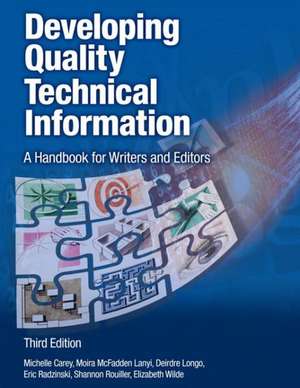
Developing Quality Technical Information
Autor Michelle Carey, Moira Lanyi, Deirdre Longo, Eric Radzinski, Shannon Rouiller, Elizabeth Wildeen Limba Engleză Paperback – 25 iun 2014
Găsim în această carte o abordare interdisciplinară riguroasă, situată la intersecția dintre comunicarea tehnică, arhitectura informației și experiența utilizatorului (UX). Developing Quality Technical Information reprezintă standardul de referință pentru profesioniștii care vizează excelența în documentația de produs, fiind fundamentată pe expertiza practică a echipei de design de conținut de la IBM. Putem afirma că relevanța acestui volum pentru curriculumul de scriere tehnică este critică, deoarece trece dincolo de simpla redactare, integrând principii de design de interfață și strategii de livrare a conținutului pe dispozitive mobile. Merită menționat că a treia ediție a fost complet revizuită pentru a reflecta evoluția domeniului, punând accent pe asistența integrată și pe tehnici de dezvăluire progresivă a informației. Structura cărții este organizată logic, pornind de la înțelegerea obiectivelor utilizatorului și progresând spre cele nouă atribute ale calității, precum claritatea, acuratețea și orientarea spre sarcini. Această abordare transformă documentația dintr-un simplu manual într-o componentă activă a produsului. Ca alternativă la How to Write and Present Technical Information pentru cursurile de comunicare profesională, acest volum oferă avantajul unei metodologii aplicate, specifice marilor corporații tehnologice, incluzând liste de verificare și sute de exemple noi. În contextul operei autorilor, deși unii contribuitori precum Michelle Carey sau Eric Radzinski s-au concentrat pe literatura tehnică și designul informației, este interesant de observat diversitatea profilurilor lor. Totuși, acest ghid rămâne lucrarea lor centrală de referință, spre deosebire de incursiunile în ficțiune sau analize politice ale altor colaboratori. Cartea reușește să ofere o viziune unitară asupra modului în care informația tehnică trebuie să servească utilizatorul, indiferent de mediul de livrare.
Preț: 356.38 lei
Carte disponibilă
Livrare economică 02-16 noiembrie
Livrare express 16-22 octombrie pentru 56.60 lei
Specificații
ISBN-10: 0133118975
Pagini: 624
Dimensiuni: 177 x 231 x 25 mm
Greutate: 0.82 kg
Ediția:3rd edition
Editura: Pearson Education
V-ar putea interesa
-
 Sketching User Experiences: The WorkbookSaul Greenberg-18%Preț: 120.36 lei146.40 lei
 -
 Don't Make Me ThinkSteve Krug-20%Preț: 225.47 lei281.84 lei
 -
 -40%Preț: 481.94 lei797.76 lei
 -
 Writing for Busy ReadersTodd RogersPreț: 102.23 lei
 -
 About FaceAlan Cooper-20%Preț: 310.92 lei388.66 lei
 -
 Communicating the User ExperienceRichard Caddick-20%Preț: 198.38 lei247.97 lei
 -
 Writing AI Prompts For DummiesStephanie Diamond-20%Preț: 97.21 lei121.52 lei
 -
 iPhone For Dummies, 2025 EditionGuy Hart-Davis-20%Preț: 193.05 lei241.31 lei
 -
 -20%Preț: 134.29 lei167.85 lei
 -
 ChatGPT For Dummies, 2nd EditionPam Baker-20%Preț: 97.96 lei122.44 lei
 -
 iPhone For Seniors For Dummies, 2026 EditionDwight SpiveyPreț: 139.48 lei
 -
 iPhone For Dummies, 2026 EditionHart-DavisPreț: 138.37 lei
 -
 Agentic AI For DummiesPam Baker-20%Preț: 146.02 lei182.53 lei
 -
 Technical TranslationJody Byrne-24%Preț: 958.81 lei1261.59 lei
 -
 -25%Preț: 468.46 lei624.34 lei
 -
 -17%Preț: 91.92 lei110.49 lei
 -
 -35%Preț: 243.51 lei372.78 lei
 -
 ClickJake KnappPreț: 137.41 lei
De ce să citești această carte
Această lucrare este esențială pentru scriitori tehnici, editori și arhitecți de informație care doresc să stăpânească standardele actuale ale industriei. Cititorul câștigă acces la metodologiile IBM pentru crearea unui conținut centrat pe utilizator, optimizat pentru căutare și dispozitive mobile. Este o resursă practică ce oferă instrumente concrete pentru a transforma informația tehnică dintr-un accesoriu într-un avantaj competitiv al produsului.
Despre autor
Echipa de autori este formată din specialiști de elită în designul de conținut și arhitectura informației din cadrul IBM. Michelle Carey, Moira Lanyi, Deirdre Longo, Eric Radzinski, Shannon Rouiller și Elizabeth Wilde au consolidat decenii de experiență colectivă în dezvoltarea de documentație software și hardware pentru a crea acest ghid. Expertiza lor acoperă întregul spectru al comunicării tehnice moderne, de la scrierea de proceduri complexe până la proiectarea interfețelor de utilizator și strategii de optimizare a regăsirii informației în medii digitale globale.
Descriere scurtă
- Advocating for users throughout the entire product development process
- Delivering information in an ordered manner by following progressive disclosure techniques
- Optimizing content so that users can find it from anywhere
- Streamlining information for mobile delivery
- Helping users right where they are
- Thoroughly revised and updated
- Extensive new coverage of self-documenting interfaces and embedded assistance
- Updated practical guidelines and checklists
- Hundreds of new examples
Notă biografică
Michelle Carey is an information architect and technical editor at IBM and has taught technical communication at University of California Santa Cruz Extension. Michelle is the co-author of the book DITA Best Practices: A Roadmap for Writing, Editing, and Architecting in DITA. She is an expert on topic-based information systems, software product error messages, grammar, embedded assistance for user interfaces, and writing for international audiences. She also writes computational linguistic rules for a grammar, style, and terminology management tool. Michelle enjoys teaching, grammar, herding cats, and riding and driving anything with a lot of horsepower.
Moira McFadden Lanyi is an information architect and technical editor at IBM. She has experience with topic-based writing, DITA, embedded assistance, user interface design, and visual design. She created 99% of the artwork in this book. She is a co-author of the book An Introduction to IMS. Moira enjoys visiting San Francisco with her family as often as possible, cooking fresh, healthy meals, and watching her courageous son ride his unicycle and surf.
Deirdre Longo is an information architect and strategist at IBM. She has been a pioneer for embedded assistance in IBM: defining the scope of that term, developing standards for embedded assistance, and modeling how to work effectively in cross-disciplinary teams. She has taught webinars for the Society of Technical Communication (STC) and published articles on information architecture topics in STC's Intercom. She is an avid yoga practitioner.
Eric Radzinski is a technical editor and information architect for industry-leading mainframe database software at IBM. He is a co-author of The IBM Style Guide: Conventions for Writers and Editors and is well versed in topic-based writing, embedded assistance, DITA, and writing for a global audience. Eric makes his home in San Jose, California, with his wife and their three children.
Shannon Rouiller is an information architect and technical editor at IBM. She has experience with quality metrics, topic-based information systems, DITA, videos, embedded assistance, and user interface design. She is a co-author of the book Designing Effective Wizards. Shannon dabbles in sports photography and likes to solve puzzles.
Elizabeth Wilde is an information quality strategist at IBM, developing strategies and education for developing high-quality content. She develops Acrolinx computational linguistic rules that enforce grammar, style, and DITA tagging rules. She teaches an extension course in technical writing at the University of California Santa Cruz. Her hobbies include growing cacti and succulents and collecting tattoos.
Cuprins
- Preface
- Acknowledgments
- About the authors
- Part 1. Introduction
- Chapter 1. Technical information continues to evolve
- Embedded assistance
- Progressive disclosure of information
- The technical writer’s role today
- Redefining quality technical information
- Chapter 2. Developing quality technical information
- Preparing to write: understanding users, goals, and product tasks
- Writing and rewriting
- Reviewing, testing, and evaluating technical information
- Part 2. Easy to use
- Chapter 3. Task orientation
- Write for the intended audience
- Present information from the users’ point of view
- Focus on users’ goals
- Identify tasks that support users’ goals
- Write user-oriented task topics, not function-oriented task topics
- Avoid an unnecessary focus on product features
- Indicate a practical reason for information
- Provide clear, step-by-step instructions
- Make each step a clear action for users to take
- Group steps for usability
- Clearly identify steps that are optional or conditional
- Task orientation checklist
- Chapter 4. Accuracy
- Research before you write
- Verify information that you write
- Maintain information currency
- Keep up with technical changes
- Avoid writing information that will become outdated
- Maintain consistency in all information about a subject
- Reuse information when possible