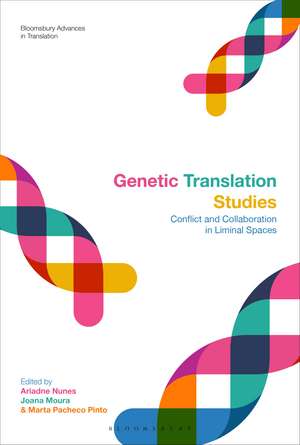
Genetic Translation Studies: Conflict and Collaboration in Liminal Spaces: Bloomsbury Advances in Translation
Editat de Dr Ariadne Nunes, Joana Moura, Marta Pacheco Pintoen Limba Engleză Paperback – 21 apr 2022
Genetic Translation Studies analyses a diverse range of translation materials including manuscripts, typographical proofs, personal papers, letters, testimonies and interviews in order to give visibility, body and presence to translators. Chapters draw on translations of works by authors such as Saint-John Perse, Nikos Kazantzakis, René Char, António Lobo Antunes and Camilo Castelo Branco, in each case revealing the conflicts and collaborations between translators and other stakeholders, including authors, editors and publishers.
Covering an impressive array of language contexts, from Portuguese, English and French to Greek, Finnish, Polish and Sanskrit, this book demonstrates the value of the genetic turn in translation studies and offers new ways of working with translator correspondences.
Din seria Bloomsbury Advances in Translation
- 23%
 Preț: 240.63 lei
 - 25%
 Preț: 208.84 lei
 - 25%
 Preț: 277.68 lei
 - 24%
 Preț: 250.15 lei
 - 25%
 Preț: 257.34 lei
 - 23%
 Preț: 276.77 lei
 - 25%
 Preț: 249.34 lei
 - 25%
 Preț: 208.46 lei
 - 23%
 Preț: 203.75 lei
 - 24%
 Preț: 280.18 lei
 - 30%
 Preț: 218.87 lei
 - 27%
 Preț: 235.86 lei
 - 16%
 Preț: 277.68 lei
 - 16%
 Preț: 284.79 lei
 - 36%
 Preț: 614.65 lei
 - 15%
 Preț: 258.13 lei
 - 16%
 Preț: 199.17 lei
 - 24%
 Preț: 258.22 lei
 - 27%
 Preț: 250.09 lei
 - 26%
 Preț: 213.76 lei
 - 25%
 Preț: 277.20 lei
 - 11%
 Preț: 371.54 lei
 - 29%
 Preț: 197.36 lei
 - 28%
 Preț: 205.49 lei
 - 25%
 Preț: 279.17 lei
 - 16%
 Preț: 277.20 lei
 - 16%
 Preț: 277.79 lei
Preț: 214.93 lei
Preț vechi: 307.67 lei
-30%
Puncte Express: 322
Carte tipărită la comandă
Livrare economică 26 noiembrie-10 decembrie
Livrare prin curier în România Termenul estimat este afișat lângă disponibilitate.
Transport gratuit de la 400.00 lei Plată online sau ramburs, în funcție de opțiunile comenzii.
Retur gratuit în 14 zile Comandă securizată și suport în română.
Specificații
ISBN-13: 9781350213005
ISBN-10: 1350213004
Pagini: 258
Dimensiuni: 154 x 232 x 16 mm
Greutate: 0.4 kg
Editura: Bloomsbury Publishing
Colecția Bloomsbury Academic
Seria Bloomsbury Advances in Translation
Locul publicării:London, United Kingdom
ISBN-10: 1350213004
Pagini: 258
Dimensiuni: 154 x 232 x 16 mm
Greutate: 0.4 kg
Editura: Bloomsbury Publishing
Colecția Bloomsbury Academic
Seria Bloomsbury Advances in Translation
Locul publicării:London, United Kingdom
Cuprins
1. What Is Genetic Translation Studies Good For?, Ariadne Nunes (Nova University of Lisbon, Portugal), Joana Moura (Catholic University of Portugal and University of Lisbon, Portugal) and Marta Pacheco Pinto (University of Lisbon, Portugal)
Part I. Genetic Approaches to Translation and Collaboration
2. Latency, Inference, Interaction, João Dionísio (University of Lisbon, Portugal)
3. Unveiling the Creative Process of Collaborative Translation, Esa Christine Hartmann (University of Strasbourg, France)
4. Czeslaw Milosz's Genetic Dossier in the Polish Translations of Negro Spirituals, Ewa Kolodziejczyk (Polish Academy of Sciences, Poland)
5. The Genesis of a Compilative Translation and its de Facto Source Text, Laura Ivaska (University of Turku, Finland)
6. Allographic Translation, Self-Translation and Alloglottic Rewriting, Elsa Pereira (University of Lisbon, Portugal)
Part II. Translators' Stories and Testimonies
7. Peter Handke as Translator of René Char, Joana Moura (Catholic University of Portugal and University of Lisbon, Portugal)
8. On the Bodily Dimension of Translators and Translating, Barbara Ivancic (University of Bologna, Italy) and Alexandra L. Zepter (University of Cologne, Germany)
9. The Translator's View of Translation, Dominique Faria (University of the Azores and University of Lisbon, Portugal)
10. Gregory Rabassa's Writings and his Translations of Lobo Antunes' Works, Marisa Mourinha (University of Lisbon, Portugal)
Part III. Translators at Work
11. The Coindreau Archives, Patrick Hersant (Université Paris 8 and École normale supérieure, France)
12. Authorship and (Self-)Translation in Academic Writing, Karen Bennett (Nova University of Lisbon, Portugal)
13. Camilo Castelo Branco as Author and Translator, Carlota Pimenta (University of Lisbon, Portugal)
14. Vasconcelos Abreu's O Panchatantra, Ariadne Nunes (Nova University of Lisbon, Portugal) and Marta Pacheco Pinto (University of Lisbon, Portugal)
Index
Part I. Genetic Approaches to Translation and Collaboration
2. Latency, Inference, Interaction, João Dionísio (University of Lisbon, Portugal)
3. Unveiling the Creative Process of Collaborative Translation, Esa Christine Hartmann (University of Strasbourg, France)
4. Czeslaw Milosz's Genetic Dossier in the Polish Translations of Negro Spirituals, Ewa Kolodziejczyk (Polish Academy of Sciences, Poland)
5. The Genesis of a Compilative Translation and its de Facto Source Text, Laura Ivaska (University of Turku, Finland)
6. Allographic Translation, Self-Translation and Alloglottic Rewriting, Elsa Pereira (University of Lisbon, Portugal)
Part II. Translators' Stories and Testimonies
7. Peter Handke as Translator of René Char, Joana Moura (Catholic University of Portugal and University of Lisbon, Portugal)
8. On the Bodily Dimension of Translators and Translating, Barbara Ivancic (University of Bologna, Italy) and Alexandra L. Zepter (University of Cologne, Germany)
9. The Translator's View of Translation, Dominique Faria (University of the Azores and University of Lisbon, Portugal)
10. Gregory Rabassa's Writings and his Translations of Lobo Antunes' Works, Marisa Mourinha (University of Lisbon, Portugal)
Part III. Translators at Work
11. The Coindreau Archives, Patrick Hersant (Université Paris 8 and École normale supérieure, France)
12. Authorship and (Self-)Translation in Academic Writing, Karen Bennett (Nova University of Lisbon, Portugal)
13. Camilo Castelo Branco as Author and Translator, Carlota Pimenta (University of Lisbon, Portugal)
14. Vasconcelos Abreu's O Panchatantra, Ariadne Nunes (Nova University of Lisbon, Portugal) and Marta Pacheco Pinto (University of Lisbon, Portugal)
Index
Recenzii
An international contribution to GTS ... [that] focuses on literature, poetry and fiction in particular ... [and] emphasizes the importance of a digital approach.
This volume represents a valuable and much-needed contribution to the emerging field of Genetic Translation Studies. Impressive in its theoretical and linguistic variety, it offers a number of pertinent and illustrative case studies, while the common focus on genetic criticism ensures the volume's cohesion and coherence.
M]ost of philology does not theorise its issues in terms of translation theory, and translation studies do not have recourse to the methods of textual criticism. ... This volume has the admirable goal of bridging the gap. ... The book ends with a Coda, a useful summary to recapitulate what covered in the preceding chapters. The final sentence is a promising 'TO BE CONTINUED', and encourages us to think in which ways future publications on GTS could continue, exploring the missed opportunities of this book.
This book represents a valuable contribution to the genetics of translations by providing an overview of the diversity of research that can be carried out using a genetic approach.
This volume represents a valuable and much-needed contribution to the emerging field of Genetic Translation Studies. Impressive in its theoretical and linguistic variety, it offers a number of pertinent and illustrative case studies, while the common focus on genetic criticism ensures the volume's cohesion and coherence.
M]ost of philology does not theorise its issues in terms of translation theory, and translation studies do not have recourse to the methods of textual criticism. ... This volume has the admirable goal of bridging the gap. ... The book ends with a Coda, a useful summary to recapitulate what covered in the preceding chapters. The final sentence is a promising 'TO BE CONTINUED', and encourages us to think in which ways future publications on GTS could continue, exploring the missed opportunities of this book.
This book represents a valuable contribution to the genetics of translations by providing an overview of the diversity of research that can be carried out using a genetic approach.