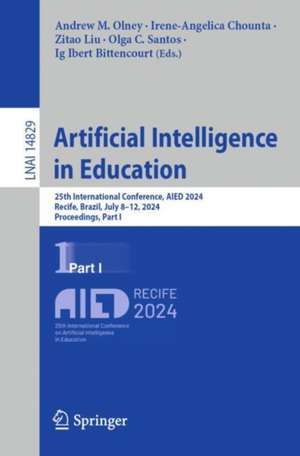
Artificial Intelligence in Education: Lecture Notes in Computer Science, cartea 14829
Editat de Andrew M. Olney, Irene-Angelica Chounta, Zitao Liu, Olga C. Santos, Ig Ibert Bittencourten Limba Engleză Paperback – 2 iul 2024
The 49 full papers and 27 short papers presented in this book were carefully reviewed and selected from 334 submissions. The papers present results in high-quality research on intelligent systems and the cognitive sciences for the improvement and advancement of education.
Din seria Lecture Notes in Computer Science
- 20%
 Preț: 558.53 lei
 - 20%
 Preț: 617.17 lei
 - 20%
 Preț: 571.88 lei
 - 20%
 Preț: 1020.28 lei
 - 20%
 Preț: 851.78 lei
 - 20%
 Preț: 560.93 lei
 - 20%
 Preț: 633.70 lei
 - 20%
 Preț: 675.83 lei
 - 20%
 Preț: 1359.66 lei
 - 20%
 Preț: 620.33 lei
 - 20%
 Preț: 733.68 lei
 - 18%
 Preț: 945.44 lei
 - 15%
 Preț: 558.12 lei
 - 20%
 Preț: 793.92 lei
 - 20%
 Preț: 560.93 lei
 - 20%
 Preț: 748.63 lei
 - 20%
 Preț: 562.49 lei
 - 20%
 Preț: 1032.47 lei
 - 20%
 Preț: 731.82 lei
 - 20%
 Preț: 556.96 lei
 - 20%
 Preț: 1022.15 lei
 - 20%
 Preț: 562.49 lei
 - 20%
 Preț: 560.93 lei
 - 20%
 Preț: 313.10 lei
 - 20%
 Preț: 828.44 lei
 - 20%
 Preț: 560.93 lei
 - 20%
 Preț: 314.86 lei
 - 20%
 Preț: 1033.45 lei
 - 20%
 Preț: 563.29 lei
 - 20%
 Preț: 733.68 lei
 - 20%
 Preț: 1137.10 lei
 - 20%
 Preț: 735.28 lei
 - 20%
 Preț: 1079.23 lei
 - 20%
 Preț: 584.42 lei
 - 20%
 Preț: 854.16 lei
 - 15%
 Preț: 672.87 lei
 - 20%
 Preț: 606.22 lei
 - 20%
 Preț: 1246.46 lei
 - 20%
 Preț: 449.81 lei
 - 20%
 Preț: 984.64 lei
 - 20%
 Preț: 620.33 lei
 - 20%
 Preț: 402.28 lei
 - 20%
 Preț: 316.28 lei
 - 20%
 Preț: 663.69 lei
 - 20%
 Preț: 320.24 lei
 - 20%
 Preț: 343.12 lei
 - 20%
 Preț: 313.87 lei
Preț: 526.26 lei
Preț vechi: 657.83 lei
-20%
Puncte Express: 789
Carte disponibilă
Livrare economică 09-23 noiembrie
Livrare prin curier în România Termenul estimat este afișat lângă disponibilitate.
Transport gratuit pentru acest produs Plată online sau ramburs, în funcție de opțiunile comenzii.
Retur gratuit în 14 zile Comandă securizată și suport în română.
Specificații
ISBN-13: 9783031643019
ISBN-10: 3031643011
Pagini: 536
Ilustrații: XXXI, 501 p. 120 illus., 97 illus. in color.
Dimensiuni: 155 x 235 x 29 mm
Greutate: 0.8 kg
Ediția:2024
Editura: Springer
Colecția Lecture Notes in Computer Science
Seria Lecture Notes in Computer Science
Locul publicării:Cham, Switzerland
ISBN-10: 3031643011
Pagini: 536
Ilustrații: XXXI, 501 p. 120 illus., 97 illus. in color.
Dimensiuni: 155 x 235 x 29 mm
Greutate: 0.8 kg
Ediția:2024
Editura: Springer
Colecția Lecture Notes in Computer Science
Seria Lecture Notes in Computer Science
Locul publicării:Cham, Switzerland
V-ar putea interesa
-
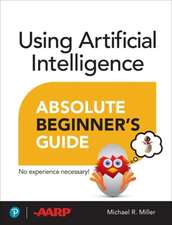 Using Artificial Intelligence Absolute Beginner's GuideMichael Miller-20%Preț: 201.24 lei251.56 lei
 -
 Uses of Artificial Intelligence in STEM EducationXiaoming Zhai-38%Preț: 806.49 lei1293.07 lei
 -
 -20%Preț: 823.96 lei1029.96 lei
 -
 -33%Preț: 616.33 lei915.67 lei
 -
 Reflective Teaching in Higher EducationPaul Ashwin-13%Preț: 275.14 lei317.75 lei
 -
 GenAI in Higher Education: Redefining Teaching and LearningDr Sam Illingworth-23%Preț: 190.69 lei246.55 lei
 -
 -10%Preț: 110.36 lei123.15 lei
 -
 Agentic AI For DummiesPam Baker-20%Preț: 145.95 lei182.44 lei
 -
 LLMs in ActionImmanuel Trummer-20%Preț: 219.46 lei274.33 lei
 -
 -19%Preț: 96.71 lei119.90 lei
 -
 Brave New WordsSalman KhanPreț: 92.67 lei
 -
 Exam NationSammy Wright-18%Preț: 129.73 lei158.91 lei
 -
 Grader Reader Workbook: Ready to ScoreMark BaileyPreț: 58.01 lei
 -
 Preț: 77.59 lei
 -
 Artificial Intelligence in EducationIg Ibert Bittencourt-20%Preț: 600.63 lei750.79 lei
 -
 -20%Preț: 328.20 lei410.26 lei
 -
 Generative Intelligence and Intelligent Tutoring SystemsAngelo Sifaleras-15%Preț: 485.44 lei571.10 lei
 -
 -20%Preț: 911.37 lei1139.20 lei
 -
 -20%Preț: 992.50 lei1240.61 lei
 -
 Emerging Technologies for EducationZuzana Kubincová-20%Preț: 509.25 lei636.55 lei
Cuprins
.- From Learning Actions to Dynamics: Characterizing Students’ Individual Temporal Behavior with Sequence Analysis.
.- Explainable Automatic Grading with Neural Additive Models.
.- PBChat: Enhance Student’s Problem Behavior Diagnosis with Large Language Model.
.- Generating Situated Reflection Triggers About Alternative Solution Paths: A Case Study in Generative AI for Computer-Supported Collaborative Learning .
.- Automated Assessment of Encouragement and Warmth in Classrooms Leveraging Multimodal Emotional Features and ChatGPT.
.- Ruffle&Riley: Insights from Designing and Evaluating a Large Language Model-Based Conversational Tutoring System.
.- Knowledge Tracing Unplugged: From Data Collection to Model Deployment.
.- Grading Documentation with Machine Learning.
.- Supporting Teaching-to-the-Curriculum by Linking Diagnostic Tests to Curriculum Goals: Using Textbook Content as Context for Retrieval-Augmented Generation with Large Language Models.
.- VerAs: Verify then Assess STEM Lab Reports.
.- Evaluating the Effectiveness of Comparison Activities in a CTAT Tutor for Algorithmic Thinking.
.- Automated Long Answer Grading with RiceChem Dataset.
.- Knowledge Tracing as Language Processing: A Large-scale
Autoregressive Paradigm.
.- Can GPT4 Answer Educational Tests? Empirical Analysis of Answer Quality based on Question Complexity and Difficulty.
.- Understanding Gender Effects in Game-Based Learning: The Role of Self-Explanation.
.- Calcium regulation assignment: Alternative styles in successfully learning about biological mechanisms.
.- Who’s helping who? When students use ChatGPT to engage in practice lab sessions.
.- Deep-IRT with a temporal convolutional network for reflecting students’ long-term history of ability data.
.- How to Teach Programming in the AI Era? Using LLMs as a Teachable Agent for Debugging.
.- Improving the Validity of Automatically Generated Feedback via Reinforcement Learning.
.- Automatic Detection of Narrative Rhetorical Categories and Elements on Middle School Written Essays.
.- Marking: Visual Grading with Highlighting Errors and Annotating Missing Bits.
.- Jill Watson: A Virtual Teaching Assistant powered by ChatGPT.
.- Evaluating the Design Features of an Intelligent Tutoring System for Advanced Mathematics Learning.
.- Anticipating Student Abandonment and Failure: Predictive Models in High School Settings.
.- Beyond the Grey Area: Exploring the Effectiveness of Scaffolding as a Learning Measure.
.- Fairness of MOOC Completion Predictions Across Demographics and Contextual Variables.
.- EngageME: Exploring Neuropsychological Tests for Assessing Attention in Online Learning.
.- The Neglected 15%: Positive Effects of Hybrid Human-AI Tutoring Among Students with Disabilities.
.- Fine-tuning a Large Language Model with Reinforcement Learning for Educational Question Generation.
.- On Cultural Intelligence in LLM-based Chatbots: Implications for Artificial Intelligence in Education.
.- Leveraging Large Language Models for Automated Chinese Essay Scoring.
.- The Unexpected Effects of Google Smart Compose on Open-Ended Writing Tasks.
.- Teaching and Measuring Multidimensional Inquiry Skills using Interactive Simulations.
.- Explainable Automatic Grading with Neural Additive Models.
.- PBChat: Enhance Student’s Problem Behavior Diagnosis with Large Language Model.
.- Generating Situated Reflection Triggers About Alternative Solution Paths: A Case Study in Generative AI for Computer-Supported Collaborative Learning .
.- Automated Assessment of Encouragement and Warmth in Classrooms Leveraging Multimodal Emotional Features and ChatGPT.
.- Ruffle&Riley: Insights from Designing and Evaluating a Large Language Model-Based Conversational Tutoring System.
.- Knowledge Tracing Unplugged: From Data Collection to Model Deployment.
.- Grading Documentation with Machine Learning.
.- Supporting Teaching-to-the-Curriculum by Linking Diagnostic Tests to Curriculum Goals: Using Textbook Content as Context for Retrieval-Augmented Generation with Large Language Models.
.- VerAs: Verify then Assess STEM Lab Reports.
.- Evaluating the Effectiveness of Comparison Activities in a CTAT Tutor for Algorithmic Thinking.
.- Automated Long Answer Grading with RiceChem Dataset.
.- Knowledge Tracing as Language Processing: A Large-scale
Autoregressive Paradigm.
.- Can GPT4 Answer Educational Tests? Empirical Analysis of Answer Quality based on Question Complexity and Difficulty.
.- Understanding Gender Effects in Game-Based Learning: The Role of Self-Explanation.
.- Calcium regulation assignment: Alternative styles in successfully learning about biological mechanisms.
.- Who’s helping who? When students use ChatGPT to engage in practice lab sessions.
.- Deep-IRT with a temporal convolutional network for reflecting students’ long-term history of ability data.
.- How to Teach Programming in the AI Era? Using LLMs as a Teachable Agent for Debugging.
.- Improving the Validity of Automatically Generated Feedback via Reinforcement Learning.
.- Automatic Detection of Narrative Rhetorical Categories and Elements on Middle School Written Essays.
.- Marking: Visual Grading with Highlighting Errors and Annotating Missing Bits.
.- Jill Watson: A Virtual Teaching Assistant powered by ChatGPT.
.- Evaluating the Design Features of an Intelligent Tutoring System for Advanced Mathematics Learning.
.- Anticipating Student Abandonment and Failure: Predictive Models in High School Settings.
.- Beyond the Grey Area: Exploring the Effectiveness of Scaffolding as a Learning Measure.
.- Fairness of MOOC Completion Predictions Across Demographics and Contextual Variables.
.- EngageME: Exploring Neuropsychological Tests for Assessing Attention in Online Learning.
.- The Neglected 15%: Positive Effects of Hybrid Human-AI Tutoring Among Students with Disabilities.
.- Fine-tuning a Large Language Model with Reinforcement Learning for Educational Question Generation.
.- On Cultural Intelligence in LLM-based Chatbots: Implications for Artificial Intelligence in Education.
.- Leveraging Large Language Models for Automated Chinese Essay Scoring.
.- The Unexpected Effects of Google Smart Compose on Open-Ended Writing Tasks.
.- Teaching and Measuring Multidimensional Inquiry Skills using Interactive Simulations.