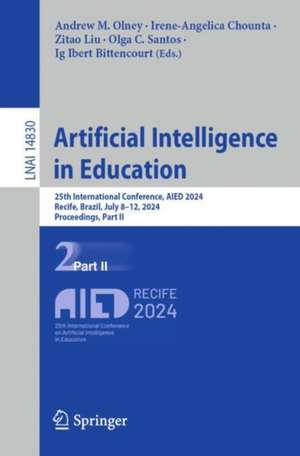
Artificial Intelligence in Education: Lecture Notes in Computer Science, cartea 14830
Editat de Andrew M. Olney, Irene-Angelica Chounta, Zitao Liu, Olga C. Santos, Ig Ibert Bittencourten Limba Engleză Paperback – 2 iul 2024
The 49 full papers and 27 short papers presented in this book were carefully reviewed and selected from 334 submissions. The papers present result in high-quality research on intelligent systems and the cognitive sciences for the improvement and advancement of education.
Din seria Lecture Notes in Computer Science
- 20%
 Preț: 558.53 lei
 - 20%
 Preț: 617.17 lei
 - 20%
 Preț: 571.88 lei
 - 20%
 Preț: 1020.28 lei
 - 20%
 Preț: 851.78 lei
 - 20%
 Preț: 560.93 lei
 - 20%
 Preț: 633.70 lei
 - 20%
 Preț: 675.83 lei
 - 20%
 Preț: 1359.66 lei
 - 20%
 Preț: 620.33 lei
 - 20%
 Preț: 733.68 lei
 - 18%
 Preț: 945.44 lei
 - 15%
 Preț: 558.12 lei
 - 20%
 Preț: 793.92 lei
 - 20%
 Preț: 560.93 lei
 - 20%
 Preț: 748.63 lei
 - 20%
 Preț: 562.49 lei
 - 20%
 Preț: 1032.47 lei
 - 20%
 Preț: 731.82 lei
 - 20%
 Preț: 556.96 lei
 - 20%
 Preț: 1022.15 lei
 - 20%
 Preț: 562.49 lei
 - 20%
 Preț: 560.93 lei
 - 20%
 Preț: 313.10 lei
 - 20%
 Preț: 828.44 lei
 - 20%
 Preț: 560.93 lei
 - 20%
 Preț: 314.86 lei
 - 20%
 Preț: 1033.45 lei
 - 20%
 Preț: 563.29 lei
 - 20%
 Preț: 733.68 lei
 - 20%
 Preț: 1137.10 lei
 - 20%
 Preț: 735.28 lei
 - 20%
 Preț: 1079.23 lei
 - 20%
 Preț: 584.42 lei
 - 20%
 Preț: 854.16 lei
 - 15%
 Preț: 672.87 lei
 - 20%
 Preț: 606.22 lei
 - 20%
 Preț: 1246.46 lei
 - 20%
 Preț: 449.81 lei
 - 20%
 Preț: 984.64 lei
 - 20%
 Preț: 620.33 lei
 - 20%
 Preț: 402.28 lei
 - 20%
 Preț: 316.28 lei
 - 20%
 Preț: 663.69 lei
 - 20%
 Preț: 320.24 lei
 - 20%
 Preț: 343.12 lei
 - 20%
 Preț: 313.87 lei
Preț: 688.79 lei
Preț vechi: 860.98 lei
-20%
Puncte Express: 1033
Carte tipărită la comandă
Livrare economică 30 noiembrie-14 decembrie
Livrare prin curier în România Termenul estimat este afișat lângă disponibilitate.
Transport gratuit pentru acest produs Plată online sau ramburs, în funcție de opțiunile comenzii.
Retur gratuit în 14 zile Comandă securizată și suport în română.
Specificații
ISBN-13: 9783031642982
ISBN-10: 3031642988
Pagini: 496
Ilustrații: XXXII, 461 p. 98 illus., 80 illus. in color.
Dimensiuni: 155 x 235 x 27 mm
Greutate: 0.74 kg
Ediția:2024
Editura: Springer
Colecția Lecture Notes in Computer Science
Seria Lecture Notes in Computer Science
Locul publicării:Cham, Switzerland
ISBN-10: 3031642988
Pagini: 496
Ilustrații: XXXII, 461 p. 98 illus., 80 illus. in color.
Dimensiuni: 155 x 235 x 27 mm
Greutate: 0.74 kg
Ediția:2024
Editura: Springer
Colecția Lecture Notes in Computer Science
Seria Lecture Notes in Computer Science
Locul publicării:Cham, Switzerland
V-ar putea interesa
-
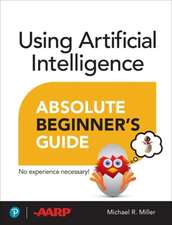 Using Artificial Intelligence Absolute Beginner's GuideMichael Miller-20%Preț: 201.24 lei251.56 lei
 -
 Uses of Artificial Intelligence in STEM EducationXiaoming Zhai-38%Preț: 806.49 lei1293.07 lei
 -
 -20%Preț: 823.96 lei1029.96 lei
 -
 -33%Preț: 616.33 lei915.67 lei
 -
 Reflective Teaching in Higher EducationPaul Ashwin-13%Preț: 275.14 lei317.75 lei
 -
 GenAI in Higher Education: Redefining Teaching and LearningDr Sam Illingworth-23%Preț: 190.69 lei246.55 lei
 -
 -10%Preț: 110.36 lei123.15 lei
 -
 Agentic AI For DummiesPam Baker-20%Preț: 145.95 lei182.44 lei
 -
 LLMs in ActionImmanuel Trummer-20%Preț: 219.46 lei274.33 lei
 -
 -19%Preț: 96.71 lei119.90 lei
 -
 Brave New WordsSalman KhanPreț: 92.67 lei
 -
 Exam NationSammy Wright-18%Preț: 129.73 lei158.91 lei
 -
 Grader Reader Workbook: Ready to ScoreMark BaileyPreț: 58.01 lei
 -
 Preț: 77.59 lei
 -
 Artificial Intelligence in EducationIg Ibert Bittencourt-20%Preț: 600.63 lei750.79 lei
 -
 -20%Preț: 328.20 lei410.26 lei
 -
 Generative Intelligence and Intelligent Tutoring SystemsAngelo Sifaleras-15%Preț: 485.44 lei571.10 lei
 -
 -20%Preț: 911.37 lei1139.20 lei
 -
 -20%Preț: 992.50 lei1240.61 lei
 -
 Emerging Technologies for EducationZuzana Kubincová-20%Preț: 509.25 lei636.55 lei
Cuprins
.- A first step to using machine learning methods to enhance interaction analysis in embodied learning environments.
.- "I am confused! How to differentiate between. . . ?" Adaptive Followup Questions Facilitate Tutor Learning with Effective Time-on-task.
.- An Automatic Question Usability Evaluation Toolkit.
.- Evaluating Behaviors of General Purpose Language Models in a Pedagogical Context.
.- Federated Learning Analytics: Investigating the Privacy-Performance Trade-off in Machine Learning for Educational Analytics.
.- Towards the automated generation of readily applicable personalised feedback in education.
.- Identifying and Mitigating Algorithmic Bias in Student Emotional Analysis.
.- Navigating Self-Regulated Learning Dimensions: Exploring Interactions Across Modalities.
.- Real-World Deployment and Evaluation of Kwame for Science, An AI Teaching Assistant for Science Education in West Africa.
.- ChatGPT for Education Research: Exploring the Potential of Large Language Models for Qualitative Codebook Development.
.- Aligning Tutor Discourse Supporting Rigorous Thinking with Tutee Content Mastery for Predicting Math Achievement.
.- Automated Educational Question Generation at Different Bloom’s Skill Levels using Large Language Models: Strategies and Evaluation.
.- VizChat: Enhancing Learning Analytics Dashboards with Contextualised Explanations using Multimodal Generative AI Chatbots.
.- Affect Behavior Prediction: Using Transformers and Timing Information to Make Early Predictions of Student Exercise Outcome.
.- To read or not to read: Predicting student engagement in interactive reading.
.- How Well Can You Articulate that Idea? Insights from Automated Formative Assessment.
.- Educational Content Personalization for Neurodiversity: A Survey of Technologies Supporting Linguistic Development in Individuals with Autism Spectrum Disorder (ASD).
.- Beyond the Obvious Multi-Choice Options: Introducing a Toolkit for Distractor Generation Enhanced with NLI Filtering.
.- Exploring the Potential of Automated and Personalized Feedback to Support Science Teacher Learning.
.- Coding With AI: How Are Tools Like ChatGPT Being Used By Students In Foundational Programming Courses.
.- Identifying Gaps In Students’ Explanations of Code Using LLMs.
.- A Multi-Task Automated Assessment System for Essay Scoring.
.- Content Knowledge Identification with Multi-Agent Large Language Models (LLMs).
.- Using knowledge graphs to improve question difficulty estimation from text.
.- The Role of First Language in Automated Essay Grading for Second Language Writing.
.- An Educational Psychology Inspired Approach to Student Interest Detection in Valence-Arousal Space.
.- Agency in AI and Education Policy: European Resolution Three on Harnessing the Potential for AI in and Through Education.
.- Nudging Adolescents Towards Recommended Maths Exercises With Gameful Rewards.
.- A Learning Approach for Increasing AI Literacy Via XAI in Informal Settings.
.- Aspect-based Semantic Textual Similarity for Educational Test Items.
.- Adapting Emotional Support in Teams: Quality of Contribution, Emotional Stability and Conscientiousness.
.- Predicting successful programming submissions based on critical logic blocks.
.- Student At-Risk Identification and Classification through Multitask Learning: A Case Study on the Moroccan Education System.
.- Investigating the Predictive Potential of Large Language Models in Student Dropout Prediction.
.- Towards Automated Multiple Choice Question Generation and Evaluation: Aligning with Bloom’s Taxonomy.
.- Enhancing student dialogue productivity with learning analytics and fuzzy rules.
.- HiTA: a RAG-based Educational Platform that Centers Educators in the Instructional Loop.
.- Towards Convergence: Characterizing Students’ Design Moves in Computational Modeling through Log Data with Video and Cluster Analysis.
.- Mars, Minecraft, and AI: A Deep Learning Approach to Improve Learning by Building.
.- Characterising Learning in Informal Settings using Deep Learning with Network Data.
.- Exploring Teachers’ Perception of Artificial Intelligence: The Socio-emotional Deficiency as Opportunities and Challenges in Human-AI Complementarity in K-12 Education.
.- Who Pilots the Copilots? Mapping a generative AI’s Actor-Network to assess its educational impacts.
.- "I am confused! How to differentiate between. . . ?" Adaptive Followup Questions Facilitate Tutor Learning with Effective Time-on-task.
.- An Automatic Question Usability Evaluation Toolkit.
.- Evaluating Behaviors of General Purpose Language Models in a Pedagogical Context.
.- Federated Learning Analytics: Investigating the Privacy-Performance Trade-off in Machine Learning for Educational Analytics.
.- Towards the automated generation of readily applicable personalised feedback in education.
.- Identifying and Mitigating Algorithmic Bias in Student Emotional Analysis.
.- Navigating Self-Regulated Learning Dimensions: Exploring Interactions Across Modalities.
.- Real-World Deployment and Evaluation of Kwame for Science, An AI Teaching Assistant for Science Education in West Africa.
.- ChatGPT for Education Research: Exploring the Potential of Large Language Models for Qualitative Codebook Development.
.- Aligning Tutor Discourse Supporting Rigorous Thinking with Tutee Content Mastery for Predicting Math Achievement.
.- Automated Educational Question Generation at Different Bloom’s Skill Levels using Large Language Models: Strategies and Evaluation.
.- VizChat: Enhancing Learning Analytics Dashboards with Contextualised Explanations using Multimodal Generative AI Chatbots.
.- Affect Behavior Prediction: Using Transformers and Timing Information to Make Early Predictions of Student Exercise Outcome.
.- To read or not to read: Predicting student engagement in interactive reading.
.- How Well Can You Articulate that Idea? Insights from Automated Formative Assessment.
.- Educational Content Personalization for Neurodiversity: A Survey of Technologies Supporting Linguistic Development in Individuals with Autism Spectrum Disorder (ASD).
.- Beyond the Obvious Multi-Choice Options: Introducing a Toolkit for Distractor Generation Enhanced with NLI Filtering.
.- Exploring the Potential of Automated and Personalized Feedback to Support Science Teacher Learning.
.- Coding With AI: How Are Tools Like ChatGPT Being Used By Students In Foundational Programming Courses.
.- Identifying Gaps In Students’ Explanations of Code Using LLMs.
.- A Multi-Task Automated Assessment System for Essay Scoring.
.- Content Knowledge Identification with Multi-Agent Large Language Models (LLMs).
.- Using knowledge graphs to improve question difficulty estimation from text.
.- The Role of First Language in Automated Essay Grading for Second Language Writing.
.- An Educational Psychology Inspired Approach to Student Interest Detection in Valence-Arousal Space.
.- Agency in AI and Education Policy: European Resolution Three on Harnessing the Potential for AI in and Through Education.
.- Nudging Adolescents Towards Recommended Maths Exercises With Gameful Rewards.
.- A Learning Approach for Increasing AI Literacy Via XAI in Informal Settings.
.- Aspect-based Semantic Textual Similarity for Educational Test Items.
.- Adapting Emotional Support in Teams: Quality of Contribution, Emotional Stability and Conscientiousness.
.- Predicting successful programming submissions based on critical logic blocks.
.- Student At-Risk Identification and Classification through Multitask Learning: A Case Study on the Moroccan Education System.
.- Investigating the Predictive Potential of Large Language Models in Student Dropout Prediction.
.- Towards Automated Multiple Choice Question Generation and Evaluation: Aligning with Bloom’s Taxonomy.
.- Enhancing student dialogue productivity with learning analytics and fuzzy rules.
.- HiTA: a RAG-based Educational Platform that Centers Educators in the Instructional Loop.
.- Towards Convergence: Characterizing Students’ Design Moves in Computational Modeling through Log Data with Video and Cluster Analysis.
.- Mars, Minecraft, and AI: A Deep Learning Approach to Improve Learning by Building.
.- Characterising Learning in Informal Settings using Deep Learning with Network Data.
.- Exploring Teachers’ Perception of Artificial Intelligence: The Socio-emotional Deficiency as Opportunities and Challenges in Human-AI Complementarity in K-12 Education.
.- Who Pilots the Copilots? Mapping a generative AI’s Actor-Network to assess its educational impacts.