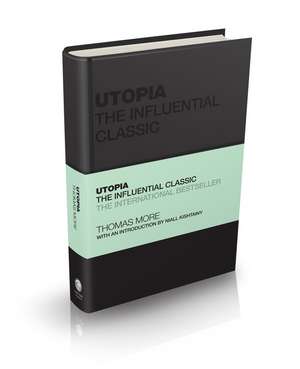
Utopia: Capstone Classics
Autor Thomas Moreen Limba Engleză Hardback – 11 feb 2021
| Toate formatele și edițiile | Preț | Express |
|---|---|---|
| Paperback (66) | 31.77 lei 3-5 săpt. | +4.86 lei 7-13 zile |
| WORDSWORTH EDITIONS LTD – 5 mar 1997 | 40.95 lei 3-5 săpt. | +4.86 lei 7-13 zile |
| Penguin Books – 27 aug 2009 | 42.57 lei 26-32 zile | +16.07 lei 7-13 zile |
| OUP OXFORD – 8 mai 2025 | 48.57 lei 20-31 zile | +19.28 lei 7-13 zile |
| Penguin Books – 24 dec 2012 | 48.64 lei 26-32 zile | +25.97 lei 7-13 zile |
| Yale University Press – 25 feb 2014 | 54.26 lei 3-5 săpt. | |
| Arcturus Publishing – 30 sep 2024 | 54.36 lei 3-5 săpt. | +5.52 lei 7-13 zile |
| Bloomsbury USA – 24 oct 2017 | 56.73 lei 3-5 săpt. | +14.23 lei 7-13 zile |
| Penguin Classics – 5 mai 2003 | 60.63 lei 3-5 săpt. | |
| Hackett Publishing Company,Inc – 15 ian 1999 | 82.04 lei 3-5 săpt. | +19.48 lei 7-13 zile |
| W. W. Norton & Company – 31 aug 2010 | 109.75 lei 3-5 săpt. | +13.57 lei 7-13 zile |
| BROADVIEW PR – 20 sep 2010 | 131.96 lei 3-5 săpt. | +29.49 lei 7-13 zile |
| e-artnow – 14 dec 2020 | 31.77 lei 3-5 săpt. | |
| Chump Change – 4 apr 1912 | 31.83 lei 6-8 săpt. | |
| Mint Editions – 12 oct 2021 | 36.87 lei 3-5 săpt. | +5.24 lei 7-13 zile |
| SKYE RYAN – 31 iul 2010 | 37.15 lei 3-5 săpt. | |
| CREATESPACE – | 38.27 lei 6-8 săpt. | |
| CreateSpace Independent Publishing Platform – | 40.05 lei 3-5 săpt. | |
| – | 40.73 lei 3-5 săpt. | |
| CreateSpace Independent Publishing Platform – | 41.64 lei 3-5 săpt. | |
| Watchmaker Publishing – 20 iun 2011 | 43.18 lei 6-8 săpt. | |
| – | 44.12 lei 3-5 săpt. | |
| Simon & Brown – 30 noi 2010 | 44.19 lei 3-5 săpt. | |
| – | 44.74 lei 3-5 săpt. | |
| – | 45.92 lei 3-5 săpt. | |
| – | 47.84 lei 6-8 săpt. | |
| – | 48.51 lei 6-8 săpt. | |
| Digireads.com – 2005 | 49.76 lei 6-8 săpt. | |
| Greenbook Publications, LLC – 30 iun 2010 | 50.70 lei 3-5 săpt. | |
| CREATESPACE – | 50.84 lei 3-5 săpt. | |
| – | 51.05 lei 3-5 săpt. | |
| CREATESPACE – | 51.06 lei 3-5 săpt. | |
| CreateSpace Independent Publishing Platform – | 52.06 lei 3-5 săpt. | |
| CreateSpace Independent Publishing Platform – | 54.16 lei 6-8 săpt. | |
| AZILOTH BOOKS – 2 sep 2018 | 55.00 lei 6-8 săpt. | |
| Simon & Brown – 31 ian 2012 | 56.41 lei 3-5 săpt. | |
| Simon & Brown – 30 sep 2011 | 56.41 lei 3-5 săpt. | |
| Lulu.Com – 27 ian 2017 | 56.89 lei 6-8 săpt. | |
| Legends Press – 26 mar 2024 | 58.57 lei 3-5 săpt. | +15.50 lei 7-13 zile |
| – | 58.95 lei 6-8 săpt. | |
| CreateSpace Independent Publishing Platform – 3 dec 2015 | 58.96 lei 6-8 săpt. | |
| CREATESPACE – | 59.12 lei 3-5 săpt. | |
| CREATESPACE – | 60.67 lei 3-5 săpt. | |
| – | 62.03 lei 3-5 săpt. | |
| CREATESPACE – | 63.13 lei 3-5 săpt. | |
| Simon & Brown – 30 noi 2011 | 63.56 lei 3-5 săpt. | |
| CREATESPACE – | 65.02 lei 3-5 săpt. | |
| CREATESPACE – | 65.27 lei 6-8 săpt. | |
| CREATESPACE – | 66.81 lei 3-5 săpt. | |
| 1st World Library – | 70.04 lei 6-8 săpt. | |
| CREATESPACE – | 73.97 lei 3-5 săpt. | |
| Aegypan Press – 31 dec 2007 | 78.31 lei 3-5 săpt. | |
| CREATESPACE – | 79.94 lei 3-5 săpt. | |
| – | 86.71 lei 3-5 săpt. | |
| SC Active Business Development SRL – 29 noi 2017 | 86.79 lei 38-44 zile | |
| BLURB INC – 29 ian 2019 | 90.62 lei 17-23 zile | |
| CREATESPACE – | 91.04 lei 3-5 săpt. | |
| Adhyaya Books – 3 mai 2022 | 91.30 lei 6-8 săpt. | |
| Bibliotech Press – 6 aug 2018 | 94.61 lei 6-8 săpt. | |
| Simon & Brown – 31 oct 2018 | 100.06 lei 38-44 zile | |
| Start Classics – 26 mar 2024 | 102.11 lei 38-44 zile | |
| Simon & Brown – 18 noi 2018 | 102.22 lei 38-44 zile | |
| Binker North – 8 oct 2019 | 105.63 lei 38-44 zile | |
| CHIZINE PUBN – 23 aug 2017 | 136.75 lei 17-23 zile | |
| Pomona Press – 31 dec 2005 | 195.62 lei 6-8 săpt. | |
| Cambridge University Press – 30 oct 2013 | 377.29 lei 6-8 săpt. | |
| Wiley – 16 ian 1991 | 51.99 lei Precomandă | |
| Hardback (19) | 60.57 lei 6-8 săpt. | +15.45 lei 7-13 zile |
| Wiley – 11 feb 2021 | 76.57 lei 3-5 săpt. | +15.45 lei 7-13 zile |
| Penguin Books – 27 feb 2020 | 80.94 lei 26-32 zile | +32.04 lei 7-13 zile |
| Hackett Publishing Company,Inc – 15 ian 1999 | 219.40 lei 3-5 săpt. | |
| Mint Editions – 15 feb 2022 | 60.57 lei 6-8 săpt. | |
| Chump Change – 7 ian 2017 | 99.79 lei 6-8 săpt. | |
| FV éditions – 2 noi 2019 | 103.23 lei 6-8 săpt. | |
| Akasha Classics – 29 mai 2008 | 107.48 lei 3-5 săpt. | +12.12 lei 7-13 zile |
| Start Classics – 26 mar 2024 | 156.54 lei 38-44 zile | |
| Simon & Brown – 16 aug 2010 | 157.18 lei 38-44 zile | |
| Simon & Brown – 31 oct 2018 | 157.35 lei 38-44 zile | |
| – | 157.91 lei 38-44 zile | |
| Simon & Brown – 18 noi 2018 | 160.31 lei 38-44 zile | |
| Indoeuropeanpublishing.com – 18 iul 2018 | 160.85 lei 6-8 săpt. | |
| – | 162.50 lei 38-44 zile | |
| – | 163.98 lei 38-44 zile | |
| 1st World Library – | 165.60 lei 6-8 săpt. | |
| Lulu.Com – 27 ian 2017 | 176.23 lei 6-8 săpt. | +50.91 lei 7-13 zile |
| Bibliotech Press – 6 aug 2018 | 181.44 lei 6-8 săpt. | |
| Pomona Press – 4 noi 2008 | 274.92 lei 6-8 săpt. |
Din seria Capstone Classics
-
 Preț: 72.51 lei
 -
 Preț: 71.88 lei
 -
 Preț: 69.60 lei
 -
 Preț: 83.83 lei
 -
 Preț: 69.41 lei
 -
 Preț: 72.16 lei
 -
 Preț: 70.15 lei
 -
 Preț: 69.05 lei
 -
 Preț: 68.91 lei
 -
 Preț: 74.16 lei
 -
 Preț: 69.38 lei
 -
 Preț: 68.93 lei
 -
 Preț: 69.89 lei
 -
 Preț: 106.68 lei
 -
 Preț: 73.59 lei
 -
 Preț: 101.51 lei
 -
 Preț: 70.20 lei
 -
 Preț: 72.75 lei
 -
 Preț: 77.66 lei
 -
 Preț: 68.86 lei
 -
 Preț: 89.87 lei
 -
 Preț: 87.39 lei
 -
 Preț: 71.91 lei
 -
 Preț: 69.95 lei
 -
 Preț: 72.27 lei
 - nou
 Preț: 91.22 lei
 - nou
 Preț: 82.62 lei
 - nou
 Preț: 98.38 lei
Preț: 76.57 lei
Puncte Express: 115
Preț estimativ în valută:
13.54€ • 15.65$ • 11.69£
13.54€ • 15.65$ • 11.69£
Carte disponibilă
Livrare economică 04-18 aprilie
Livrare express 21-27 martie pentru 25.44 lei
Specificații
ISBN-13: 9781119754381
ISBN-10: 1119754380
Pagini: 240
Dimensiuni: 134 x 205 x 25 mm
Greutate: 0.35 kg
Editura: Wiley
Colecția Capstone
Seria Capstone Classics
Locul publicării:Chichester, United Kingdom
ISBN-10: 1119754380
Pagini: 240
Dimensiuni: 134 x 205 x 25 mm
Greutate: 0.35 kg
Editura: Wiley
Colecția Capstone
Seria Capstone Classics
Locul publicării:Chichester, United Kingdom
V-ar putea interesa
-
 Rosalind FranklinBrenda MaddoxPreț: 102.70 lei
 -
 Social IntelligenceDaniel Goleman-20%Preț: 71.87 lei89.53 lei
 -
 The Diversity of LifeEdward O. Wilson-20%Preț: 72.01 lei89.59 lei
 -
 Think: A Compelling Introduction to PhilosophySimon Blackburn-20%Preț: 68.84 lei85.90 lei
 -
 -20%Preț: 60.35 lei75.48 lei
 -
 Lateral Thinking: A Textbook of CreativityEdward de Bono-21%Preț: 59.39 lei75.01 lei
 -
 Fermat's EnigmaSimon SinghPreț: 96.51 lei
 -
 Naked StatisticsCharles WheelanPreț: 94.55 lei
 -
 A Doll's HouseHenrik Ibsen-20%Preț: 19.08 lei23.89 lei
 -
 The Scarlet LetterNathaniel HawthornePreț: 33.82 lei
 -
 Working with Emotional IntelligenceDaniel Goleman-28%Preț: 64.57 lei89.23 lei
 -
 Dangerous GamesMargaret MacmillanPreț: 104.95 lei
 -
 A Brief History of TimeStephen Hawking-20%Preț: 60.18 lei75.38 lei
 -
 A Shattered Peace: Versailles 1919 and the Price We Pay TodaySir Harold EvansPreț: 119.24 lei
 -
 50 Ethics Ideas You Really Need to KnowBen Dupre-24%Preț: 69.81 lei92.42 lei
 -
 Plato and a Platypus Walk Into a BarDaniel KleinPreț: 74.90 lei
 -
 The Music of the PrimesMarcus Du SautoyPreț: 75.66 lei
 -
 Nature via NurtureMatt RidleyPreț: 89.23 lei
 -
 Seventeen Equations that Changed the WorldProfessor Ian Stewart-20%Preț: 66.68 lei82.85 lei
Notă biografică
SIR THOMAS MORE was a rising intellectual star of Renaissance Europe. His brilliance made him an advisor and friend of King Henry VIII. More's Utopia contrasts the squalor and brutal politics of the England of his time with a picture of a peaceful and prosperous society. NIALL KISHTAINY is a writer with interests in economics and in the history of ideas. He holds a PhD in economics from the University of Warwick and has taught economic history at the London School of Economics. His most recent book, A Little History of Economics, was published by Yale University Press in 2017. TOM BUTLER-BOWDEN is Series Editor of the Capstone Classics series, and has provided introductions for Plato's Republic, Adam Smith's Wealth of Nations, Machiavelli's The Prince, Florence Scovel Shinn's The Game of Life and How to Play It, and Kahlil Gibran's The Prophet. A graduate of the London School of Economics, he is also the author of 50 Economics Classics (2017) and 50 Politics Classics (2015). www.butler-bowdon.com
Textul de pe ultima copertă
First published in 1516, during a period of astonishing political and technological change, Sir Thomas More's utopia depicts an imaginary society free of private property, sexual discrimination and religious intolerance.
Descriere
Descriere de la o altă ediție sau format:
In Thomas More's hugely influential Utopia, a traveller recounts his discovery of an island nation in which the inhabitants enjoy unprecedented social cohesion and justice. The book imagines a community in which laws, personal relations and professional ambition are based on reason, in contrast with the tradition-bound superstitions of Europe, which were, in More's eyes, impediments to equality and peaceful coexistence.
One of the indicators of the profound cultural and political influence of More's masterpiece is today's common use of the word "Utopia" - a term he invented. This extraordinary treatise on the values of rationality and reason - here presented in a sparkling new translation by Roger Clarke and accompanied by copious notes and additional texts - questions what a philosopher can do to enact change in society, and how idealized visions can inform political practice.
A sparkling new translation by Roger Clarke of one of the most influential philosophical works of all time, which renders the original Latin into an English that is clear, readable and true to the spirit of Thomas More's writing.
Accompanied by: Biographical notes on contemporary figures and an index explaining More's Utopian vocabulary; a map of the island of Utopia; correspondence relevant to the text (as well as letters of endorsement and even celebratory verses), written by numerous prominent sixteenth-century European humanists. These letters - presented chronologically and translated from Latin - work in conjunction with the detailed notes on Thomas More's life, the genesis of Utopia and information about the verse metres employed to offer a unique and fascinating insight into the composition and publication of Utopia, which no student of the text should be without. Moreover, they offer a glimpse not only into the character of More, Erasmus and other members of their circle, but also into the world in which they inhabited.
Our edition, therefore, offers unprecedented background detail for an accessible mass-market edition.
In Thomas More's hugely influential Utopia, a traveller recounts his discovery of an island nation in which the inhabitants enjoy unprecedented social cohesion and justice. The book imagines a community in which laws, personal relations and professional ambition are based on reason, in contrast with the tradition-bound superstitions of Europe, which were, in More's eyes, impediments to equality and peaceful coexistence.
One of the indicators of the profound cultural and political influence of More's masterpiece is today's common use of the word "Utopia" - a term he invented. This extraordinary treatise on the values of rationality and reason - here presented in a sparkling new translation by Roger Clarke and accompanied by copious notes and additional texts - questions what a philosopher can do to enact change in society, and how idealized visions can inform political practice.
A sparkling new translation by Roger Clarke of one of the most influential philosophical works of all time, which renders the original Latin into an English that is clear, readable and true to the spirit of Thomas More's writing.
Accompanied by: Biographical notes on contemporary figures and an index explaining More's Utopian vocabulary; a map of the island of Utopia; correspondence relevant to the text (as well as letters of endorsement and even celebratory verses), written by numerous prominent sixteenth-century European humanists. These letters - presented chronologically and translated from Latin - work in conjunction with the detailed notes on Thomas More's life, the genesis of Utopia and information about the verse metres employed to offer a unique and fascinating insight into the composition and publication of Utopia, which no student of the text should be without. Moreover, they offer a glimpse not only into the character of More, Erasmus and other members of their circle, but also into the world in which they inhabited.
Our edition, therefore, offers unprecedented background detail for an accessible mass-market edition.
Recenzii
In addition to its elegant and precise translation of Utopia, this edition offers the prefatory material and postscripts from the 1518 edition, and More's letter to Giles form the 1517 edition. Mr. Wootton has also added Erasmus's 'The Sileni of Alcibiades,' which is crucial for the interpretation he gives in his Introduction of the many ambiguities and contradictions in More's text as well as his life. The Introduction is a most valuable guide for understanding this man who was a proponent of toleration and a persecutor of heretics, a courtier full of worldly ambition ending as a fearless martyr. The contradictions of the man translated into a complicated and contradictory historiography to which Mr. Wootton's Introduction is a most intelligent guide. A welcome addition to the More literature. -J. W. Smit, Professor of History, Columbia University
Every serious reader of Utopia, friends and foes alike of Thomas More, will be enlightened by Wootton's essay. Combining it with his translations of More and Erasmus works well. This is a delightfully fine piece of scholarship, even down to the notes on the illustrations. --Donald J. Millus, Sixteenth Century Journal
Like his Introduction, which says much, both directly and indirectly, about the complexity of More's language and mentality, David Wootton's translation of the Utopia is a thoughtful and careful one. Wootton has been particularly scrupulous in his handling of marginal annotations. . . notes are economical but helpful. Students interested in 16th century humanism and/or developments in early modern Europe will find this edition especially appealing, as will everyone interested in interpretations of More's Utopia, here fruitfully juxtaposed with Erasmus’ philosophy and perspective on the world as these are represented by his adage on ‘The Sileni of Alcibiades.' --Elizabeth McCutcheon, Utopian Studies
Cuprins
Introduction
A Note on the Text
Utopia
In Context
Illustration of Utopia
Utopian Language
Poems in the Utopian Tongue
From Thomas More’s Correspondence
From Erasmus, Letter to Ulrich von Hutten (23 July, 1519)
From Plato, Republic (c. 380 BCE)
From Acts of the Apostles, 4.32–5.11
A Note on the Text
Utopia
In Context
Illustration of Utopia
Utopian Language
Poems in the Utopian Tongue
From Thomas More’s Correspondence
- from Letter to Erasmus (3 September, 1516)
- from Letter to Erasmus (c. 20 September, 1516)
- Letter to Erasmus (31 October, 1516)
- from Letter to Cuthbert Tunstall (c. November, 1516)
- from Letter to William Warham (January, 1517)
From Erasmus, Letter to Ulrich von Hutten (23 July, 1519)
From Plato, Republic (c. 380 BCE)
- from Book 3
- from Book 4
From Acts of the Apostles, 4.32–5.11