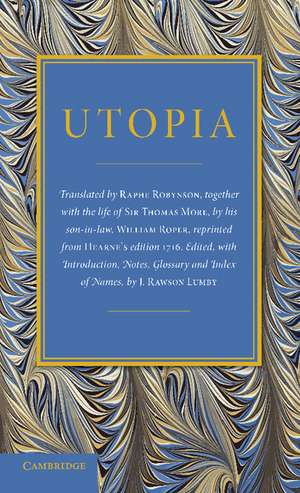
Utopia
Autor Thomas More Traducere de Raphe Robynson Editat de J. Rawson Lumbyen Limba Engleză Paperback – 30 oct 2013
Preț: 378.73 lei
Puncte Express: 568
Carte tipărită la comandă
Livrare economică 06-20 iulie
Specificații
ISBN-13: 9781107645158
ISBN-10: 1107645158
Pagini: 330
Dimensiuni: 205 x 203 x 21 mm
Greutate: 0.36 kg
Editura: Cambridge University Press
Colecția Cambridge University Press
Locul publicării:New York, United States
ISBN-10: 1107645158
Pagini: 330
Dimensiuni: 205 x 203 x 21 mm
Greutate: 0.36 kg
Editura: Cambridge University Press
Colecția Cambridge University Press
Locul publicării:New York, United States
V-ar putea interesa
-
 Rosalind FranklinBrenda MaddoxPreț: 106.16 lei
 -
 The Diversity of LifeEdward O. Wilson-20%Preț: 74.24 lei92.61 lei
 -
 Think: A Compelling Introduction to PhilosophySimon Blackburn-20%Preț: 70.98 lei88.78 lei
 -
 Teach Your Child How To ThinkEdward de Bono-20%Preț: 62.20 lei78.00 lei
 -
 Lateral ThinkingEdward de Bono-21%Preț: 61.58 lei77.61 lei
 -
 Fermat's EnigmaSimon SinghPreț: 97.26 lei
 -
 Naked StatisticsCharles WheelanPreț: 96.15 lei
 -
 A Doll's HouseHenrik Ibsen-20%Preț: 19.66 lei24.70 lei
 -
 The Scarlet LetterNathaniel HawthornePreț: 33.82 lei
 -
 Working with Emotional IntelligenceDaniel Goleman-27%Preț: 65.80 lei89.87 lei
 -
 Dangerous GamesMargaret MacmillanPreț: 104.95 lei
 -
 A Brief History of TimeStephen Hawking-20%Preț: 62.04 lei77.90 lei
 -
 A Shattered PeaceDavid A AndelmanPreț: 118.99 lei
 -
 50 Ethics Ideas You Really Need to KnowBen Dupre-24%Preț: 70.23 lei92.52 lei
 -
 Homo Deus: A Brief History of TomorrowYuval Noah Harari-18%Preț: 77.46 lei94.55 lei
 -
 Plato and a Platypus Walk Into a BarDaniel KleinPreț: 77.22 lei
 -
 The Music of the PrimesMarcus Du SautoyPreț: 78.28 lei
 -
 Nature via NurtureMatt RidleyPreț: 92.32 lei
 -
 Seventeen Equations that Changed the WorldProfessor Ian Stewart-20%Preț: 68.74 lei85.63 lei
Cuprins
Introduction; The life of Sir Thomas More; Utopia; Notes; Index of names; Glossary.
Descriere
Originally published in 1879, and reprinted numerous times, this book presents the complete English text of Thomas More's Utopia.
Textul de pe ultima copertă
First published in Latin in 1516, Utopia was the work of Sir Thomas More (1477 1535), the brilliant humanist, scholar, and churchman executed by Henry VIII for his refusal to accept the king as the supreme head of the Church of England.
In this work, which gave its name to the whole genre of books and movements hypothesizing an ideal society, More envisioned a patriarchal island kingdom that practiced religious tolerance, in which everybody worked, no one has more than his fellows, all goods were community-owned, and violence, bloodshed, and vice nonexistent. Based to some extent on the writings of Plato and other earlier authors, Utopia nevertheless contained much that was original with More.
In this inexpensive edition, readers can study for themselves the essentials of More's utopian vision and how, although the ideal society he envisioned is still unrealized, at least some of his proposals have come to pass in today's world.
"
In this work, which gave its name to the whole genre of books and movements hypothesizing an ideal society, More envisioned a patriarchal island kingdom that practiced religious tolerance, in which everybody worked, no one has more than his fellows, all goods were community-owned, and violence, bloodshed, and vice nonexistent. Based to some extent on the writings of Plato and other earlier authors, Utopia nevertheless contained much that was original with More.
In this inexpensive edition, readers can study for themselves the essentials of More's utopian vision and how, although the ideal society he envisioned is still unrealized, at least some of his proposals have come to pass in today's world.
"
Recenzii
In addition to its elegant and precise translation of Utopia, this edition offers the prefatory material and postscripts from the 1518 edition, and More's letter to Giles form the 1517 edition. Mr. Wootton has also added Erasmus's 'The Sileni of Alcibiades,' which is crucial for the interpretation he gives in his Introduction of the many ambiguities and contradictions in More's text as well as his life. The Introduction is a most valuable guide for understanding this man who was a proponent of toleration and a persecutor of heretics, a courtier full of worldly ambition ending as a fearless martyr. The contradictions of the man translated into a complicated and contradictory historiography to which Mr. Wootton's Introduction is a most intelligent guide. A welcome addition to the More literature. -J. W. Smit, Professor of History, Columbia University
Every serious reader of Utopia, friends and foes alike of Thomas More, will be enlightened by Wootton's essay. Combining it with his translations of More and Erasmus works well. This is a delightfully fine piece of scholarship, even down to the notes on the illustrations. --Donald J. Millus, Sixteenth Century Journal
Like his Introduction, which says much, both directly and indirectly, about the complexity of More's language and mentality, David Wootton's translation of the Utopia is a thoughtful and careful one. Wootton has been particularly scrupulous in his handling of marginal annotations. . . notes are economical but helpful. Students interested in 16th century humanism and/or developments in early modern Europe will find this edition especially appealing, as will everyone interested in interpretations of More's Utopia, here fruitfully juxtaposed with Erasmus’ philosophy and perspective on the world as these are represented by his adage on ‘The Sileni of Alcibiades.' --Elizabeth McCutcheon, Utopian Studies