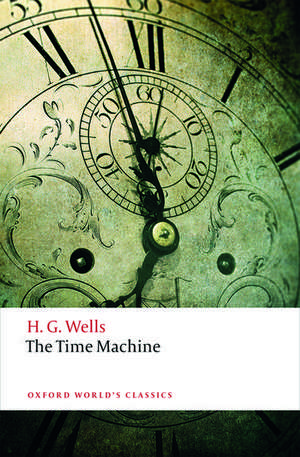
The Time Machine: Oxford World's Classics
Autor H. G. Wells Editat de Roger Luckhursten Limba Engleză Paperback – 12 ian 2017
Din seria Oxford World's Classics
-
 Preț: 65.48 lei
 -
 Preț: 54.65 lei
 -
 Preț: 58.99 lei
 -
 Preț: 37.13 lei
 - 17%
 Preț: 48.25 lei
 - 15%
 Preț: 50.79 lei
 -
 Preț: 59.42 lei
 - 18%
 Preț: 88.17 lei
 - 20%
 Preț: 51.19 lei
 - 11%
 Preț: 63.01 lei
 - 20%
 Preț: 50.48 lei
 -
 Preț: 80.28 lei
 -
 Preț: 58.52 lei
 - 17%
 Preț: 72.68 lei
 - 18%
 Preț: 52.92 lei
 - 18%
 Preț: 65.98 lei
 -
 Preț: 50.39 lei
 -
 Preț: 71.00 lei
 - 17%
 Preț: 61.15 lei
 - 15%
 Preț: 38.37 lei
 - 19%
 Preț: 35.22 lei
 -
 Preț: 52.53 lei
 - 18%
 Preț: 54.07 lei
 - 15%
 Preț: 107.37 lei
 - 17%
 Preț: 79.28 lei
 -
 Preț: 65.48 lei
 -
 Preț: 59.10 lei
 - 19%
 Preț: 58.10 lei
 - 9%
 Preț: 80.73 lei
 - 13%
 Preț: 53.65 lei
 -
 Preț: 54.11 lei
 - 19%
 Preț: 63.31 lei
 - 14%
 Preț: 45.28 lei
 - 14%
 Preț: 52.73 lei
 - 19%
 Preț: 68.92 lei
 -
 Preț: 66.81 lei
 - 20%
 Preț: 67.31 lei
 -
 Preț: 61.92 lei
 - 17%
 Preț: 49.22 lei
 - 12%
 Preț: 117.30 lei
 -
 Preț: 64.11 lei
 - 13%
 Preț: 60.55 lei
 -
 Preț: 80.95 lei
 - 12%
 Preț: 69.22 lei
 - 18%
 Preț: 64.98 lei
 -
 Preț: 52.48 lei
 -
 Preț: 72.97 lei
 - 18%
 Preț: 53.36 lei
 -
 Preț: 63.50 lei
 - 15%
 Preț: 63.51 lei
Preț: 51.39 lei
Preț vechi: 63.99 lei
-20%
Puncte Express: 77
Carte disponibilă
Livrare economică 06-11 noiembrie
Livrare express 21-27 octombrie pentru 28.30 lei
Livrare prin curier în România Termenul estimat este afișat lângă disponibilitate.
Transport gratuit de la 400.00 lei Plată online sau ramburs, în funcție de opțiunile comenzii.
Retur gratuit în 14 zile Comandă securizată și suport în română.
Specificații
ISBN-13: 9780198707516
ISBN-10: 0198707517
Pagini: 160
Dimensiuni: 137 x 195 x 10 mm
Greutate: 0.12 kg
Editura: OUP OXFORD
Colecția OUP Oxford
Seria Oxford World's Classics
Locul publicării:Oxford, United Kingdom
ISBN-10: 0198707517
Pagini: 160
Dimensiuni: 137 x 195 x 10 mm
Greutate: 0.12 kg
Editura: OUP OXFORD
Colecția OUP Oxford
Seria Oxford World's Classics
Locul publicării:Oxford, United Kingdom
V-ar putea interesa
-
 The Time ShipsStephen BaxterPreț: 66.27 lei
 -
 Dragon's GateLaurence YepPreț: 59.78 lei
 -
 The Count of Monte CristoAlexandre Dumas-17%Preț: 54.96 lei66.10 lei
 -
 The PrinceNiccolo Machiavelli-28%Preț: 86.67 lei121.16 lei
 -
 The Great Science FictionH. G. Wells-27%Preț: 80.67 lei110.30 lei
 -
 David CopperfieldCharles DickensPreț: 54.73 lei
 -
 The Time Machine/The Invisible ManH. G. WellsPreț: 45.90 lei
 -
 The First Men in the MoonH. G. WellsPreț: 53.36 lei
 -
 Odd JohnOlaf Stapledon-26%Preț: 57.98 lei78.87 lei
 -
 HG Wells Classic CollectionH. G. Wells-28%Preț: 142.19 lei198.26 lei
 -
 Time TravelJames GleickPreț: 98.92 lei
 -
 Preț: 81.04 lei
 -
 Level 3: The Cellist of SarajevoAnnette KeenPreț: 79.76 lei
 -
 Classic Starts®: The Time MachineH. G. Wells-28%Preț: 40.00 lei55.66 lei
 -
 The Wind's Twelve Quarters and The Compass RoseUrsula K. Le Guin-25%Preț: 82.06 lei109.36 lei
 -
 The Time MachineHerbert George WellsPreț: 40.29 lei
 -
 H. G. WellsH. G. Wells-14%Preț: 129.54 lei151.33 lei
 -
 My Time Machine: A Graphic NovelCarol Lay-22%Preț: 151.44 lei195.13 lei
 -
 The Time Machine (Legend Classics)H. G. Wells-13%Preț: 54.22 lei62.67 lei
 -
 Preț: 50.57 lei
 -
 Sci-Fi Classics: The Time Machine (Easy Classics)Nick MoffattPreț: 49.30 lei
 -
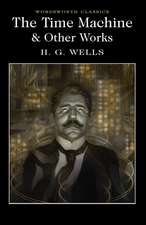 The Time Machine and Other WorksH. G. WellsPreț: 36.72 lei
 -
 The Picture of Dorian GrayOscar WildePreț: 30.66 lei
 -
 David CopperfieldCharles DickensPreț: 57.30 lei
 -
 The Project SaboteurJeroen GietemaPreț: 127.02 lei
 -
 Preț: 48.83 lei
Recenzii
Very smart-looking new editions of SF classics.
Notă biografică
Roger Luckhurst has written widely on Victorian popular fiction, science fiction and Gothic literature. He has edited Stevenson's Strange Case of Dr Jekyll and Mr Hyde, Stoker's Dracula, and an anthology of Late Victorian Gothic Tales for Oxford World's Classics, and an edition of H. P. Lovecraft's Classic Horror Stories. His books include The Mummy's Curse: The True History of a Dark Fantasy (Oxford, 2012).
Textul de pe ultima copertă
In The Time Machine Wells pioneers the concept of travel in the 'Fourth Dimension' and speculates about the ultimate decay of the human species. The world of the effete Eloi and ape-like Morlocks, the age of giant crabs, and the final portrayal of the heat-death of the sun constitute an unforgettable vision of the future. The Time Traveller's narrow escape from the remote descendants of humanity is paralleled by Edward Prendick's horrifying adventures among the Beast Folk of The Island of Doctor Moreau. Moreau, a ruthless vivisector, chooses an uninhabited Pacific island for his attempts to change animals into human beings on the operating table. Prendick soon fears that he, too, may become a victim of Moreau's experiments. Even at their most bleakly pessimistic and ironic, these stories testify to the resources of human courage and ingenuity. This edition offers authoritative texts of both novels, explanatory notes, and an introduction setting them in the context of Wells's life and thought.
Cuprins
Acknowledgements
Introduction
H. G. Wells: A Brief Chronology
A Note on the Text
The Time Machine: An Invention
Appendix A. The Evolutionary Context: Biology
Appendix G. Wells on The Time Machine
Works Cited
Introduction
H. G. Wells: A Brief Chronology
A Note on the Text
The Time Machine: An Invention
Appendix A. The Evolutionary Context: Biology
- Charles Darwin, from The Origin of Species (1859, 1872)
- E. Ray Lankester, from Degeneration (1880)
- Thomas H. Huxley, from “The Struggle for Existence in Human Society” (1888)
- H. G. Wells, from “Zoological Retrogression” (1891)
- H. G. Wells, from Text-Book of Biology (1893)
- Thomas H. Huxley, from “Evolution and Ethics” (1893)
- H. G. Wells, “On Extinction” (1893)
- H. G. Wells, from “The Man of the Year Million” (1893)
- H. G. Wells, from “The Extinction of Man” (1894)
- Thomas Carlyle, from Past and Present (1843)
- Karl Marx, from various writings (1844-64)
- Frederick Engels, from The Condition of the Working-Class (1845)
- Benjamin Disraeli, from Sybil (1845)
- Herbert Spencer, from Social Statics (1851)
- Herbert Spencer, from First Principles (1862)
- Jules Verne, from The Child of the Cavern (1877)
- Henry George, from Progress and Poverty (1880)
- Edward Bellamy, from Looking Backward (1888)
- Thomas H. Huxley, from “The Struggle for Existence in Human Society” (1888)
- William Morris, from News from Nowhere (1890)
- Benjamin Kidd, from Social Evolution (1894)
- Winwood Reade, from The Martyrdom of Man (1872, 1875)
- Friedrich Nietzsche, from The Joyful Wisdom (1882, 1886)
- H. G. Wells, from “The Rediscovery of the Unique” (1891)
- Max Nordau, from Degeneration (1892, 1895)
- Edwin A. Abbott, from Flatland (1884)
- C. H. Hinton, from “What Is the Fourth Dimension?” (1884)
- “S,” “Four-Dimensional Space” (1885)
- E. A. Hamilton Gordon, from “The Fourth Dimension” (1887)
- Oscar Wilde, from “The Canterville Ghost” (1887)
- William James, from The Principles of Psychology (1890)
- Simon Newcomb, from “Modern Mathematical Thought” (1894)
- Jonathan Swift, from Gulliver’s Travels (1726)
- William Thomson, from “On the Age of the Sun’s Heat” (1862)
- Balfour Stewart, from The Conservation of Energy (1874)
- Balfour Stewart & Peter Guthrie Tait, from The Unseen Universe (1875)
- George Howard Darwin, from “The Determination of the Secular Effects of Tidal Friction by a Graphical Method” (1879)
- George Howard Darwin, from “On the Precession of a Viscous Spheroid” (1879)
- H. G. Wells, from “The ‘Cyclic’ Delusion” (1894)
- Camille Flammarion, from Omega (1894)
Appendix G. Wells on The Time Machine
- H. G. Wells, from “Popularising Science” (1894)
- H. G. Wells, from “Preface,” Works of H. G. Wells, Vol. 1 (1924)
- H. G. Wells, from “Preface,” The Time Machine: An Invention (1931)
- H. G. Wells, from “Preface,” Seven Famous Novels (1934)
- H. G. Wells, from Experiment in Autobiography (1934)
- H. G. Wells, from “Fiction About the Future” (1938)
- From Review of Reviews [London] (March 1895)
- From Review of Reviews [New York] (June 1895)
- New York Times (23 June 1895)
- Spectator (13 July 1895)
- Literary World (13 July 1895)
- Nature (18 July 1895)
- From Saturday Review (20 July 1895)
- Daily Chronicle (27 July 1895)
- Israel Zangwill, from Pall Mall Magazine (September 1895)
- From Review of Reviews [New York] (October 1895)
- From Bookman (August 1895)
- “Picaroon,” from Chap-Book [Chicago] (1896)
Works Cited