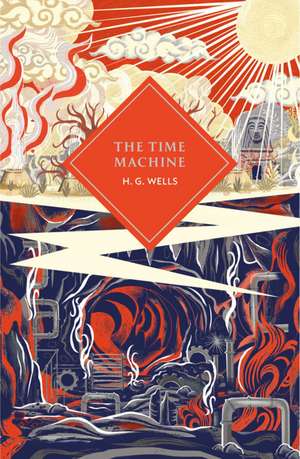
The Time Machine: Vintage Classics
Autor H. G. Wellsen Limba Engleză Hardback – 3 sep 2026
In the Time Traveller's miraculous new machine, we will be carried from a Victorian dinner table to 802,701 AD, when the Earth is divided between the gentle, ineffective Eloi, and the ape-like Morlocks; forward again by a million years or so to glimpse a dying world of blood-red beaches and menacing shapes; and on again to the last days of our planet, a remote twilight where nothing moves but darkness and a cold wind. Is this brilliantly imagined fiction or a prophetic vision of the future of the planet?
This hardback is part of VINTAGE COLLECTOR'S CLASSICS, a series of luxurious books especially crafted for collectors and fans of beautiful special editions. Sumptuous design meets the highest quality production. Discover timeless classics beautifully bound for every bookshelf.
Din seria Vintage Classics
-
 Preț: 65.81 lei
 - 29%
 Preț: 40.34 lei
 - 19%
 Preț: 57.92 lei
 - 22%
 Preț: 63.86 lei
 - 20%
 Preț: 56.59 lei
 - 23%
 Preț: 62.75 lei
 - 18%
 Preț: 60.00 lei
 - 19%
 Preț: 58.52 lei
 - 17%
 Preț: 79.75 lei
 - 19%
 Preț: 57.90 lei
 - 17%
 Preț: 79.78 lei
 - 19%
 Preț: 58.30 lei
 - 20%
 Preț: 57.02 lei
 - 27%
 Preț: 70.64 lei
 - 19%
 Preț: 58.30 lei
 - 20%
 Preț: 57.33 lei
 - 18%
 Preț: 65.13 lei
 - 20%
 Preț: 57.23 lei
 - 20%
 Preț: 63.11 lei
 - 20%
 Preț: 62.50 lei
 - 37%
 Preț: 58.91 lei
 - 25%
 Preț: 60.13 lei
 - 30%
 Preț: 66.40 lei
 - 25%
 Preț: 59.13 lei
 - 20%
 Preț: 57.20 lei
 - 18%
 Preț: 89.32 lei
 - 26%
 Preț: 82.91 lei
 - 19%
 Preț: 57.62 lei
 - 19%
 Preț: 58.06 lei
 - 36%
 Preț: 44.76 lei
 - 19%
 Preț: 58.40 lei
 - 16%
 Preț: 68.20 lei
 - 20%
 Preț: 56.60 lei
 - 18%
 Preț: 59.23 lei
 - 28%
 Preț: 50.64 lei
 - 18%
 Preț: 59.70 lei
 - 19%
 Preț: 57.78 lei
 - 37%
 Preț: 58.33 lei
 - 20%
 Preț: 56.60 lei
 - 18%
 Preț: 59.58 lei
 - 20%
 Preț: 57.33 lei
 - 18%
 Preț: 59.55 lei
 - 15%
 Preț: 82.31 lei
 - 19%
 Preț: 57.93 lei
 - 26%
 Preț: 82.89 lei
 - 17%
 Preț: 60.92 lei
 - 13%
 Preț: 73.95 lei
 - 28%
 Preț: 68.56 lei
 - 20%
 Preț: 56.69 lei
 - 19%
 Preț: 57.72 lei
Preț: 135.03 lei
Nou
Puncte Express: 203
Carte disponibilă
Livrare economică 07-21 noiembrie
Livrare express 24-30 octombrie pentru 22.35 lei
Livrare prin curier în România Termenul estimat este afișat lângă disponibilitate.
Transport gratuit de la 400.00 lei Plată online sau ramburs, în funcție de opțiunile comenzii.
Retur gratuit în 14 zile Comandă securizată și suport în română.
Specificații
ISBN-13: 9781529981988
ISBN-10: 1529981980
Pagini: 176
Dimensiuni: 131 x 200 x 18 mm
Greutate: 0.26 kg
Editura: Random House
Seriile Vintage Classics, Vintage Collector's Classics
ISBN-10: 1529981980
Pagini: 176
Dimensiuni: 131 x 200 x 18 mm
Greutate: 0.26 kg
Editura: Random House
Seriile Vintage Classics, Vintage Collector's Classics
V-ar putea interesa
-
 Wuthering HeightsEmily BrontëPreț: 28.01 lei
 -
 The Secret GardenFrances Hodgson BurnettPreț: 28.01 lei
 -
 The Prince and the PauperMark TwainPreț: 28.01 lei
 -
 CLASSICS PARADISE LOST AND PAJohn MiltonPreț: 28.01 lei
 -
 The Rime of the Ancient Mariner and Other PoemsSamuel Taylor ColeridgePreț: 28.47 lei
 -
 Robots and EmpireIsaac AsimovPreț: 73.45 lei
 -
 Neil Gaiman & Chris Riddell Box SetNeil GaimanPreț: 202.70 lei
 -
 Brave New WorldAldous HuxleyPreț: 63.49 lei
 -
 The Neverending StoryMichael EndePreț: 100.97 lei
 -
 Nineteen Eighty-Four (1984): 1984George Orwell-26%Preț: 52.87 lei71.82 lei
 -
 The London Eye MysterySiobhan Dowd-26%Preț: 48.50 lei65.47 lei
 -
 James and the Giant Peach: A PlayRoald DahlPreț: 38.25 lei
 -
 The Dark Eidolon and Other FantasiesClark Ashton SmithPreț: 100.77 lei
 -
 Cat's CradleKurt Vonnegut-27%Preț: 51.56 lei71.03 lei
 -
 Seven Dada Manifestos and LampisteriesTristan TzaraPreț: 63.50 lei
 -
 His Dark Materials Wormell SlipcasePhilip PullmanPreț: 214.25 lei
 -
 Count ZeroWilliam Gibson-25%Preț: 59.84 lei79.99 lei
 -
 Mona Lisa OverdriveWilliam Gibson-25%Preț: 59.75 lei79.92 lei
 -
 Burning ChromeWilliam Gibson-26%Preț: 58.09 lei78.92 lei
 -
 -16%Preț: 142.50 lei170.16 lei
 -
 Ham On RyeCharles BukowskiPreț: 72.62 lei
 -
 MoonfleetJ. Meade FalknerPreț: 37.23 lei
Notă biografică
H.G. Wells was born in Bromley, Kent, in 1866. After an education repeatedly interrupted by his family's financial problems, he eventually found work as a teacher at a succession of schools, where he began to write his first stories.
Wells became a prolific writer with a diverse output, of which the famous works are his science fiction novels. These are some of the earliest and most influential examples of the genre, and include classics such as The Time Machine and The War of the Worlds. Most of his books very well-received, and had a huge influence on many younger writers, including George Orwell and Isaac Asimov. Wells also wrote many popular non-fiction books, and used his writing to support the wide range of political and social causes in which he had an interest, although these became increasingly eccentric towards the end of his life.
Twice-married, Wells had many affairs, including a ten-year liaison with Rebecca West that produced a son. He died in London in 1946.
Wells became a prolific writer with a diverse output, of which the famous works are his science fiction novels. These are some of the earliest and most influential examples of the genre, and include classics such as The Time Machine and The War of the Worlds. Most of his books very well-received, and had a huge influence on many younger writers, including George Orwell and Isaac Asimov. Wells also wrote many popular non-fiction books, and used his writing to support the wide range of political and social causes in which he had an interest, although these became increasingly eccentric towards the end of his life.
Twice-married, Wells had many affairs, including a ten-year liaison with Rebecca West that produced a son. He died in London in 1946.
Descriere
Descriere de la o altă ediție sau format:
'So, in the end, above ground you must have the Haves, pursuing pleasure and comfort and beauty, and below ground the Have-nots, the Workers...'At a Victorian dinner party, in Richmond, London, the Time Traveller returns to tell his extraordinary tale of mankind's future in the year 802,701 AD. It is a dystopian vision of Darwinian evolution, with humans split into an above-ground species of Eloi, and their troglodyte brothers. The first book H. G. Wells published, The Time Machine is a scientific romance that helped invent the genre of science fiction and the time travel story. Even before its serialisation had finished in the spring of 1895, Wells had been declared 'a man of genius', and the book heralded a fifty year career of a major cultural and political controversialist. It is a sardonic rejection of Victorian ideals of progress and improvement and a detailed satirical commentary on the Decadent culture of the 1890s.This edition features a contextual introduction, detailed explanatory notes, and two essays Wells wrote just prior to the publication of his first book.
'So, in the end, above ground you must have the Haves, pursuing pleasure and comfort and beauty, and below ground the Have-nots, the Workers...'At a Victorian dinner party, in Richmond, London, the Time Traveller returns to tell his extraordinary tale of mankind's future in the year 802,701 AD. It is a dystopian vision of Darwinian evolution, with humans split into an above-ground species of Eloi, and their troglodyte brothers. The first book H. G. Wells published, The Time Machine is a scientific romance that helped invent the genre of science fiction and the time travel story. Even before its serialisation had finished in the spring of 1895, Wells had been declared 'a man of genius', and the book heralded a fifty year career of a major cultural and political controversialist. It is a sardonic rejection of Victorian ideals of progress and improvement and a detailed satirical commentary on the Decadent culture of the 1890s.This edition features a contextual introduction, detailed explanatory notes, and two essays Wells wrote just prior to the publication of his first book.
Recenzii
Wells was interested in the implications of evolutionary theory on the future of human beings at the biological, sociological, and cultural levels, and The Time Machine, short and readable, draws on many of the social and scientific debates of the time. The Broadview edition of this science fiction classic includes extensive materials on Wells’s scientific and political influences.
“This is undoubtedly the definitive edition of H.G. Wells’s masterpiece, as fresh today in its imaginative power as the day it was written; but here refreshed by excellent introduction, notes and a comprehensive collection of appendices by Wells’s contemporaries. The method could not be bettered.” — Brian W. Aldiss, author of the Helliconia trilogy; Billion Year Spree: A History of Science Fiction and, most recently, White Mars: or, the Mind Set Free: A 21st-Century Utopia
“This is an invaluable edition of a text with a crucial role in modern culture. Wielding his meticulous scholarship and wide-ranging knowledge, Ruddick produces a splendid introduction and a rich selection of contextual materials.” — H. Bruce Franklin, author of War Stars: The Superweapon and the American Imagination and Future Perfect: American Science Fiction of the Nineteenth Century
“Ruddick offers a wide-ranging and stimulating Introduction to this generously documented edition of one of the great source texts of modern science fiction. General readers, students, and scholars will all be grateful for the comprehensive appendices, which provide a full selection of the scientific, philosophical, and cultural contexts out of which The Time Machine first emerged. This should be the scholarly edition for some time to come.” — Douglas Barbour, University of Alberta
“The structure of Ruddick’s book makes the complexity of The Time Machine easy to map, while the critical materials provide a basis for deep and detailed study. The impressive scholarship included ensures that it will remain a useful resource for teachers, essential for libraries and especially suitable for students or newcomers to Wells’ canon.” — Journal of the Fantastic in the Arts
“I exclusively use your edition of The Time Machine and cannot say enough about its perspective. Mathematics and science in literature is a specialty of mine, and there is no finer edition of that text. It is a keystone in my Mathematics and Science in the Humanities course. You folks at Broadview are outstanding!” — Michael J. Gormley, Quinsigamond Community College
“This is undoubtedly the definitive edition of H.G. Wells’s masterpiece, as fresh today in its imaginative power as the day it was written; but here refreshed by excellent introduction, notes and a comprehensive collection of appendices by Wells’s contemporaries. The method could not be bettered.” — Brian W. Aldiss, author of the Helliconia trilogy; Billion Year Spree: A History of Science Fiction and, most recently, White Mars: or, the Mind Set Free: A 21st-Century Utopia
“This is an invaluable edition of a text with a crucial role in modern culture. Wielding his meticulous scholarship and wide-ranging knowledge, Ruddick produces a splendid introduction and a rich selection of contextual materials.” — H. Bruce Franklin, author of War Stars: The Superweapon and the American Imagination and Future Perfect: American Science Fiction of the Nineteenth Century
“Ruddick offers a wide-ranging and stimulating Introduction to this generously documented edition of one of the great source texts of modern science fiction. General readers, students, and scholars will all be grateful for the comprehensive appendices, which provide a full selection of the scientific, philosophical, and cultural contexts out of which The Time Machine first emerged. This should be the scholarly edition for some time to come.” — Douglas Barbour, University of Alberta
“The structure of Ruddick’s book makes the complexity of The Time Machine easy to map, while the critical materials provide a basis for deep and detailed study. The impressive scholarship included ensures that it will remain a useful resource for teachers, essential for libraries and especially suitable for students or newcomers to Wells’ canon.” — Journal of the Fantastic in the Arts
“I exclusively use your edition of The Time Machine and cannot say enough about its perspective. Mathematics and science in literature is a specialty of mine, and there is no finer edition of that text. It is a keystone in my Mathematics and Science in the Humanities course. You folks at Broadview are outstanding!” — Michael J. Gormley, Quinsigamond Community College
Textul de pe ultima copertă
In The Time Machine Wells pioneers the concept of travel in the 'Fourth Dimension' and speculates about the ultimate decay of the human species. The world of the effete Eloi and ape-like Morlocks, the age of giant crabs, and the final portrayal of the heat-death of the sun constitute an unforgettable vision of the future. The Time Traveller's narrow escape from the remote descendants of humanity is paralleled by Edward Prendick's horrifying adventures among the Beast Folk of The Island of Doctor Moreau. Moreau, a ruthless vivisector, chooses an uninhabited Pacific island for his attempts to change animals into human beings on the operating table. Prendick soon fears that he, too, may become a victim of Moreau's experiments. Even at their most bleakly pessimistic and ironic, these stories testify to the resources of human courage and ingenuity. This edition offers authoritative texts of both novels, explanatory notes, and an introduction setting them in the context of Wells's life and thought.
Cuprins
Acknowledgements
Introduction
H. G. Wells: A Brief Chronology
A Note on the Text
The Time Machine: An Invention
Appendix A. The Evolutionary Context: Biology
Appendix G. Wells on The Time Machine
Works Cited
Introduction
H. G. Wells: A Brief Chronology
A Note on the Text
The Time Machine: An Invention
Appendix A. The Evolutionary Context: Biology
- Charles Darwin, from The Origin of Species (1859, 1872)
- E. Ray Lankester, from Degeneration (1880)
- Thomas H. Huxley, from “The Struggle for Existence in Human Society” (1888)
- H. G. Wells, from “Zoological Retrogression” (1891)
- H. G. Wells, from Text-Book of Biology (1893)
- Thomas H. Huxley, from “Evolution and Ethics” (1893)
- H. G. Wells, “On Extinction” (1893)
- H. G. Wells, from “The Man of the Year Million” (1893)
- H. G. Wells, from “The Extinction of Man” (1894)
- Thomas Carlyle, from Past and Present (1843)
- Karl Marx, from various writings (1844-64)
- Frederick Engels, from The Condition of the Working-Class (1845)
- Benjamin Disraeli, from Sybil (1845)
- Herbert Spencer, from Social Statics (1851)
- Herbert Spencer, from First Principles (1862)
- Jules Verne, from The Child of the Cavern (1877)
- Henry George, from Progress and Poverty (1880)
- Edward Bellamy, from Looking Backward (1888)
- Thomas H. Huxley, from “The Struggle for Existence in Human Society” (1888)
- William Morris, from News from Nowhere (1890)
- Benjamin Kidd, from Social Evolution (1894)
- Winwood Reade, from The Martyrdom of Man (1872, 1875)
- Friedrich Nietzsche, from The Joyful Wisdom (1882, 1886)
- H. G. Wells, from “The Rediscovery of the Unique” (1891)
- Max Nordau, from Degeneration (1892, 1895)
- Edwin A. Abbott, from Flatland (1884)
- C. H. Hinton, from “What Is the Fourth Dimension?” (1884)
- “S,” “Four-Dimensional Space” (1885)
- E. A. Hamilton Gordon, from “The Fourth Dimension” (1887)
- Oscar Wilde, from “The Canterville Ghost” (1887)
- William James, from The Principles of Psychology (1890)
- Simon Newcomb, from “Modern Mathematical Thought” (1894)
- Jonathan Swift, from Gulliver’s Travels (1726)
- William Thomson, from “On the Age of the Sun’s Heat” (1862)
- Balfour Stewart, from The Conservation of Energy (1874)
- Balfour Stewart & Peter Guthrie Tait, from The Unseen Universe (1875)
- George Howard Darwin, from “The Determination of the Secular Effects of Tidal Friction by a Graphical Method” (1879)
- George Howard Darwin, from “On the Precession of a Viscous Spheroid” (1879)
- H. G. Wells, from “The ‘Cyclic’ Delusion” (1894)
- Camille Flammarion, from Omega (1894)
Appendix G. Wells on The Time Machine
- H. G. Wells, from “Popularising Science” (1894)
- H. G. Wells, from “Preface,” Works of H. G. Wells, Vol. 1 (1924)
- H. G. Wells, from “Preface,” The Time Machine: An Invention (1931)
- H. G. Wells, from “Preface,” Seven Famous Novels (1934)
- H. G. Wells, from Experiment in Autobiography (1934)
- H. G. Wells, from “Fiction About the Future” (1938)
- From Review of Reviews [London] (March 1895)
- From Review of Reviews [New York] (June 1895)
- New York Times (23 June 1895)
- Spectator (13 July 1895)
- Literary World (13 July 1895)
- Nature (18 July 1895)
- From Saturday Review (20 July 1895)
- Daily Chronicle (27 July 1895)
- Israel Zangwill, from Pall Mall Magazine (September 1895)
- From Review of Reviews [New York] (October 1895)
- From Bookman (August 1895)
- “Picaroon,” from Chap-Book [Chicago] (1896)
Works Cited