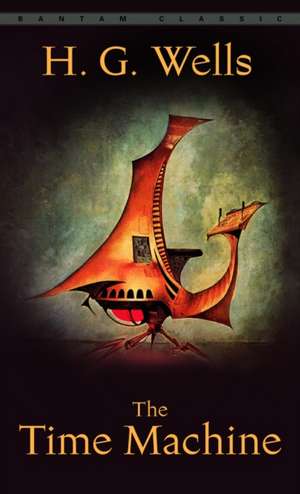
The Time Machine
Autor H. G. Wellsen Limba Engleză Paperback – 1984
Preț: 37.41 lei
Puncte Express: 56
Carte disponibilă
Livrare economică 05-19 noiembrie
Livrare prin curier în România Termenul estimat este afișat lângă disponibilitate.
Transport gratuit de la 400.00 lei Plată online sau ramburs, în funcție de opțiunile comenzii.
Retur gratuit în 14 zile Comandă securizată și suport în română.
Specificații
ISBN-13: 9780553213515
ISBN-10: 0553213512
Pagini: 128
Dimensiuni: 106 x 175 x 12 mm
Greutate: 0.07 kg
Editura: Random House
ISBN-10: 0553213512
Pagini: 128
Dimensiuni: 106 x 175 x 12 mm
Greutate: 0.07 kg
Editura: Random House
V-ar putea interesa
-
 Wuthering HeightsEmily BrontëPreț: 28.01 lei
 -
 The Secret GardenFrances Hodgson BurnettPreț: 28.01 lei
 -
 The Prince and the PauperMark TwainPreț: 28.01 lei
 -
 CLASSICS PARADISE LOST AND PAJohn MiltonPreț: 28.01 lei
 -
 The Rime of the Ancient Mariner and Other PoemsSamuel Taylor ColeridgePreț: 28.47 lei
 -
 Robots and EmpireIsaac AsimovPreț: 73.45 lei
 -
 Neil Gaiman & Chris Riddell Box SetNeil GaimanPreț: 202.70 lei
 -
 Brave New WorldAldous HuxleyPreț: 63.49 lei
 -
 The Neverending StoryMichael EndePreț: 100.97 lei
 -
 Nineteen Eighty-Four (1984): 1984George Orwell-26%Preț: 52.87 lei71.82 lei
 -
 The London Eye MysterySiobhan Dowd-26%Preț: 48.46 lei65.47 lei
 -
 James and the Giant Peach: A PlayRoald DahlPreț: 38.25 lei
 -
 The Dark Eidolon and Other FantasiesClark Ashton SmithPreț: 100.77 lei
 -
 Cat's CradleKurt Vonnegut-27%Preț: 51.56 lei71.03 lei
 -
 Seven Dada Manifestos and LampisteriesTristan TzaraPreț: 63.50 lei
 -
 His Dark Materials Wormell SlipcasePhilip PullmanPreț: 214.25 lei
 -
 Count ZeroWilliam Gibson-25%Preț: 59.84 lei79.99 lei
 -
 Mona Lisa OverdriveWilliam Gibson-25%Preț: 59.86 lei80.00 lei
 -
 Burning ChromeWilliam Gibson-26%Preț: 58.06 lei78.92 lei
 -
 -16%Preț: 142.41 lei170.16 lei
 -
 Ham On RyeCharles BukowskiPreț: 72.62 lei
 -
 MoonfleetJ. Meade FalknerPreț: 37.23 lei
Notă biografică
Ursula K. Le Guin has published more than one hundred short stories, two collections of essays, eleven books for children, five volumes of poetry, and seventeen novels. She has received numerous awards, including a National Book Award and a Pushcart Prize. She lives in Oregon.
From the Trade Paperback edition.
From the Trade Paperback edition.
Recenzii
“[Wells] contrives to give over humanity into the clutches of the Impossible and yet manages to keep it down (or up) to its humanity, to its flesh, blood, sorrow, folly.” —Joseph Conrad
Descriere
When the Time Traveler courageously stepped out of his machine for the first time, he found himself in the year 802,700--and everything had changed. H.G. Wells's famous novel of one man's astonishing journey beyond the conventional limits of the imagination is regarded as one of the great masterpieces in the literature of science fiction.
Textul de pe ultima copertă
In The Time Machine Wells pioneers the concept of travel in the 'Fourth Dimension' and speculates about the ultimate decay of the human species. The world of the effete Eloi and ape-like Morlocks, the age of giant crabs, and the final portrayal of the heat-death of the sun constitute an unforgettable vision of the future. The Time Traveller's narrow escape from the remote descendants of humanity is paralleled by Edward Prendick's horrifying adventures among the Beast Folk of The Island of Doctor Moreau. Moreau, a ruthless vivisector, chooses an uninhabited Pacific island for his attempts to change animals into human beings on the operating table. Prendick soon fears that he, too, may become a victim of Moreau's experiments. Even at their most bleakly pessimistic and ironic, these stories testify to the resources of human courage and ingenuity. This edition offers authoritative texts of both novels, explanatory notes, and an introduction setting them in the context of Wells's life and thought.
Cuprins
Acknowledgements
Introduction
H. G. Wells: A Brief Chronology
A Note on the Text
The Time Machine: An Invention
Appendix A. The Evolutionary Context: Biology
Appendix G. Wells on The Time Machine
Works Cited
Introduction
H. G. Wells: A Brief Chronology
A Note on the Text
The Time Machine: An Invention
Appendix A. The Evolutionary Context: Biology
- Charles Darwin, from The Origin of Species (1859, 1872)
- E. Ray Lankester, from Degeneration (1880)
- Thomas H. Huxley, from “The Struggle for Existence in Human Society” (1888)
- H. G. Wells, from “Zoological Retrogression” (1891)
- H. G. Wells, from Text-Book of Biology (1893)
- Thomas H. Huxley, from “Evolution and Ethics” (1893)
- H. G. Wells, “On Extinction” (1893)
- H. G. Wells, from “The Man of the Year Million” (1893)
- H. G. Wells, from “The Extinction of Man” (1894)
- Thomas Carlyle, from Past and Present (1843)
- Karl Marx, from various writings (1844-64)
- Frederick Engels, from The Condition of the Working-Class (1845)
- Benjamin Disraeli, from Sybil (1845)
- Herbert Spencer, from Social Statics (1851)
- Herbert Spencer, from First Principles (1862)
- Jules Verne, from The Child of the Cavern (1877)
- Henry George, from Progress and Poverty (1880)
- Edward Bellamy, from Looking Backward (1888)
- Thomas H. Huxley, from “The Struggle for Existence in Human Society” (1888)
- William Morris, from News from Nowhere (1890)
- Benjamin Kidd, from Social Evolution (1894)
- Winwood Reade, from The Martyrdom of Man (1872, 1875)
- Friedrich Nietzsche, from The Joyful Wisdom (1882, 1886)
- H. G. Wells, from “The Rediscovery of the Unique” (1891)
- Max Nordau, from Degeneration (1892, 1895)
- Edwin A. Abbott, from Flatland (1884)
- C. H. Hinton, from “What Is the Fourth Dimension?” (1884)
- “S,” “Four-Dimensional Space” (1885)
- E. A. Hamilton Gordon, from “The Fourth Dimension” (1887)
- Oscar Wilde, from “The Canterville Ghost” (1887)
- William James, from The Principles of Psychology (1890)
- Simon Newcomb, from “Modern Mathematical Thought” (1894)
- Jonathan Swift, from Gulliver’s Travels (1726)
- William Thomson, from “On the Age of the Sun’s Heat” (1862)
- Balfour Stewart, from The Conservation of Energy (1874)
- Balfour Stewart & Peter Guthrie Tait, from The Unseen Universe (1875)
- George Howard Darwin, from “The Determination of the Secular Effects of Tidal Friction by a Graphical Method” (1879)
- George Howard Darwin, from “On the Precession of a Viscous Spheroid” (1879)
- H. G. Wells, from “The ‘Cyclic’ Delusion” (1894)
- Camille Flammarion, from Omega (1894)
Appendix G. Wells on The Time Machine
- H. G. Wells, from “Popularising Science” (1894)
- H. G. Wells, from “Preface,” Works of H. G. Wells, Vol. 1 (1924)
- H. G. Wells, from “Preface,” The Time Machine: An Invention (1931)
- H. G. Wells, from “Preface,” Seven Famous Novels (1934)
- H. G. Wells, from Experiment in Autobiography (1934)
- H. G. Wells, from “Fiction About the Future” (1938)
- From Review of Reviews [London] (March 1895)
- From Review of Reviews [New York] (June 1895)
- New York Times (23 June 1895)
- Spectator (13 July 1895)
- Literary World (13 July 1895)
- Nature (18 July 1895)
- From Saturday Review (20 July 1895)
- Daily Chronicle (27 July 1895)
- Israel Zangwill, from Pall Mall Magazine (September 1895)
- From Review of Reviews [New York] (October 1895)
- From Bookman (August 1895)
- “Picaroon,” from Chap-Book [Chicago] (1896)
Works Cited