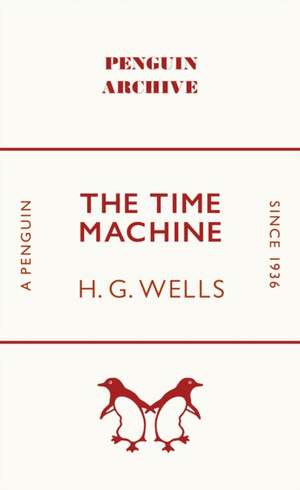
The Time Machine: Penguin Archive
Autor H. G. Wellsen Limba Engleză Paperback – 17 apr 2025
The Adventures of Sherlock Holmes by Arthur Conan Doyle https: //www.createspace.com/6498370
The Hound of the Baskervilles by Arthur Conan Doyle https: //www.createspace.com/6498594
The Sign of the Four by Arthur Conan Doyle https: //www.createspace.com/6499304
The Return of Sherlock Holmes by Arthur Conan Doyle https: //www.createspace.com/6500007
The Lost World by Arthur Conan Doyle https: //www.createspace.com/6499480
The Open Boat and Other Stories by Stephen Crane https: //www.createspace.com/6447605
A Sicilian Romance by Ann Radcliffe https: //www.createspace.com/6493459
The Aspern Papers by Henry James https: //www.createspace.com/6495613
Mrs. Warren's Profession by George Bernard Shaw https: //www.createspace.com/6497582 The Valley of Fear by Arthur Conan Doyle https: //www.createspace.com/6502771 The Adventures of Gerard by Arthur Conan Doyle https: //www.createspace.com/6502339 Through the Magic Door by Arthur Conan Doyle https: //www.createspace.com/6502006 The Adventure of the Devil's Foot by Arthur Conan Doyle https: //www.createspace.com/6501272
Din seria Penguin Archive
-
 Preț: 42.88 lei
 -
 Preț: 42.52 lei
 -
 Preț: 42.68 lei
 -
 Preț: 42.50 lei
 -
 Preț: 42.98 lei
 -
 Preț: 42.65 lei
 -
 Preț: 42.75 lei
 -
 Preț: 42.75 lei
 -
 Preț: 42.66 lei
 -
 Preț: 42.18 lei
 -
 Preț: 42.88 lei
 -
 Preț: 41.94 lei
 -
 Preț: 42.58 lei
 -
 Preț: 42.75 lei
 -
 Preț: 42.45 lei
 -
 Preț: 42.05 lei
 -
 Preț: 42.98 lei
 -
 Preț: 42.68 lei
 -
 Preț: 42.38 lei
 -
 Preț: 42.96 lei
 -
 Preț: 42.58 lei
 -
 Preț: 43.05 lei
 -
 Preț: 42.41 lei
 -
 Preț: 42.81 lei
 -
 Preț: 41.84 lei
 -
 Preț: 42.75 lei
 -
 Preț: 42.65 lei
 -
 Preț: 42.88 lei
 -
 Preț: 41.84 lei
 -
 Preț: 42.07 lei
 -
 Preț: 41.78 lei
 -
 Preț: 42.65 lei
 -
 Preț: 42.75 lei
 -
 Preț: 42.88 lei
 -
 Preț: 42.88 lei
 -
 Preț: 43.01 lei
 -
 Preț: 42.62 lei
 -
 Preț: 42.65 lei
 -
 Preț: 42.46 lei
 -
 Preț: 42.72 lei
 -
 Preț: 42.81 lei
 -
 Preț: 42.65 lei
 -
 Preț: 42.81 lei
 -
 Preț: 42.14 lei
 -
 Preț: 42.75 lei
 -
 Preț: 42.00 lei
 -
 Preț: 42.88 lei
 -
 Preț: 42.69 lei
 -
 Preț: 42.69 lei
Preț: 42.65 lei
Puncte Express: 64
Carte disponibilă
Livrare economică 04-18 noiembrie
Livrare express 21-27 octombrie pentru 13.76 lei
Livrare prin curier în România Termenul estimat este afișat lângă disponibilitate.
Transport gratuit de la 400.00 lei Plată online sau ramburs, în funcție de opțiunile comenzii.
Retur gratuit în 14 zile Comandă securizată și suport în română.
Specificații
ISBN-13: 9780241746721
ISBN-10: 0241746728
Pagini: 119
Dimensiuni: 111 x 178 x 10 mm
Greutate: 0.08 kg
Editura: Penguin Books
Colecția Penguin Classics
Seria Penguin Archive
ISBN-10: 0241746728
Pagini: 119
Dimensiuni: 111 x 178 x 10 mm
Greutate: 0.08 kg
Editura: Penguin Books
Colecția Penguin Classics
Seria Penguin Archive
V-ar putea interesa
-
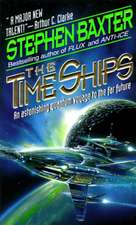 The Time ShipsStephen BaxterPreț: 66.27 lei
 -
 Dragon's GateLaurence YepPreț: 59.78 lei
 -
 The Count of Monte CristoAlexandre Dumas-17%Preț: 54.96 lei66.10 lei
 -
 The PrinceNiccolo Machiavelli-28%Preț: 86.67 lei121.16 lei
 -
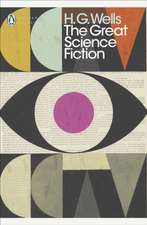 The Great Science FictionH. G. Wells-27%Preț: 80.67 lei110.30 lei
 -
 David CopperfieldCharles DickensPreț: 54.73 lei
 -
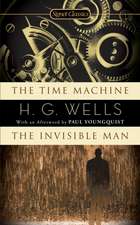 The Time Machine/The Invisible ManH. G. WellsPreț: 45.90 lei
 -
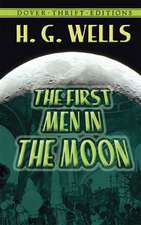 The First Men in the MoonH. G. WellsPreț: 53.36 lei
 -
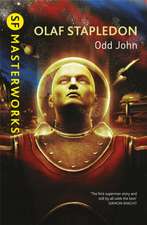 Odd JohnOlaf Stapledon-26%Preț: 57.98 lei78.87 lei
 -
 HG Wells Classic CollectionH. G. Wells-28%Preț: 142.19 lei198.26 lei
 -
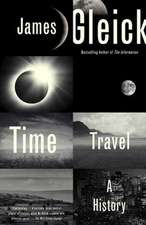 Time TravelJames GleickPreț: 98.92 lei
 -
 Preț: 81.04 lei
 -
 Level 3: The Cellist of SarajevoAnnette KeenPreț: 79.76 lei
 -
 Classic Starts®: The Time MachineH. G. Wells-28%Preț: 40.00 lei55.66 lei
 -
 The Wind's Twelve Quarters and The Compass RoseUrsula K. Le Guin-25%Preț: 82.06 lei109.36 lei
 -
 The Time MachineHerbert George WellsPreț: 40.29 lei
 -
 H. G. WellsH. G. Wells-13%Preț: 132.98 lei153.36 lei
 -
 My Time Machine: A Graphic NovelCarol Lay-22%Preț: 151.44 lei195.13 lei
 -
 The Time Machine (Legend Classics)H. G. Wells-13%Preț: 54.22 lei62.67 lei
 -
 Preț: 50.57 lei
 -
 Sci-Fi Classics: The Time Machine (Easy Classics)Nick MoffattPreț: 49.30 lei
 -
 The Time Machine and Other WorksH. G. WellsPreț: 36.72 lei
 -
 The Picture of Dorian GrayOscar WildePreț: 30.66 lei
 -
 David CopperfieldCharles DickensPreț: 57.30 lei
 -
 The Project SaboteurJeroen GietemaPreț: 127.02 lei
 -
 Preț: 48.83 lei
Notă biografică
Herbert George Wells (21 September 1866 - 13 August 1946) was an English writer. He was prolific in many genres, writing dozens of novels, short stories, and works of social commentary, satire, biography, and autobiography, and even including two books on recreational war games. He is now best remembered for his science fiction novels and is often called a "father of science fiction", along with Jules Verne and Hugo Gernsback.[5][6][a] During his own lifetime, however, he was most prominent as a forward-looking, even prophetic social critic who devoted his literary talents to the development of a progressive vision on a global scale. A futurist, he wrote a number of utopian works and foresaw the advent of aircraft, tanks, space travel, nuclear weapons, satellite television and something resembling the World Wide Web.[7] His science fiction imagined time travel, alien invasion, invisibility, and biological engineering. Brian Aldiss referred to Wells as the "Shakespeare of science fiction".[8] Wells rendered his works convincing by instilling commonplace detail alongside a single extraordinary assumption - dubbed "Wells's law" - leading Joseph Conrad to hail him in 1898 as "O Realist of the Fantastic!".[9] His most notable science fiction works include The Time Machine (1895), The Island of Doctor Moreau (1896), The Invisible Man (1897), The War of the Worlds (1898) and the military science fiction The War in the Air (1907). Wells was nominated for the Nobel Prize in Literature four times.[10] Wells's earliest specialised training was in biology, and his thinking on ethical matters took place in a specifically and fundamentally Darwinian context.[11] He was also from an early date an outspoken socialist, often (but not always, as at the beginning of the First World War) sympathising with pacifist views. His later works became increasingly political and didactic, and he wrote little science fiction, while he sometimes indicated on official documents that his profession was that of journalist.[12] Novels such as Kipps and The History of Mr Polly, which describe lower-middle-class life, led to the suggestion that he was a worthy successor to Charles Dickens,[13]but Wells described a range of social strata and even attempted, in Tono-Bungay (1909), a diagnosis of English society as a whole. A diabetic, Wells co-founded the charity The Diabetic Association (known today as Diabetes UK) in 1934 Herbert George Wells was born at Atlas House, 162 High Street in Bromley, Kent,[15] on 21 September 1866.[4] Called "Bertie" in the family, he was the fourth and last child of Joseph Wells (a former domestic gardener, and at the time a shopkeeper and professional cricketer) and his wife, Sarah Neal (a former domestic servant). An inheritance had allowed the family to acquire a shop in which they sold china and sporting goods, although it failed to prosper: the stock was old and worn out, and the location was poor. Joseph Wells managed to earn a meagre income, but little of it came from the shop and he received an unsteady amount of money from playing professional cricket for the Kent county team.[16] Payment for skilled bowlers and batsmen came from voluntary donations afterwards, or from small payments from the clubs where matches were played.
Recenzii
Wells was interested in the implications of evolutionary theory on the future of human beings at the biological, sociological, and cultural levels, and The Time Machine, short and readable, draws on many of the social and scientific debates of the time. The Broadview edition of this science fiction classic includes extensive materials on Wells’s scientific and political influences.
“This is undoubtedly the definitive edition of H.G. Wells’s masterpiece, as fresh today in its imaginative power as the day it was written; but here refreshed by excellent introduction, notes and a comprehensive collection of appendices by Wells’s contemporaries. The method could not be bettered.” — Brian W. Aldiss, author of the Helliconia trilogy; Billion Year Spree: A History of Science Fiction and, most recently, White Mars: or, the Mind Set Free: A 21st-Century Utopia
“This is an invaluable edition of a text with a crucial role in modern culture. Wielding his meticulous scholarship and wide-ranging knowledge, Ruddick produces a splendid introduction and a rich selection of contextual materials.” — H. Bruce Franklin, author of War Stars: The Superweapon and the American Imagination and Future Perfect: American Science Fiction of the Nineteenth Century
“Ruddick offers a wide-ranging and stimulating Introduction to this generously documented edition of one of the great source texts of modern science fiction. General readers, students, and scholars will all be grateful for the comprehensive appendices, which provide a full selection of the scientific, philosophical, and cultural contexts out of which The Time Machine first emerged. This should be the scholarly edition for some time to come.” — Douglas Barbour, University of Alberta
“The structure of Ruddick’s book makes the complexity of The Time Machine easy to map, while the critical materials provide a basis for deep and detailed study. The impressive scholarship included ensures that it will remain a useful resource for teachers, essential for libraries and especially suitable for students or newcomers to Wells’ canon.” — Journal of the Fantastic in the Arts
“I exclusively use your edition of The Time Machine and cannot say enough about its perspective. Mathematics and science in literature is a specialty of mine, and there is no finer edition of that text. It is a keystone in my Mathematics and Science in the Humanities course. You folks at Broadview are outstanding!” — Michael J. Gormley, Quinsigamond Community College
“This is undoubtedly the definitive edition of H.G. Wells’s masterpiece, as fresh today in its imaginative power as the day it was written; but here refreshed by excellent introduction, notes and a comprehensive collection of appendices by Wells’s contemporaries. The method could not be bettered.” — Brian W. Aldiss, author of the Helliconia trilogy; Billion Year Spree: A History of Science Fiction and, most recently, White Mars: or, the Mind Set Free: A 21st-Century Utopia
“This is an invaluable edition of a text with a crucial role in modern culture. Wielding his meticulous scholarship and wide-ranging knowledge, Ruddick produces a splendid introduction and a rich selection of contextual materials.” — H. Bruce Franklin, author of War Stars: The Superweapon and the American Imagination and Future Perfect: American Science Fiction of the Nineteenth Century
“Ruddick offers a wide-ranging and stimulating Introduction to this generously documented edition of one of the great source texts of modern science fiction. General readers, students, and scholars will all be grateful for the comprehensive appendices, which provide a full selection of the scientific, philosophical, and cultural contexts out of which The Time Machine first emerged. This should be the scholarly edition for some time to come.” — Douglas Barbour, University of Alberta
“The structure of Ruddick’s book makes the complexity of The Time Machine easy to map, while the critical materials provide a basis for deep and detailed study. The impressive scholarship included ensures that it will remain a useful resource for teachers, essential for libraries and especially suitable for students or newcomers to Wells’ canon.” — Journal of the Fantastic in the Arts
“I exclusively use your edition of The Time Machine and cannot say enough about its perspective. Mathematics and science in literature is a specialty of mine, and there is no finer edition of that text. It is a keystone in my Mathematics and Science in the Humanities course. You folks at Broadview are outstanding!” — Michael J. Gormley, Quinsigamond Community College
Descriere
Descriere de la o altă ediție sau format:
'So, in the end, above ground you must have the Haves, pursuing pleasure and comfort and beauty, and below ground the Have-nots, the Workers...'At a Victorian dinner party, in Richmond, London, the Time Traveller returns to tell his extraordinary tale of mankind's future in the year 802,701 AD. It is a dystopian vision of Darwinian evolution, with humans split into an above-ground species of Eloi, and their troglodyte brothers. The first book H. G. Wells published, The Time Machine is a scientific romance that helped invent the genre of science fiction and the time travel story. Even before its serialisation had finished in the spring of 1895, Wells had been declared 'a man of genius', and the book heralded a fifty year career of a major cultural and political controversialist. It is a sardonic rejection of Victorian ideals of progress and improvement and a detailed satirical commentary on the Decadent culture of the 1890s.This edition features a contextual introduction, detailed explanatory notes, and two essays Wells wrote just prior to the publication of his first book.
'So, in the end, above ground you must have the Haves, pursuing pleasure and comfort and beauty, and below ground the Have-nots, the Workers...'At a Victorian dinner party, in Richmond, London, the Time Traveller returns to tell his extraordinary tale of mankind's future in the year 802,701 AD. It is a dystopian vision of Darwinian evolution, with humans split into an above-ground species of Eloi, and their troglodyte brothers. The first book H. G. Wells published, The Time Machine is a scientific romance that helped invent the genre of science fiction and the time travel story. Even before its serialisation had finished in the spring of 1895, Wells had been declared 'a man of genius', and the book heralded a fifty year career of a major cultural and political controversialist. It is a sardonic rejection of Victorian ideals of progress and improvement and a detailed satirical commentary on the Decadent culture of the 1890s.This edition features a contextual introduction, detailed explanatory notes, and two essays Wells wrote just prior to the publication of his first book.
Textul de pe ultima copertă
In The Time Machine Wells pioneers the concept of travel in the 'Fourth Dimension' and speculates about the ultimate decay of the human species. The world of the effete Eloi and ape-like Morlocks, the age of giant crabs, and the final portrayal of the heat-death of the sun constitute an unforgettable vision of the future. The Time Traveller's narrow escape from the remote descendants of humanity is paralleled by Edward Prendick's horrifying adventures among the Beast Folk of The Island of Doctor Moreau. Moreau, a ruthless vivisector, chooses an uninhabited Pacific island for his attempts to change animals into human beings on the operating table. Prendick soon fears that he, too, may become a victim of Moreau's experiments. Even at their most bleakly pessimistic and ironic, these stories testify to the resources of human courage and ingenuity. This edition offers authoritative texts of both novels, explanatory notes, and an introduction setting them in the context of Wells's life and thought.
Cuprins
Acknowledgements
Introduction
H. G. Wells: A Brief Chronology
A Note on the Text
The Time Machine: An Invention
Appendix A. The Evolutionary Context: Biology
Appendix G. Wells on The Time Machine
Works Cited
Introduction
H. G. Wells: A Brief Chronology
A Note on the Text
The Time Machine: An Invention
Appendix A. The Evolutionary Context: Biology
- Charles Darwin, from The Origin of Species (1859, 1872)
- E. Ray Lankester, from Degeneration (1880)
- Thomas H. Huxley, from “The Struggle for Existence in Human Society” (1888)
- H. G. Wells, from “Zoological Retrogression” (1891)
- H. G. Wells, from Text-Book of Biology (1893)
- Thomas H. Huxley, from “Evolution and Ethics” (1893)
- H. G. Wells, “On Extinction” (1893)
- H. G. Wells, from “The Man of the Year Million” (1893)
- H. G. Wells, from “The Extinction of Man” (1894)
- Thomas Carlyle, from Past and Present (1843)
- Karl Marx, from various writings (1844-64)
- Frederick Engels, from The Condition of the Working-Class (1845)
- Benjamin Disraeli, from Sybil (1845)
- Herbert Spencer, from Social Statics (1851)
- Herbert Spencer, from First Principles (1862)
- Jules Verne, from The Child of the Cavern (1877)
- Henry George, from Progress and Poverty (1880)
- Edward Bellamy, from Looking Backward (1888)
- Thomas H. Huxley, from “The Struggle for Existence in Human Society” (1888)
- William Morris, from News from Nowhere (1890)
- Benjamin Kidd, from Social Evolution (1894)
- Winwood Reade, from The Martyrdom of Man (1872, 1875)
- Friedrich Nietzsche, from The Joyful Wisdom (1882, 1886)
- H. G. Wells, from “The Rediscovery of the Unique” (1891)
- Max Nordau, from Degeneration (1892, 1895)
- Edwin A. Abbott, from Flatland (1884)
- C. H. Hinton, from “What Is the Fourth Dimension?” (1884)
- “S,” “Four-Dimensional Space” (1885)
- E. A. Hamilton Gordon, from “The Fourth Dimension” (1887)
- Oscar Wilde, from “The Canterville Ghost” (1887)
- William James, from The Principles of Psychology (1890)
- Simon Newcomb, from “Modern Mathematical Thought” (1894)
- Jonathan Swift, from Gulliver’s Travels (1726)
- William Thomson, from “On the Age of the Sun’s Heat” (1862)
- Balfour Stewart, from The Conservation of Energy (1874)
- Balfour Stewart & Peter Guthrie Tait, from The Unseen Universe (1875)
- George Howard Darwin, from “The Determination of the Secular Effects of Tidal Friction by a Graphical Method” (1879)
- George Howard Darwin, from “On the Precession of a Viscous Spheroid” (1879)
- H. G. Wells, from “The ‘Cyclic’ Delusion” (1894)
- Camille Flammarion, from Omega (1894)
Appendix G. Wells on The Time Machine
- H. G. Wells, from “Popularising Science” (1894)
- H. G. Wells, from “Preface,” Works of H. G. Wells, Vol. 1 (1924)
- H. G. Wells, from “Preface,” The Time Machine: An Invention (1931)
- H. G. Wells, from “Preface,” Seven Famous Novels (1934)
- H. G. Wells, from Experiment in Autobiography (1934)
- H. G. Wells, from “Fiction About the Future” (1938)
- From Review of Reviews [London] (March 1895)
- From Review of Reviews [New York] (June 1895)
- New York Times (23 June 1895)
- Spectator (13 July 1895)
- Literary World (13 July 1895)
- Nature (18 July 1895)
- From Saturday Review (20 July 1895)
- Daily Chronicle (27 July 1895)
- Israel Zangwill, from Pall Mall Magazine (September 1895)
- From Review of Reviews [New York] (October 1895)
- From Bookman (August 1895)
- “Picaroon,” from Chap-Book [Chicago] (1896)
Works Cited