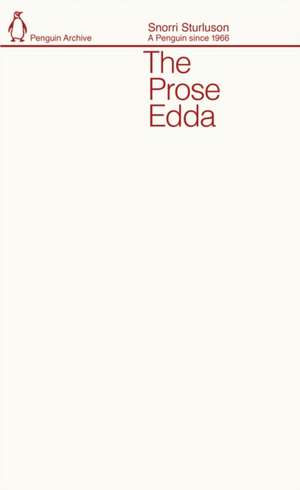
The Prose Edda: Penguin Archive
Autor Snorri Sturluson Traducere de Jesse Byocken Limba Engleză Paperback – 17 apr 2025
The Prose Edda
Also Called
Snorre's Edda, Or The Younger Edda
by Snorri Sturluson
The Prose Edda, also known as the Younger Edda, Snorri's Edda (Icelandic: Snorra Edda) or simply Edda, is an Old Norse work of literature written in Iceland in the early 13th century. Together with the Poetic Edda, it comprises the major store of Scandinavian mythology. The work is often assumed to have been written, or at least compiled, by the Icelandic scholar and historian Snorri Sturluson around the year 1220.
It begins with a euhemerized Prologue, a section on the Norse cosmogony, pantheon and myths. This is followed by three distinct books: Gylfaginning (consisting of around 20,000 words), SkAldskaparmAl (around 50,000 words) and HAttatal (around 20,000 words). Seven manuscripts, dating from around 1300 to around 1600, have independent textual value. Sturluson planned the collection as a textbook. It was to enable Icelandic poets and readers to understand the subtleties of alliterative verse, and to grasp the meaning behind the many kenningar (compounds) that were used in skaldic poetry.
The Prose Edda was originally referred to as simply the Edda, but was later called the Prose Edda to distinguish it from the Poetic Edda, a collection of anonymous poetry from earlier traditional sources compiled around the same time as the Prose Edda in 13th century Iceland. The Prose Edda is related to the Poetic Edda in that the Prose Edda cites various poems collected in the Poetic Edda as sources.
In the beginning, before the heaven and the earth and the sea were created, the great abyss Ginungagap was without form and void, and the spirit of Fimbultyr moved upon the face of the deep, until the ice-cold rivers, the Elivogs, flowing from Niflheim, came in contact with the dazzling flames from Muspelheim. This was before Chaos.
And Fimbultyr said: Let the melted drops of vapor quicken into life, and the giant Ymer was born in the midst of Ginungagap. He was not a god, but the father of all the race of evil giants. This was Chaos.
And Fimbultyr said: Let Ymer be slain and let order be established. And straightway Odin and his brothers--the bright sons of Bure--gave Ymer a mortal wound, and from his body made they the universe; from his flesh, the earth; from his blood, the sea; from his bones, the rocks; from his hair, the trees; from his skull, the vaulted heavens; from his eye-brows, the bulwark called Midgard. And the gods formed man and woman in their own image of two trees, and breathed into them the breath of life. Ask and Embla became living souls, and they received a garden in Midgard as a dwelling-place for themselves and their children until the end of time. This was Cosmos.
Din seria Penguin Archive
-
 Preț: 42.88 lei
 -
 Preț: 42.52 lei
 -
 Preț: 42.68 lei
 -
 Preț: 42.50 lei
 -
 Preț: 42.98 lei
 -
 Preț: 42.65 lei
 -
 Preț: 42.75 lei
 -
 Preț: 42.75 lei
 -
 Preț: 42.66 lei
 -
 Preț: 42.18 lei
 -
 Preț: 42.88 lei
 -
 Preț: 41.94 lei
 -
 Preț: 42.58 lei
 -
 Preț: 42.75 lei
 -
 Preț: 42.45 lei
 -
 Preț: 42.05 lei
 -
 Preț: 42.98 lei
 -
 Preț: 42.68 lei
 -
 Preț: 42.98 lei
 -
 Preț: 42.96 lei
 -
 Preț: 42.58 lei
 -
 Preț: 43.05 lei
 -
 Preț: 42.41 lei
 -
 Preț: 42.88 lei
 -
 Preț: 41.84 lei
 -
 Preț: 42.75 lei
 -
 Preț: 42.65 lei
 -
 Preț: 41.84 lei
 -
 Preț: 42.07 lei
 -
 Preț: 42.52 lei
 -
 Preț: 42.65 lei
 -
 Preț: 42.75 lei
 -
 Preț: 42.88 lei
 -
 Preț: 42.88 lei
 -
 Preț: 43.01 lei
 -
 Preț: 42.62 lei
 -
 Preț: 42.65 lei
 -
 Preț: 42.46 lei
 -
 Preț: 42.72 lei
 -
 Preț: 42.81 lei
 -
 Preț: 42.65 lei
 -
 Preț: 42.81 lei
 -
 Preț: 42.14 lei
 -
 Preț: 42.75 lei
 -
 Preț: 42.65 lei
 -
 Preț: 42.00 lei
 -
 Preț: 42.88 lei
 -
 Preț: 42.69 lei
 -
 Preț: 42.69 lei
Preț: 42.88 lei
Carte disponibilă
Livrare economică 06-20 noiembrie
Livrare express 23-29 octombrie pentru 14.66 lei
Specificații
ISBN-10: 0241752299
Pagini: 160
Dimensiuni: 178 x 106 x 11 mm
Greutate: 0.1 kg
Editura: Penguin Books
Colecția Penguin Classics
Seria Penguin Archive
V-ar putea interesa
-
 Sapiens: A Brief History of Human KindYuval Noah Harari-17%Preț: 80.04 lei95.89 lei
 -
 The Saga of the VolsungsJesse L Byock-27%Preț: 56.97 lei77.93 lei
 -
 FictionsJorge Luis Borges-26%Preț: 57.59 lei78.30 lei
 -
 CantiGiacomo LeopardiPreț: 108.72 lei
 -
 Ancient Sorceries and Other Weird StoriesAlgernon BlackwoodPreț: 91.77 lei
 -
 Preț: 101.88 lei
 -
 The White People and Other Weird StoriesArthur MachenPreț: 73.12 lei
 -
 Go Like HellA.J. Baime-18%Preț: 65.91 lei80.05 lei
 -
 Incredible Adventures (Lovecraft's Library)Algernon BlackwoodPreț: 105.84 lei
 -
 Preț: 168.83 lei
 -
 The CentaurAlgernon BlackwoodPreț: 101.41 lei
 -
 EurekaEdgar Allan PoePreț: 84.32 lei
 -
 D'Aulaires' Book of Norse MythsIngri D'AulairePreț: 161.77 lei
 -
 Essential SolitudeH. P. LovecraftPreț: 204.91 lei
 -
 Essential SolitudeH. P. LovecraftPreț: 206.10 lei
 -
 Time And The Gods: An OmnibusLord Dunsany-25%Preț: 82.20 lei109.43 lei
 -
 Maldoror & the Complete Works of the Comte de LautréamontComte de LautréamontPreț: 111.83 lei
Notă biografică
Jesse Bycock is Professor of Icelandic and Old Norse Literature at the University of California and has published widely on Medieval Iceland. For Penguin, he is the author of Viking Age Iceland (2001).