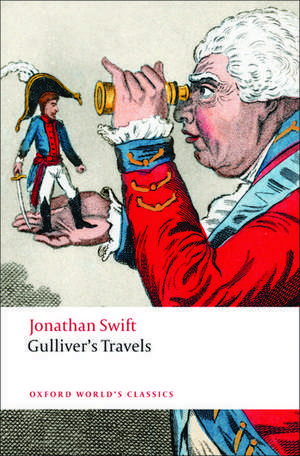
Gulliver's Travels
Autor Jonathan Swift Editat de Claude Rawson, Ian Higginsen Limba Engleză Paperback – 12 iun 2008
Această ediție din colecția Wordsworth Classics ne propune o incursiune în genul aventurii satirice, oferind o perspectivă mult mai profundă decât adaptările simplificate pentru copii. Reținem faptul că Gulliver's Travels nu este doar o poveste despre pitici și uriași, ci o critică tăioasă la adresa vanității și ignoranței umane, structurată în patru călătorii distincte ale medicului de bord Lemuel Gulliver.
Ne-a atras atenția rigoarea cu care a fost îngrijit acest volum: textul restaurat reflectă viziunea originală a lui Jonathan Swift, incluzând pasaje care au fost eliminate de editorii vremii din motive politice. Pe același raft cu Gulliver's Travels and a Modest Proposal, această ediție se adresează tinerilor cititori de peste 12 ani și adulților care caută o experiență de lectură autentică, îmbogățită de un aparat critic impresionant. Structura cărții este exemplară, ghidând cititorul de la primele scrisori fictive dintre personaj și editorul său, până la anexe ce explorează legăturile cu Utopia lui Sir Thomas More.
În contextul operei sale, volumul de față reprezintă culmea stilului satiric al lui Swift, regăsit și în The Battle of the Books sau A Modest Proposal and Other Satirical Works. Dacă în alte scrieri Swift se concentrează pe dispute intelectuale specifice, aici el construiește lumi întregi — de la insula plutitoare Laputa la raționalele creaturi Houyhnhnms — pentru a pune în oglindă defectele societății engleze. Este o lectură care solicită atenție, dar care răsplătește prin umorul său intelectual și prin actualitatea surprinzătoare a observațiilor sociale.
Preț: 38.98 lei
Preț vechi: 45.45 lei
-14%
Carte disponibilă
Livrare economică 30 octombrie-10 noiembrie
Livrare express 17-23 octombrie pentru 30.51 lei
Specificații
ISBN-10: 0199536848
Pagini: 432
Ilustrații: original frontispiece; 5 halftones & 3 maps
Dimensiuni: 128 x 195 x 19 mm
Greutate: 0.27 kg
Ediția:Reissued
Editura: Oxford University Press
Colecția OUP Oxford
Locul publicării:Oxford, United Kingdom
V-ar putea interesa
-
 Oscar Wilde Stories For ChildrenOscar Wilde-28%Preț: 35.68 lei49.28 lei
 -
 Bob's Red Mill Everyday Gluten-Free CookbookCamilla V. SaulsburyPreț: 153.98 lei
 -
 Harry Potter and the Chamber of SecretsJ. K. Rowling-24%Preț: 50.59 lei66.40 lei
 -
 Vegan Desserts in Jars: Adorably Delicious Pies, Cakes, Puddings, and Much MoreKris Holechek Peters-20%Preț: 90.45 lei112.95 lei
 -
 At First Sight: from the bestselling author of The Inheritance GamesJennifer Lynn Barnes-26%Preț: 53.31 lei71.63 lei
 -
 Crime and PunishmentFyodor DostoevskyPreț: 39.53 lei
 -
 The IdiotFyodor DostoevskyPreț: 40.12 lei
 -
 Anna KareninaLeo TolstoyPreț: 42.39 lei
De ce să citești această carte
Recomandăm această carte părinților care doresc să le ofere copiilor o ediție integrală a unui clasic universal. Dincolo de elementele fantastice care captivează imaginația, cititorul câștigă o lecție valoroasă de gândire critică. Este un instrument educativ excelent datorită anexelor istorice, ajutându-i pe tineri să înțeleagă cum literatura poate deveni o voce puternică împotriva nedreptății și a prostiei umane.
Despre autor
Jonathan Swift (1667-1745) a fost un scriitor anglo-irlandez, cleric și activist politic, considerat cel mai important autor de satiră în proză din limba engleză. Maestru al pseudonimelor, el a semnat lucrări fundamentale precum Gulliver's Travels și A Tale of a Tub. Cariera sa a fost marcată de o implicare profundă în viața politică și socială, fiind un apărător fervent al cauzelor irlandeze prin scrieri precum The Drapier's Letters. Stilul său, care variază de la ironia fină la satira caustică, a influențat generații de scriitori, lăsând în urmă o operă ce analizează fără menajamente condiția umană.
Descriere
Notă biografică
Textul de pe ultima copertă
The direct and unadorned narrative describes four remarkable journies of ship's surgeon Lemuel Gulliver, among them, one to the land of Lilliput, where six-inch-high inhabitants bicker over trivialities; and another to Brobdingnag, a land where giants reduce man to insignificance.
Written with disarming simplicity and careful attention to detail, this classic is diverse in its appeal: for children, it remains an enchanting fantasy. For adults, it is a witty parody of political life in Swift's time and a scathing send-up of manners and morals in 18th-century England."
Recenzii
This edition uses the 1735 edition as the copy text, retaining the original, unmodernized text. Historical appendices provide a context for the novel’s literary models, scientific influences, and complex political and religious allusions.
“Gulliver’s Travels is a timeless work, but Allan Ingram’s edition reminds us that it’s a timely one, too. His introduction, notes, and appendices put the eighteenth century’s greatest satire in a wide variety of contexts—biographical, historical, political, scientific, and literary—giving us an ideal edition for classroom use. No edition does a better job of explaining Swift’s masterpiece as a product of its age.” — Jack Lynch, Rutgers University
“This new edition of Jonathan Swift’s Gulliver’s Travels provides both first-time and return readers with a well-constructed framework within which to place a familiar work. Allan Ingram’s engaging introduction deftly combines a summary of contemporary controversies over politics, religion, learning, science, and Ireland, with a summary of Swift’s life and a history of the composition, publication, and critical reception of the Travels. The footnotes to the text anticipate the kinds of knowledge a twenty-first-century reader might lack: the outmoded usage of a single word or the identity of an individual, as well as references to broader issues and ideas. Ingram observes that Swift ‘asks the kinds of questions of his readers to which we have few answers.’ His edition will enable readers to carry on the debate about those questions.” — Melinda Alliker Rabb, Brown University
Cuprins
Acknowledgements
Introduction
Jonathan Swift: A Brief Chronology
A Note on the Text
Gulliver’s Travels
Appendix A: Preliminary Correspondence
- “Richard Sympson” to Benjamin Motte (8 August 1726)
- Benjamin Motte to “Richard Sympson” (11 August 1726)
- “Richard Sympson” to Benjamin Motte (13 August 1726)
- From Lucian’s True History (2nd century CE)
- From Sir Thomas More, Utopia (1516)
- From Cyrano de Bergerac, The Comical History of the States and Empires of the Worlds of the Moon and Sun (1657, 1662)
- From William Dampier, A New Voyage Round the World (1697)
- From Thomas Sprat, The History of the Royal Society (1702)
- From Henry St John, Viscount Bolingbroke, A Dissertation Upon Parties (1735)
- Jonathan Swift, Brotherly Love. A Sermon (1717)
- From William Molyneux, The Case of Ireland (1698)
- From Jonathan Swift, The Drapier’s First Letter (1724)
- Jonathan Swift, A Short View of the State of Ireland (1728)
- Swift’s Correspondence
- John Gay and Alexander Pope to Swift ([7] November 1726)
- Alexander Pope to Swift (16 November 1726)
- Swift to Alexander Pope (17 November 1726)
- “Lemuel Gulliver” to Mrs. Howard (28 November 1726)
- Swift to Benjamin Motte (28 December 1727)
- From Anon., A Letter from a Clergyman (1726)
- Poems Attached to Gulliver’s Travels (1727)
- From John, Earl of Orrery, Remarks on the Life and Writings of Dr. Jonathan Swift (1752)