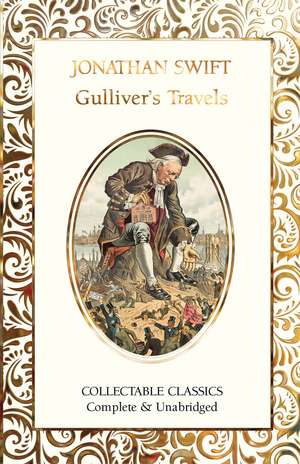
Gulliver's Travels
Autor Jonathan Swiften Limba Engleză Hardback – 26 mar 2024
Preț: 62.06 lei
Preț vechi: 69.91 lei
-11%
Puncte Express: 93
Carte disponibilă
Livrare economică 16-30 mai
Livrare express 02-08 mai pentru 31.81 lei
Specificații
ISBN-13: 9781804177891
ISBN-10: 180417789X
Pagini: 384
Dimensiuni: 96 x 154 x 20 mm
Greutate: 0.01 kg
Ediția:Nouă
Editura: Flame Tree Publishing
Colecția Flame Tree Collectable Classics
Locul publicării:London, United Kingdom
ISBN-10: 180417789X
Pagini: 384
Dimensiuni: 96 x 154 x 20 mm
Greutate: 0.01 kg
Ediția:Nouă
Editura: Flame Tree Publishing
Colecția Flame Tree Collectable Classics
Locul publicării:London, United Kingdom
V-ar putea interesa
-
 Oscar Wilde Stories For ChildrenOscar Wilde-28%Preț: 34.15 lei47.59 lei
 -
 Bob's Red Mill Everyday Gluten-Free CookbookCamilla V. SaulsburyPreț: 143.78 lei
 -
 Harry Potter and the Chamber of SecretsJ. K. Rowling-25%Preț: 47.36 lei63.29 lei
 -
 Vegan Desserts in Jars: Adorably Delicious Pies, Cakes, Puddings, and Much MoreKris Holechek Peters-21%Preț: 86.61 lei109.10 lei
 -
 At First Sight: from the bestselling author of The Inheritance GamesJennifer Lynn Barnes-27%Preț: 50.76 lei69.29 lei
 -
 Crime and PunishmentFyodor DostoevskyPreț: 37.65 lei
 -
 The IdiotFyodor DostoevskyPreț: 38.21 lei
 -
 Anna KareninaLeo TolstoyPreț: 40.38 lei
Textul de pe ultima copertă
In this narrative of the gullible ship's doctor Lemuel Gulliver and his extraordinary travels, Jonathan Swift takes readers through a series of apparently child-like fantasy worlds of tiny people and giants, floating islands and talking horses. But through this fantastic journey, he also gave to literature an enduring model of mankind's follies, vulnerabilities, vanities, and self-destructiveness. Dangerously topical in its own time and much debated ever since, Gulliver's Travels is among those works of English literature that entrap and challenge readers in every period. This edition uses the 1735 edition as the copy text, retaining the original, unmodernized text. Historical appendices provide a context for the novel's literary models, scientific influences, and complex political and religious allusions.
Notă biografică
Jonathan Swift was an Anglo-Irish satirist, author, essayist, political pamphleteer (first for the Whigs, then for the Tories), poet, and Anglican cleric. He rose to the position of dean of St. Patrick's Cathedral in Dublin, earning him the moniker "Dean Swift." He lived from 30 November 1667 to 19 October 1745. A Tale of a Tub (1704), An Argument Against Abolishing Christianity (1712), Gulliver's Travels (1726), and A Modest Proposal are among Swift's best-known writings (1729). He first published all of his works anonymously or using aliases, such as Lemuel Gulliver, Isaac Bickerstaff, and M. B. Drapier. He was a master of the Horatian and Juvenalian satirical genres. His writing is deadpan and sardonic, especially in "A Modest Proposal", which is why such satire has come to be known as "Swiftian." On November 30, 1667, in Dublin, in the Kingdom of Ireland, Jonathan Swift was born. He was the only son and the second child of Frisby on the Wreake residents Jonathan Swift (1640-1667) and Abigail Erick (or Herrick). After 1700, Swift lived in Trim, County Meath. Many of his works were written by him at this time. Swift graduated with a Doctor of Divinity degree from Trinity College Dublin in February 1702.
Recenzii
In this narrative of the gullible ship’s doctor Lemuel Gulliver and his extraordinary travels, Jonathan Swift takes readers through a series of apparently child-like fantasy worlds of tiny people and giants, floating islands and talking horses. But through this fantastic journey, he also gave to literature an enduring model of mankind’s follies, vulnerabilities, vanities, and self-destructiveness. Dangerously topical in its own time and much debated ever since, Gulliver’s Travels is among those works of English literature that entrap and challenge readers in every period.
This edition uses the 1735 edition as the copy text, retaining the original, unmodernized text. Historical appendices provide a context for the novel’s literary models, scientific influences, and complex political and religious allusions.
“Gulliver’s Travels is a timeless work, but Allan Ingram’s edition reminds us that it’s a timely one, too. His introduction, notes, and appendices put the eighteenth century’s greatest satire in a wide variety of contexts—biographical, historical, political, scientific, and literary—giving us an ideal edition for classroom use. No edition does a better job of explaining Swift’s masterpiece as a product of its age.” — Jack Lynch, Rutgers University
“This new edition of Jonathan Swift’s Gulliver’s Travels provides both first-time and return readers with a well-constructed framework within which to place a familiar work. Allan Ingram’s engaging introduction deftly combines a summary of contemporary controversies over politics, religion, learning, science, and Ireland, with a summary of Swift’s life and a history of the composition, publication, and critical reception of the Travels. The footnotes to the text anticipate the kinds of knowledge a twenty-first-century reader might lack: the outmoded usage of a single word or the identity of an individual, as well as references to broader issues and ideas. Ingram observes that Swift ‘asks the kinds of questions of his readers to which we have few answers.’ His edition will enable readers to carry on the debate about those questions.” — Melinda Alliker Rabb, Brown University
This edition uses the 1735 edition as the copy text, retaining the original, unmodernized text. Historical appendices provide a context for the novel’s literary models, scientific influences, and complex political and religious allusions.
“Gulliver’s Travels is a timeless work, but Allan Ingram’s edition reminds us that it’s a timely one, too. His introduction, notes, and appendices put the eighteenth century’s greatest satire in a wide variety of contexts—biographical, historical, political, scientific, and literary—giving us an ideal edition for classroom use. No edition does a better job of explaining Swift’s masterpiece as a product of its age.” — Jack Lynch, Rutgers University
“This new edition of Jonathan Swift’s Gulliver’s Travels provides both first-time and return readers with a well-constructed framework within which to place a familiar work. Allan Ingram’s engaging introduction deftly combines a summary of contemporary controversies over politics, religion, learning, science, and Ireland, with a summary of Swift’s life and a history of the composition, publication, and critical reception of the Travels. The footnotes to the text anticipate the kinds of knowledge a twenty-first-century reader might lack: the outmoded usage of a single word or the identity of an individual, as well as references to broader issues and ideas. Ingram observes that Swift ‘asks the kinds of questions of his readers to which we have few answers.’ His edition will enable readers to carry on the debate about those questions.” — Melinda Alliker Rabb, Brown University
Cuprins
List of Illustrations
Acknowledgements
Introduction
Jonathan Swift: A Brief Chronology
A Note on the Text
Gulliver’s Travels
Appendix A: Preliminary Correspondence
Acknowledgements
Introduction
Jonathan Swift: A Brief Chronology
A Note on the Text
Gulliver’s Travels
Appendix A: Preliminary Correspondence
- “Richard Sympson” to Benjamin Motte (8 August 1726)
- Benjamin Motte to “Richard Sympson” (11 August 1726)
- “Richard Sympson” to Benjamin Motte (13 August 1726)
- From Lucian’s True History (2nd century CE)
- From Sir Thomas More, Utopia (1516)
- From Cyrano de Bergerac, The Comical History of the States and Empires of the Worlds of the Moon and Sun (1657, 1662)
- From William Dampier, A New Voyage Round the World (1697)
- From Thomas Sprat, The History of the Royal Society (1702)
- From Henry St John, Viscount Bolingbroke, A Dissertation Upon Parties (1735)
- Jonathan Swift, Brotherly Love. A Sermon (1717)
- From William Molyneux, The Case of Ireland (1698)
- From Jonathan Swift, The Drapier’s First Letter (1724)
- Jonathan Swift, A Short View of the State of Ireland (1728)
- Swift’s Correspondence
- John Gay and Alexander Pope to Swift ([7] November 1726)
- Alexander Pope to Swift (16 November 1726)
- Swift to Alexander Pope (17 November 1726)
- “Lemuel Gulliver” to Mrs. Howard (28 November 1726)
- Swift to Benjamin Motte (28 December 1727)
- From Anon., A Letter from a Clergyman (1726)
- Poems Attached to Gulliver’s Travels (1727)
- From John, Earl of Orrery, Remarks on the Life and Writings of Dr. Jonathan Swift (1752)