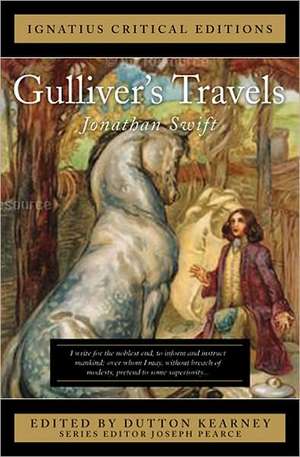
Gulliver's Travels: Ignatius Critical Editions
Autor Jonathan Swift Editat de Dutton Kearney, Joseph Pearceen Limba Engleză Paperback – 31 mar 2010
Preț: 67.14 lei
Puncte Express: 101
Carte disponibilă
Livrare economică 20 mai-03 iunie
Specificații
ISBN-13: 9781586173951
ISBN-10: 1586173952
Pagini: 434
Dimensiuni: 138 x 201 x 28 mm
Greutate: 0.5 kg
Editura: Ignatius Press
Seria Ignatius Critical Editions
ISBN-10: 1586173952
Pagini: 434
Dimensiuni: 138 x 201 x 28 mm
Greutate: 0.5 kg
Editura: Ignatius Press
Seria Ignatius Critical Editions
V-ar putea interesa
-
 Oscar Wilde Stories For ChildrenOscar Wilde-28%Preț: 34.15 lei47.59 lei
 -
 Bob's Red Mill Everyday Gluten-Free CookbookCamilla V. SaulsburyPreț: 143.78 lei
 -
 Harry Potter and the Chamber of SecretsJ. K. Rowling-25%Preț: 47.36 lei63.29 lei
 -
 Vegan Desserts in Jars: Adorably Delicious Pies, Cakes, Puddings, and Much MoreKris Holechek Peters-21%Preț: 86.61 lei109.10 lei
 -
 At First Sight: from the bestselling author of The Inheritance GamesJennifer Lynn Barnes-27%Preț: 50.76 lei69.29 lei
 -
 Crime and PunishmentFyodor DostoevskyPreț: 37.65 lei
 -
 The IdiotFyodor DostoevskyPreț: 38.21 lei
 -
 Anna KareninaLeo TolstoyPreț: 40.38 lei
Notă biografică
Poet, satirist, political pamphleteer and clergyman, Jonathan Swift (1667-1745) had a rich literary lineage that could boast of the likes of John Dryden and Sir Walter Raleigh. Early in his career, Swift published his works either anonymously or under pen-names. He wrote under his own name only after he had become an established author and commentator. He was a master of sarire, and employed this technique brilliantly in works such as A Tale of a Tub, A Modest Proposal, and Gulliver's Travels.
Descriere
Descriere de la o altă ediție sau format:
'Thus, gentle Reader, I have given thee a faithful History of my Travels for Sixteen Years, and above Seven Months; wherein I have not been so studious of Ornament as of Truth.'In these words Gulliver represents himself as a reliable reporter of the fantastic adventures he has just set down; but how far can we rely on a narrator whose identity is elusive and whoses inventiveness is self-evident? Gulliver's Travels purports to be a travel book, and describes Gulliver's encounters with the inhabitants of four extraordinary places: Lilliput, Brobdingnag, Laputa, and the country of the Houyhnhnms. A consummately skilful blend of fantasy and realism makes Gulliver's Travels by turns hilarious, frightening, and profound. Swift plays tricks on us, and delivers one of the world's most disturbing satires of the human condition.This new edition includes the changing frontispiece portraits of Gulliver that appeared in successive early editions. ABOUT THE SERIES: For over 100 years Oxford World's Classics has made available the widest range of literature from around the globe. Each affordable volume reflects Oxford's commitment to scholarship, providing the most accurate text plus a wealth of other valuable features, including expert introductions by leading authorities, helpful notes to clarify the text, up-to-date bibliographies for further study, and much more.
'Thus, gentle Reader, I have given thee a faithful History of my Travels for Sixteen Years, and above Seven Months; wherein I have not been so studious of Ornament as of Truth.'In these words Gulliver represents himself as a reliable reporter of the fantastic adventures he has just set down; but how far can we rely on a narrator whose identity is elusive and whoses inventiveness is self-evident? Gulliver's Travels purports to be a travel book, and describes Gulliver's encounters with the inhabitants of four extraordinary places: Lilliput, Brobdingnag, Laputa, and the country of the Houyhnhnms. A consummately skilful blend of fantasy and realism makes Gulliver's Travels by turns hilarious, frightening, and profound. Swift plays tricks on us, and delivers one of the world's most disturbing satires of the human condition.This new edition includes the changing frontispiece portraits of Gulliver that appeared in successive early editions. ABOUT THE SERIES: For over 100 years Oxford World's Classics has made available the widest range of literature from around the globe. Each affordable volume reflects Oxford's commitment to scholarship, providing the most accurate text plus a wealth of other valuable features, including expert introductions by leading authorities, helpful notes to clarify the text, up-to-date bibliographies for further study, and much more.
Textul de pe ultima copertă
In this narrative of the gullible ship's doctor Lemuel Gulliver and his extraordinary travels, Jonathan Swift takes readers through a series of apparently child-like fantasy worlds of tiny people and giants, floating islands and talking horses. But through this fantastic journey, he also gave to literature an enduring model of mankind's follies, vulnerabilities, vanities, and self-destructiveness. Dangerously topical in its own time and much debated ever since, Gulliver's Travels is among those works of English literature that entrap and challenge readers in every period. This edition uses the 1735 edition as the copy text, retaining the original, unmodernized text. Historical appendices provide a context for the novel's literary models, scientific influences, and complex political and religious allusions.
Recenzii
In this narrative of the gullible ship’s doctor Lemuel Gulliver and his extraordinary travels, Jonathan Swift takes readers through a series of apparently child-like fantasy worlds of tiny people and giants, floating islands and talking horses. But through this fantastic journey, he also gave to literature an enduring model of mankind’s follies, vulnerabilities, vanities, and self-destructiveness. Dangerously topical in its own time and much debated ever since, Gulliver’s Travels is among those works of English literature that entrap and challenge readers in every period.
This edition uses the 1735 edition as the copy text, retaining the original, unmodernized text. Historical appendices provide a context for the novel’s literary models, scientific influences, and complex political and religious allusions.
“Gulliver’s Travels is a timeless work, but Allan Ingram’s edition reminds us that it’s a timely one, too. His introduction, notes, and appendices put the eighteenth century’s greatest satire in a wide variety of contexts—biographical, historical, political, scientific, and literary—giving us an ideal edition for classroom use. No edition does a better job of explaining Swift’s masterpiece as a product of its age.” — Jack Lynch, Rutgers University
“This new edition of Jonathan Swift’s Gulliver’s Travels provides both first-time and return readers with a well-constructed framework within which to place a familiar work. Allan Ingram’s engaging introduction deftly combines a summary of contemporary controversies over politics, religion, learning, science, and Ireland, with a summary of Swift’s life and a history of the composition, publication, and critical reception of the Travels. The footnotes to the text anticipate the kinds of knowledge a twenty-first-century reader might lack: the outmoded usage of a single word or the identity of an individual, as well as references to broader issues and ideas. Ingram observes that Swift ‘asks the kinds of questions of his readers to which we have few answers.’ His edition will enable readers to carry on the debate about those questions.” — Melinda Alliker Rabb, Brown University
This edition uses the 1735 edition as the copy text, retaining the original, unmodernized text. Historical appendices provide a context for the novel’s literary models, scientific influences, and complex political and religious allusions.
“Gulliver’s Travels is a timeless work, but Allan Ingram’s edition reminds us that it’s a timely one, too. His introduction, notes, and appendices put the eighteenth century’s greatest satire in a wide variety of contexts—biographical, historical, political, scientific, and literary—giving us an ideal edition for classroom use. No edition does a better job of explaining Swift’s masterpiece as a product of its age.” — Jack Lynch, Rutgers University
“This new edition of Jonathan Swift’s Gulliver’s Travels provides both first-time and return readers with a well-constructed framework within which to place a familiar work. Allan Ingram’s engaging introduction deftly combines a summary of contemporary controversies over politics, religion, learning, science, and Ireland, with a summary of Swift’s life and a history of the composition, publication, and critical reception of the Travels. The footnotes to the text anticipate the kinds of knowledge a twenty-first-century reader might lack: the outmoded usage of a single word or the identity of an individual, as well as references to broader issues and ideas. Ingram observes that Swift ‘asks the kinds of questions of his readers to which we have few answers.’ His edition will enable readers to carry on the debate about those questions.” — Melinda Alliker Rabb, Brown University
Cuprins
List of Illustrations
Acknowledgements
Introduction
Jonathan Swift: A Brief Chronology
A Note on the Text
Gulliver’s Travels
Appendix A: Preliminary Correspondence
Acknowledgements
Introduction
Jonathan Swift: A Brief Chronology
A Note on the Text
Gulliver’s Travels
Appendix A: Preliminary Correspondence
- “Richard Sympson” to Benjamin Motte (8 August 1726)
- Benjamin Motte to “Richard Sympson” (11 August 1726)
- “Richard Sympson” to Benjamin Motte (13 August 1726)
- From Lucian’s True History (2nd century CE)
- From Sir Thomas More, Utopia (1516)
- From Cyrano de Bergerac, The Comical History of the States and Empires of the Worlds of the Moon and Sun (1657, 1662)
- From William Dampier, A New Voyage Round the World (1697)
- From Thomas Sprat, The History of the Royal Society (1702)
- From Henry St John, Viscount Bolingbroke, A Dissertation Upon Parties (1735)
- Jonathan Swift, Brotherly Love. A Sermon (1717)
- From William Molyneux, The Case of Ireland (1698)
- From Jonathan Swift, The Drapier’s First Letter (1724)
- Jonathan Swift, A Short View of the State of Ireland (1728)
- Swift’s Correspondence
- John Gay and Alexander Pope to Swift ([7] November 1726)
- Alexander Pope to Swift (16 November 1726)
- Swift to Alexander Pope (17 November 1726)
- “Lemuel Gulliver” to Mrs. Howard (28 November 1726)
- Swift to Benjamin Motte (28 December 1727)
- From Anon., A Letter from a Clergyman (1726)
- Poems Attached to Gulliver’s Travels (1727)
- From John, Earl of Orrery, Remarks on the Life and Writings of Dr. Jonathan Swift (1752)