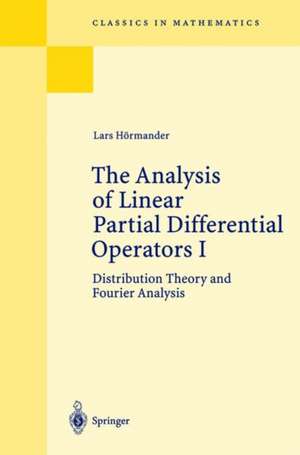
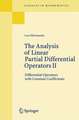
The Analysis of Linear Partial Differential Operators I: Classics in Mathematics
Autor Lars Hörmanderen Limba Engleză Paperback – 7 iul 2003
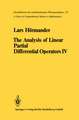
Descoperim în The Analysis of Linear Partial Differential Operators I un manual de referință ce fundamentează analiza modernă la nivel de studii aprofundate. Această ediție a doua, publicată în colecția Classics in Mathematics la Springer, marchează o tranziție importantă de la tratatul specializat către un instrument pedagogic complet, prin includerea unei secțiuni de exerciții cu soluții și indicații. Suntem de părere că această adăugire, bazată pe cursurile susținute de Lars Hörmander la Universitatea din Lund, transformă textul dintr-o resursă de cercetare într-un curs de bază pentru orice student la matematică. Structura este riguros organizată, începând cu revizuirea calculului diferențial și studiul funcțiilor test, continuând cu definițiile de bază ale distribuțiilor și proprietățile lor fundamentale. Găsim în capitolele dedicate convoluției și spațiilor produs o claritate specifică autorului, care a dominat acest domeniu timp de decenii. Această lucrare reprezintă fundamentul pe care se construiesc volumele ulterioare ale seriei, precum The Analysis of Linear Partial Differential Operators II și The Analysis of Linear Partial Differential Operators III, unde complexitatea crește către teoria împrăștierii și variabile complexe. În contextul literaturii de specialitate, acest volum completează perspectiva oferită de Distributions, Partial Differential Equations, and Harmonic Analysis de Dorina Mitrea. În timp ce lucrarea Dorinei Mitrea oferă o introducere rapidă și concisă, potrivită pentru un curs de un semestru, tratatul lui Hörmander este mult mai detaliat, oferind o rigoare istorică și tehnică ce lipsește adesea din textele mai noi. Față de Introduction to the Theory of Distributions de F. G. Friedlander, care evită pe cât posibil teoria spațiilor vectoriale topologice, Hörmander integrează aceste instrumente ca elemente esențiale ale analizei moderne.
Din seria Classics in Mathematics
-
 Preț: 423.31 lei
 -
 Preț: 439.68 lei
 -
 Preț: 433.26 lei
 -
 Preț: 409.58 lei
 -
 Preț: 433.26 lei
 -
 Preț: 423.17 lei
 -
 Preț: 442.78 lei
 -
 Preț: 429.79 lei
 -
 Preț: 445.07 lei
 -
 Preț: 405.14 lei
 -
 Preț: 399.60 lei
 -
 Preț: 464.78 lei
 -
 Preț: 421.03 lei
 -
 Preț: 461.78 lei
 -
 Preț: 423.61 lei
 -
 Preț: 446.15 lei
 -
 Preț: 448.65 lei
 -
 Preț: 444.01 lei
 -
 Preț: 510.27 lei
 -
 Preț: 421.54 lei
 -
 Preț: 443.01 lei
 -
 Preț: 465.98 lei
 -
 Preț: 431.98 lei
 -
 Preț: 412.72 lei
 -
 Preț: 436.95 lei
 -
 Preț: 439.92 lei
 -
 Preț: 413.62 lei
 -
 Preț: 518.36 lei
 -
 Preț: 418.58 lei
 -
 Preț: 411.79 lei
 -
 Preț: 428.75 lei
 -
 Preț: 453.56 lei
 -
 Preț: 427.04 lei
 -
 Preț: 453.04 lei
 -
 Preț: 451.76 lei
 - 20%
 Preț: 370.38 lei
 -
 Preț: 416.03 lei
 -
 Preț: 413.24 lei
 -
 Preț: 418.64 lei
 -
 Preț: 432.27 lei
 -
 Preț: 412.37 lei
 -
 Preț: 420.47 lei
 -
 Preț: 421.98 lei
 -
 Preț: 459.34 lei
 -
 Preț: 454.57 lei
Preț: 434.23 lei
Carte tipărită la comandă
Livrare economică 30 noiembrie-14 decembrie
Specificații
ISBN-10: 3540006621
Pagini: 456
Ilustrații: XI, 440 p.
Dimensiuni: 155 x 235 x 25 mm
Greutate: 0.69 kg
Ediția:Second Edition 2003
Editura: Springer
Colecția Classics in Mathematics
Seria Classics in Mathematics
Locul publicării:Berlin, Heidelberg, Germany
V-ar putea interesa
-
 -19%Preț: 653.68 lei807.01 lei
 -
 -23%Preț: 627.24 lei814.60 lei
 -
 Fractal GeometryKenneth FalconerPreț: 426.81 lei
 -
 -18%Preț: 896.42 lei1093.19 lei
 -
 Hypergeometric SummationWolfram Koepf-15%Preț: 502.35 lei591.01 lei
 -
 Quadratic and Higher Degree FormsKrishnaswami Alladi-18%Preț: 929.01 lei1132.94 lei
 -
 -15%Preț: 606.90 lei714.01 lei
 -
 -18%Preț: 830.45 lei1012.74 lei
 -
 Geometric Aspects of Functional AnalysisBo'az KlartagPreț: 383.37 lei
 -
 Dynamic Inequalities On Time ScalesRavi AgarwalPreț: 407.16 lei
 -
 A Topological Introduction to Nonlinear AnalysisRobert F. BrownPreț: 488.13 lei
 -
 HILBERT-HUANG TRANSFORM AND ITS APPLICATIONS (2ND ED)Huang Norden E-18%Preț: 849.16 lei1035.56 lei
Public țintă
ResearchDe ce să citești această carte
Această carte este indispensabilă cercetătorilor și studenților la masterat care doresc să stăpânească teoria distribuțiilor de la cel mai înalt nivel de rigoare. Câștigați acces la viziunea lui Lars Hörmander, laureat al Medaliei Fields, într-o ediție revizuită ce include exerciții practice. Este alegerea optimă dacă aveți nevoie de o bază solidă pentru studiul ecuațiilor diferențiale parțiale sau al analizei armonice.