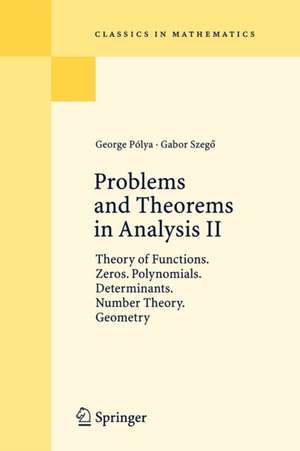
Problems and Theorems in Analysis II: Theory of Functions. Zeros. Polynomials. Determinants. Number Theory. Geometry: Classics in Mathematics
Autor George Polya Traducere de C.E. Billigheimer Autor Gabor Szegöen Limba Engleză Paperback – 11 dec 1997
Evoluția analizei matematice moderne a fost marcată de trecerea de la memorarea unor formule rigide la dezvoltarea unei intuiții profunde prin rezolvarea de probleme, o tranziție pe care Problems and Theorems in Analysis II o exemplifică magistral. Această lucrare, semnată de George Polya și Gabor Szegö, nu este un simplu manual, ci o arhivă a gândirii matematice de vârf din perioada 1850-1925, păstrându-și relevanța chiar și la un secol de la prima apariție. Suntem de părere că valoarea acestui volum rezidă în modul în care structurează progresia învățării, pornind de la funcții de o variabilă complexă și culminând cu studiul aprofundat al polinoamelor și al determinanților.
Remarcăm organizarea riguroasă a conținutului, care ghidează cercetătorul prin demonstrații complexe precum regula semnelor a lui Descartes sau geometria planului complex în raport cu zerourile polinoamelor. Ediția din seria Classics in Mathematics menține rigoarea originală, oferind în același timp claritatea traducerii realizate de C.E. Billigheimer. Cartea completează perspectiva oferită de Polynomials de Edward J Barbeau, adăugând o profunzime teoretică superioară și o conexiune directă cu literatura clasică de cercetare, acolo unde volumul lui Barbeau se concentrează mai mult pe exerciții pentru concursuri și nivelul de licență.
Subliniem că acest volum tratează exhaustiv polinoamele trigonometrice și seriile Fourier, oferind instrumente analitice esențiale pentru studiul aproximării. Ritmul lecturii este dictat de densitatea conceptuală a fiecărei probleme, transformând procesul de studiu într-o explorare activă a fundamentelor analizei. Este o resursă indispensabilă pentru cei care doresc să înțeleagă nu doar rezultatele, ci și mecanismele de descoperire matematică utilizate de marii gânditori ai secolului trecut.
Din seria Classics in Mathematics
-
 Preț: 423.31 lei
 -
 Preț: 439.68 lei
 -
 Preț: 433.26 lei
 -
 Preț: 409.58 lei
 -
 Preț: 433.26 lei
 -
 Preț: 423.17 lei
 -
 Preț: 442.78 lei
 -
 Preț: 429.79 lei
 -
 Preț: 445.07 lei
 -
 Preț: 405.14 lei
 -
 Preț: 399.60 lei
 -
 Preț: 464.78 lei
 -
 Preț: 421.03 lei
 -
 Preț: 461.78 lei
 -
 Preț: 423.61 lei
 -
 Preț: 446.15 lei
 -
 Preț: 448.65 lei
 -
 Preț: 444.01 lei
 -
 Preț: 510.27 lei
 -
 Preț: 421.54 lei
 -
 Preț: 443.01 lei
 -
 Preț: 465.98 lei
 -
 Preț: 431.98 lei
 -
 Preț: 412.72 lei
 -
 Preț: 436.95 lei
 -
 Preț: 439.92 lei
 -
 Preț: 518.36 lei
 -
 Preț: 448.95 lei
 -
 Preț: 418.58 lei
 -
 Preț: 411.79 lei
 -
 Preț: 443.26 lei
 -
 Preț: 453.56 lei
 -
 Preț: 441.50 lei
 -
 Preț: 453.04 lei
 -
 Preț: 451.76 lei
 - 20%
 Preț: 370.38 lei
 -
 Preț: 416.03 lei
 -
 Preț: 413.24 lei
 -
 Preț: 418.64 lei
 -
 Preț: 442.63 lei
 -
 Preț: 412.37 lei
 -
 Preț: 420.47 lei
 -
 Preț: 421.98 lei
 -
 Preț: 459.34 lei
 -
 Preț: 454.57 lei
Preț: 413.62 lei
Carte tipărită la comandă
Livrare economică 07-21 decembrie
Specificații
ISBN-10: 3540636862
Pagini: 412
Ilustrații: XII, 392 p.
Dimensiuni: 155 x 235 x 22 mm
Greutate: 0.62 kg
Ediția:1998
Editura: Springer Berlin, Heidelberg
Colecția Springer
Seria Classics in Mathematics
Locul publicării:Berlin, Heidelberg, Germany
V-ar putea interesa
-
 How to Solve ItGeorge Polya-30%Preț: 64.67 lei92.81 lei
 -
 Calculus Made EasySilvanus P Thompson-11%Preț: 368.01 lei413.50 lei
 -
 Applied Functional AnalysisEberhard Zeidler-18%Preț: 819.08 lei998.88 lei
 -
 A Short Course on Spectral TheoryWilliam Arveson-18%Preț: 972.36 lei1185.80 lei
 -
 Mathematical DiscoveryGeorge Polya-27%Preț: 1547.42 lei2119.76 lei
 -
 Spline FunctionsLarry Schumaker-11%Preț: 601.48 lei675.81 lei
 -
 Regularization of Inverse ProblemsHeinz Werner Engl-18%Preț: 1150.67 lei1403.26 lei
 -
 Simulation and the Monte Carlo Method 3eR. Rubinstein-27%Preț: 759.57 lei1040.51 lei
 -
 -27%Preț: 853.70 lei1169.45 lei
 -
 Calculus: Early TranscendentalsWilliam Briggs-15%Preț: 576.28 lei679.82 lei
 -
 Optimization with PDE ConstraintsMichael Hinze-18%Preț: 924.87 lei1127.89 lei
 -
 Introduction to Numerical AnalysisJ. Stoer-15%Preț: 611.78 lei719.74 lei
 -
 Elementary AnalysisKenneth A. RossPreț: 431.95 lei
 -
 -9%Preț: 1021.17 lei1122.17 lei
 -
 Programming Finite Elements in Java(TM)Gennadiy P. Nikishkov-15%Preț: 617.58 lei726.56 lei
 -
 Vector CalculusPaul C. MatthewsPreț: 267.95 lei
 -
 Principles of Computational Fluid DynamicsPieter Wesseling-15%Preț: 632.63 lei744.28 lei
 -
 Nonlinear Solid MechanicsAdnan IbrahimbegovicPreț: 427.88 lei
 -
 Introduction to Computational Mathematics (2nd Edition)UK" University of Cambridge, UK <p> "University of Cambridge, UK" <p> "University of Cambridge, UK" University of Cambridge, UK <p> "University of Cambridge, UK" <p> "University of Cambridge, UK" University of Cambridge, UK) Yang, Xin-She (<p> "University of CambridgePreț: 475.21 lei
Public țintă
ResearchDe ce să citești această carte
Această carte este destinată matematicienilor și cercetătorilor care caută să își perfecționeze tehnica de demonstrație prin contactul cu probleme clasice de o eleganță rară. Cititorul câștigă acces la o colecție istorică de probleme de analiză, selectate și rezolvate de doi dintre cei mai mari pedagogi ai domeniului, oferind un fundament solid în teoria funcțiilor și a polinoamelor care depășește programa universitară standard.
Despre autor
George Polya (1887-1985) a fost un matematician de origine maghiară, celebru pentru contribuțiile sale în combinatorică, teoria numerelor și, mai ales, în euristică și pedagogia matematicii. Lucrarea sa „How to Solve It” a revoluționat modul în care este predată rezolvarea problemelor. Gabor Szegö (1895-1985) a fost un matematician remarcabil, cunoscut pentru munca sa în domeniul polinoamelor ortogonale și al matricelor Toeplitz. Colaborarea lor a produs unele dintre cele mai influente texte din analiza matematică, amândoi fiind profesori distinși la universități de prestigiu precum Stanford, unde au modelat generații de matematicieni.
Cuprins
Recenzii
-Bull.Americ.Math.Soc.
Notă biografică
Born in Budapest, December 13, 1887, George Pólya initially studied law, then languages and literature in Budapest. He came to mathematics in order to understand philosophy, but the subject of his doctorate in 1912 was in probability theory and he promptly abandoned philosophy.
After a year in Göttingen and a short stay in Paris, he received an appointment at the ETH in Zürich. His research was multi-faceted, ranging from series, probability, number theory and combinatorics to astronomy and voting systems. Some of his deepest work was on entire functions. He also worked in conformal mappings, potential theory, boundary value problems, and isoperimetric problems in mathematical physics, as well as heuristics late in his career. When Pólya left Europe in 1940, he first went to Brown University, then two years later to Stanford, where he remained until his death on September 7, 1985.
Biography of Gabor Szegö
Born in Kunhegyes, Hungary, January 20, 1895, Szegö studied in Budapest and Vienna, where he received his Ph. D. in 1918, after serving in the Austro-Hungarian army in the First World War. He became a privatdozent at the University of Berlin and in 1926 succeeded Knopp at the University of Kšnigsberg. It was during his time in Berlin that he and Pólya collaborated on their great joint work, the Problems and Theorems in Analysis. Szegö's own research concentrated on orthogonal polynomials and Toeplitz matrices. With the deteriorating situation in Germany at that time, he moved in 1934 to Washington University, St. Louis, where he remained until 1938, when he moved to Stanford. As department head at Stanford, he arranged for Pólya to join the Stanford faculty in 1942. Szegö remained at Stanford until his death on August 7, 1985.