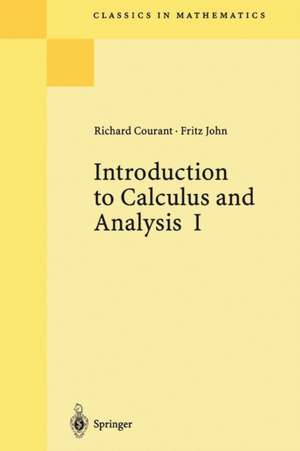
Introduction to Calculus and Analysis I: Classics in Mathematics
Autor Richard Courant, Fritz Johnen Limba Engleză Paperback – 3 dec 1998
Remarcăm acest manual de referință, Introduction to Calculus and Analysis I, ca fiind o piesă fundamentală în literatura matematică, reeditată în prestigioasa serie Classics in Mathematics. Richard Courant și Fritz John reușesc să echilibreze rigoarea teoretică cu o abordare intuitivă, transformând analiza matematică dintr-un domeniu pur abstract într-un instrument viu pentru înțelegerea lumii fizice. Ne-a atras atenția în mod deosebit modul în care autorii integrează metodele numerice și aplicațiile practice, o raritate pentru manualele de analiză clasică. Structura volumului urmează o progresie logică, pornind de la ideile fundamentale ale calculului integral și diferențial, trecând prin tehnici de calcul și expansiuni Taylor, până la subiecte avansate precum ecuațiile diferențiale pentru vibrații și serii trigonometrice. Un element distinctiv îl reprezintă capitolul final de date biografice, care, alături de referințele istorice presărate în text, oferă contextul necesar evoluției ideilor matematice. Această lucrare continuă viziunea autorului începută în Methoden der mathematischen Physik, unde matematica nu este izolată, ci se află în dialog constant cu fizica. Ca alternativă la Mathematical Analysis I de Claudio Canuto pentru cursurile de analiză reală, volumul lui Courant aduce avantajul unei expuneri mai bogate în exemple istorice și o orientare mai pronunțată către modelarea fenomenelor naturale. În timp ce manualul lui Canuto este modular și adaptat ingineriei moderne, Introduction to Calculus and Analysis I rămâne de neegalat prin profunzimea explicațiilor și calitatea exercițiilor care ghidează studentul de la intuiție la demonstrație formală. Este o resursă esențială pentru cei care doresc să înțeleagă nu doar „cum”, ci și „de ce” funcționează mecanismele analizei.
Din seria Classics in Mathematics
-
 Preț: 423.31 lei
 -
 Preț: 439.68 lei
 -
 Preț: 433.26 lei
 -
 Preț: 409.58 lei
 -
 Preț: 433.26 lei
 -
 Preț: 423.17 lei
 -
 Preț: 422.20 lei
 -
 Preț: 428.28 lei
 -
 Preț: 430.48 lei
 -
 Preț: 405.14 lei
 -
 Preț: 399.60 lei
 -
 Preț: 464.78 lei
 -
 Preț: 421.03 lei
 -
 Preț: 439.80 lei
 -
 Preț: 423.61 lei
 -
 Preț: 446.15 lei
 -
 Preț: 421.40 lei
 -
 Preț: 510.27 lei
 -
 Preț: 421.54 lei
 -
 Preț: 437.97 lei
 -
 Preț: 431.78 lei
 -
 Preț: 431.98 lei
 -
 Preț: 412.72 lei
 -
 Preț: 436.95 lei
 -
 Preț: 439.92 lei
 -
 Preț: 413.62 lei
 -
 Preț: 501.33 lei
 -
 Preț: 434.23 lei
 -
 Preț: 418.58 lei
 -
 Preț: 411.79 lei
 -
 Preț: 428.75 lei
 -
 Preț: 438.71 lei
 -
 Preț: 427.04 lei
 -
 Preț: 438.19 lei
 -
 Preț: 436.95 lei
 - 20%
 Preț: 370.38 lei
 -
 Preț: 416.03 lei
 -
 Preț: 413.24 lei
 -
 Preț: 418.64 lei
 -
 Preț: 432.27 lei
 -
 Preț: 412.37 lei
 -
 Preț: 420.47 lei
 -
 Preț: 421.98 lei
 -
 Preț: 445.98 lei
 -
 Preț: 439.68 lei
Preț: 448.65 lei
Carte tipărită la comandă
Livrare economică 23 octombrie-06 noiembrie
Specificații
ISBN-10: 354065058X
Pagini: 688
Ilustrații: XXIII, 661 p. 184 illus.
Dimensiuni: 155 x 235 x 37 mm
Greutate: 1.03 kg
Ediția:1999
Editura: Springer
Colecția Classics in Mathematics
Seria Classics in Mathematics
Locul publicării:Berlin, Heidelberg, Germany
V-ar putea interesa
-
 A Clockwork OrangeAnthony Burgess-29%Preț: 49.55 lei69.31 lei
 -
 Stochastic Calculus for Finance ISteven Shreve-17%Preț: 403.41 lei486.04 lei
 -
 CalculusMorris KlinePreț: 324.03 lei
 -
 CalculusJames Stewart-23%Preț: 657.49 lei853.88 lei
 -
 CalculusMichael SpivakPreț: 457.84 lei
 -
 A Course in Financial CalculusAlison EtheridgePreț: 406.23 lei
 -
 WonderR. J. Palacio-17%Preț: 47.92 lei57.85 leiRecomandat
 -
 Was Sind Und Was Sollen Die Zahlen?Richard DedekindPreț: 334.13 lei
 -
 Introduction to Stochastic Calculus Applied to FinanceDamien Lamberton-18%Preț: 715.44 lei872.49 lei
 -
 Introduction to Calculus and Analysis II/1Richard CourantPreț: 423.61 lei
 -
 Introduction to Calculus and Analysis II/2Richard CourantPreț: 433.26 lei
Public țintă
ResearchDe ce să citești această carte
Recomandăm această carte studenților și cercetătorilor care caută o bază solidă în analiza matematică, dincolo de simpla manipulare a formulelor. Cititorul câștigă o perspectivă istorică și practică rară, datorită integrării metodelor numerice și a aplicațiilor din fizică. Este alegerea ideală pentru cei care preferă un stil de învățare bazat pe motivație vizuală și exerciții cu semnificație intuitivă, fiind un standard de aur în pedagogia matematică.
Despre autor
Richard Courant (1888–1972) a fost o figură monumentală a matematicii secolului XX, conducând Departamentul de Matematică de la New York University și fondând institutul care astăzi îi poartă numele (Courant Institute of Mathematical Sciences). Reputația sa de pedagog de excepție este confirmată de lucrări precum Dirichlet's Principle, Conformal Mapping, and Minimal Surfaces și celebrul tratat scris împreună cu David Hilbert. Stilul său se caracterizează prin echilibrul între problemele specifice, ușor de înțeles, și soluțiile matematice complexe, punând mereu accent pe unitatea dintre metodele matematice și aplicațiile lor practice.
Descriere scurtă
Cuprins
Recenzii
Notă biografică
Richard Courant was born in 1888 in a small town of what is now Poland, and died in New Rochelle, N.Y. in 1972. He received his doctorate from the legendary David Hilbert in Göttingen, where later he founded and directed its famed mathematics Institute, a Mecca for mathematicians in the twenties. In 1933 the Nazi government dismissed Courant for being Jewish, and he emigrated to the United States. He found, in New York, what he called "a reservoir of talent" to be tapped. He built, at New York University, a new mathematical Sciences Institute that shares the philosophy of its illustrious predecessor and rivals it in worldwide influence.
For Courant mathematics was an adventure, with applications forming a vital part. This spirit is reflected in his books, in particular in his influential calculus text, revised in collaboration with his brilliant younger colleague, Fritz John.
(P.D. Lax)
Biography of Fritz John
Fritz John was born on June 14, 1910, in Berlin. After his school years in Danzig (now Gdansk, Poland), he studied in Göttingen and received his doctorate in 1933, just when the Nazi regime came to power. As he was half-Jewish and his bride Aryan, he had to flee Germany in 1934. After a year in Cambridge, UK, he accepted a position at the University of Kentucky, and in 1946 joined Courant, Friedrichs and Stoker in building up New York University the institute that later became the Courant Institute of Mathematical Sciences. He remained there until his death in New Rochelle on February 10, 1994.
John's research and the books he wrote had a strong impact on the development of many fields of mathematics, foremost in partial differential equations. He also worked on Radon transforms, illposed problems, convex geometry, numerical analysis, elasticity theory. In connection with his work in latter field, he andNirenberg introduced the space of the BMO-functions (bounded mean oscillations). Fritz John's work exemplifies the unity of mathematics as well as its elegance and its beauty.
(J. Moser)