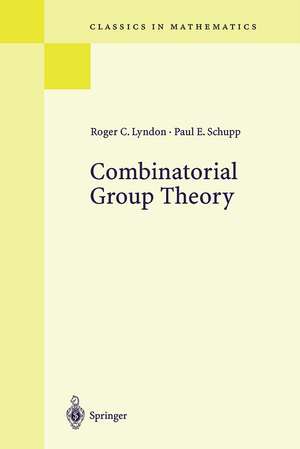
Combinatorial Group Theory: Classics in Mathematics
Autor Roger C. Lyndon, Paul E. Schuppen Limba Engleză Paperback – 12 ian 2001
Autorii Roger C. Lyndon și Paul E. Schupp semnează o lucrare de referință fundamentală, bazată pe decenii de cercetare de vârf la intersecția dintre algebră și geometrie. Roger C. Lyndon, recunoscut pentru contribuțiile sale esențiale în coomologia grupurilor, aduce în acest volum o rigoare analitică ce a definit limitele disciplinei cunoscute astăzi sub numele de teoria combinatorială a grupurilor. Ne-a atras atenția modul în care autorii reușesc să sintetizeze o cantitate imensă de informație, oferind o bibliografie de peste 1100 de intrări, ceea ce transformă cartea într-un instrument de lucru indispensabil pentru cercetători. Observăm o abordare progresivă: volumul debutează cu studiul grupurilor libere și al metodelor Nielsen, trece prin analiza generatorilor și a relațiilor — incluzând calculul Fox și grupurile cu o singură relație definitorie — și culminează cu o secțiune densă dedicată metodelor geometrice, precum complexele Cayley și diagramele sferice. Cititorii familiarizați cu Algebra VII de D.J. Collins vor aprecia faptul că, spre deosebire de acea lucrare care se concentrează pe prezentări sintetice fără demonstrații, volumul de față oferă o tratare exhaustivă și riguroasă a rezultatelor, multe dintre ele fiind prezentate aici pentru prima dată într-un format de carte. În contextul operei lui Roger C. Lyndon, acest titlu reprezintă maturizarea conceptelor explorate în Groups and Geometry, extinzând cadrul teoretic către aplicații combinatoriale complexe. Structura clară, împărțită în trei mari capitole, facilitează navigarea de la fundamentele algebrice spre structurile topologice și geometrice asferice, confirmând statutul lucrării în seria Classics in Mathematics.
Din seria Classics in Mathematics
-
 Preț: 423.31 lei
 -
 Preț: 439.68 lei
 -
 Preț: 433.26 lei
 -
 Preț: 433.26 lei
 -
 Preț: 423.17 lei
 -
 Preț: 442.78 lei
 -
 Preț: 429.79 lei
 -
 Preț: 445.07 lei
 -
 Preț: 405.14 lei
 -
 Preț: 399.60 lei
 -
 Preț: 464.78 lei
 -
 Preț: 421.03 lei
 -
 Preț: 461.78 lei
 -
 Preț: 423.61 lei
 -
 Preț: 446.15 lei
 -
 Preț: 448.65 lei
 -
 Preț: 444.01 lei
 -
 Preț: 510.27 lei
 -
 Preț: 421.54 lei
 -
 Preț: 443.01 lei
 -
 Preț: 465.98 lei
 -
 Preț: 431.98 lei
 -
 Preț: 412.72 lei
 -
 Preț: 436.95 lei
 -
 Preț: 439.92 lei
 -
 Preț: 413.62 lei
 -
 Preț: 518.36 lei
 -
 Preț: 448.95 lei
 -
 Preț: 418.58 lei
 -
 Preț: 411.79 lei
 -
 Preț: 443.26 lei
 -
 Preț: 453.56 lei
 -
 Preț: 441.50 lei
 -
 Preț: 453.04 lei
 -
 Preț: 451.76 lei
 - 20%
 Preț: 370.38 lei
 -
 Preț: 416.03 lei
 -
 Preț: 413.24 lei
 -
 Preț: 418.64 lei
 -
 Preț: 442.63 lei
 -
 Preț: 412.37 lei
 -
 Preț: 420.47 lei
 -
 Preț: 421.98 lei
 -
 Preț: 459.34 lei
 -
 Preț: 454.57 lei
Preț: 409.58 lei
Carte tipărită la comandă
Livrare economică 05-19 decembrie
Specificații
ISBN-10: 3540411585
Pagini: 360
Ilustrații: XIV, 339 p.
Dimensiuni: 155 x 235 x 19 mm
Greutate: 0.52 kg
Ediția:Softcover reprint of the original 1st ed. 2001
Editura: Springer Berlin, Heidelberg
Colecția Springer
Seria Classics in Mathematics
Locul publicării:Berlin, Heidelberg, Germany
V-ar putea interesa
-
 Schaum's Outline of Group TheoryB. Baumslag-33%Preț: 166.49 lei250.18 lei
 -
 The Theory of Infinite Soluble GroupsJohn C. Lennox-32%Preț: 1504.83 lei2207.12 lei
 -
 Groups and GeometryPeter M. Neumann-30%Preț: 581.41 lei830.60 lei
 -
 Techniques of Semigroup TheoryPeter M. Higgins-20%Preț: 326.25 lei409.69 lei
 -
 Categories of Commutative AlgebrasYves Diers-31%Preț: 657.06 lei957.56 lei
 -
 Symmetry: A Very Short IntroductionIan Stewart-19%Preț: 57.46 lei71.12 lei
 -
 Symmetry, Representations, and InvariantsRoe GoodmanPreț: 537.66 lei
 -
 Groups and SymmetryMark A. ArmstrongPreț: 401.95 lei
 -
 Linear Algebraic GroupsArmand Borel-40%Preț: 344.12 lei573.54 lei
 -
 One-Parameter Semigroups for Linear Evolution EquationsKlaus-Jochen Engel-15%Preț: 736.15 lei866.06 lei
 -
 Group TheoryPierre Ramond-11%Preț: 706.74 lei794.08 lei
 -
 Lie GroupsAnthony W. Knapp-18%Preț: 783.48 lei955.47 lei
 -
 A Course in the Theory of GroupsDerek J. S. Robinson-15%Preț: 502.41 lei591.06 lei
 -
 An Introduction to the Theory of GroupsJoseph J. Rotman-15%Preț: 463.69 lei545.52 lei
 -
 Developments and Retrospectives in Lie TheoryGeoffrey Mason-32%Preț: 235.61 lei346.49 lei
Public țintă
ResearchDe ce să citești această carte
Această carte este esențială pentru matematicienii care activează în cercetare, oferind fundamentul teoretic complet pentru teoria combinatorială a grupurilor. Cititorul câștigă acces la o sinteză magistrală a tehnicilor de calcul Fox și a metodelor geometrice, susținută de o bibliografie monumentală. Este resursa definitivă pentru înțelegerea modului în care proprietățile algebrice ale grupurilor derivă din prezentările lor combinatoriale.
Despre autor
Roger C. Lyndon (1917–1988) a fost un matematician american de prestigiu, a cărui carieră a fost marcată de o tranziție neobișnuită de la literatură la matematică în timpul studiilor la Harvard. Sub îndrumarea lui Saunders MacLane, a obținut doctoratul cu o teză despre coomologia grupurilor, domeniu în care a rămas o autoritate incontestabilă. De-a lungul activității sale academice, a predat la instituții de renume precum Georgia Tech și Princeton, dedicându-și cercetarea conexiunilor dintre logică, geometrie și algebră. Lucrarea sa, scrisă împreună cu Paul E. Schupp, rămâne un pilon al literaturii matematice moderne.
Descriere scurtă
"This book (...) defines the boundaries of the subject now called combinatorial group theory. (...)it is a considerable achievement to have concentrated a survey of the subject into 339 pages. This includes a substantial and useful bibliography; (over 1100 (items)). ...the book is a valuable and welcome addition to the literature, containing many results not previously available in a book. It will undoubtedly become a standard reference." Mathematical Reviews, AMS, 1979
Cuprins
Recenzii
"This book (...) defines the boundaries of the subject now called combinatorial group theory. (...)it is a considerable achievement to have concentrated a survey of the subject into 339 pages. This includes a substantial and useful bibliography; (over 1100 items). ...the book is a valuable and welcome addition to the literature, containing many results not previously available in a book. It will undoubtedly become a standard reference." Mathematical Reviews, AMS, 1979
"This is a reprint of the 1977 edition … of this famous and very popular book, which became a desk copy for everybody who is dealing with combinatorial group theory. The complete bibliography (more than 1000 titles) well reflects the situation in the combinatorial group theory at the time when the book was published. Definitely, since the face of combinatorial group theory has significantly changed … this well-written book still is very functional and efficient." (Igor Subbotin, Zentralblatt MATH, Vol. 997 (22), 2002)
Notă biografică
Roger Lyndon, born on Dec. 18, 1917 in Calais (Maine, USA), entered Harvard University in 1935 with the aim of studying literature and becoming a writer. However, when he discovered that, for him, mathematics required less effort than literature, he switched and graduated from Harvard in 1939.
After completing his Master's Degree in 1941, he taught at Georgia Tech, then returned to Harvard in 1942 and there taught navigation to pilots while, supervised by S. MacLane, he studied for his Ph.D., awarded in 1946 for a thesis entitled The Cohomology Theory of Group Extensions.
Influenced by Tarski, Lyndon was later to work on model theory. Accepting a position at Princeton, Ralph Fox and Reidemeister's visit in 1948 were major influencea on him to work in combinatorial group theory. In 1953 Lyndon left Princeton for a chair at the University of Michigan where he then remained except for visiting professorships at Berkeley, London, Montpellier and Amiens.
Lyndon made numerous major contributions to combinatorial group theory. These included the development of "small cancellation theory", his introduction of "aspherical" presentations of groups and his work on length functions. He died on June 8, 1988.
Biography of Paul E. Schupp
Paul Schupp, born on March 12, 1937 in Cleveland, Ohio was a student of Roger Lyndon's at the Univ. of Michigan. Where he wrote a thesis on "Dehn's Algorithm and the Conjugacy Problem". After a year at the University of Wisconsin he moved to the University of Illinois where he remained. For several years he was also concurrently Visiting Professor at the University Paris VII and a member of the Laboratoire d'Informatique Théorique et Programmation (founded by M. P. Schutzenberger).
Schupp further developed the use of cancellation diagrams in combinatorial group theory, introducing conjugacy diagrams, diagrams on compact surfaces, diagrams over free products with amalgamation and HNN extensions and applications to Artin groups. He then worked with David Muller on connections between group theory and formal language theory and on the theory of finite automata on infinite inputs. His current interest is using geometric methods to investigate the computational complexity of algorithms in combinatorial group theory.