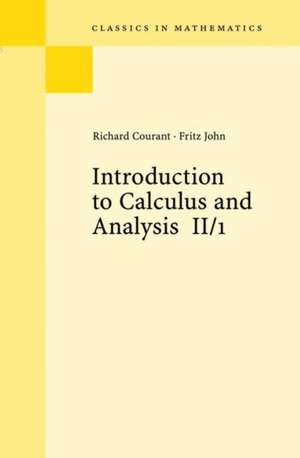
Introduction to Calculus and Analysis II/1: Classics in Mathematics
Autor Richard Courant, Fritz Johnen Limba Engleză Paperback – 14 dec 1999
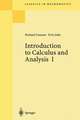
Acest manual universitar, publicat în prestigioasa serie Classics in Mathematics de către Springer, reprezintă prima parte a celui de-al doilea volum dintr-o lucrare monumentală dedicată analizei matematice. Suntem de părere că ediția din 2000 păstrează intactă rigoarea pedagogică ce a format generații de matematicieni, oferind o tranziție fluidă de la calculul diferențial de bază către studiul avansat al funcțiilor de mai multe variabile. Apreciem în mod deosebit echilibrul pe care Richard Courant și Fritz John îl mențin între demonstrațiile matematice stricte și aplicațiile practice, o trăsătură care face textul accesibil nu doar studenților la matematică, ci și cercetătorilor din fizică sau inginerie.
Structura volumului este organizată meticulos, începând cu topologia mulțimilor de puncte și continuând cu derivatele parțiale, diferențiala unei funcții și semnificația sa geometrică. Un capitol esențial este dedicat calculului vectorial și matricial, pregătind terenul pentru transformările liniare. Spre deosebire de Multidimensional Differential and Integral Calculus de Giorgio Riccardi, care adoptă un stil conversațional și informal, lucrarea de față rămâne fidelă formalismului clasic, fiind mult mai densă în conținut teoretic. Totodată, Introduction to Calculus and Analysis II/1 completează perspectiva oferită de Basic Analysis II de James K. Peterson, adăugând o profunzime istorică și o rigoare a demonstrațiilor care lipsesc deseori din manualele moderne simplificate.
Subliniem importanța secțiunilor de apendice, unde sunt tratate riguros noțiuni precum principiul punctului de acumulare în mai multe dimensiuni. Această abordare reflectă filozofia autorului, întâlnită și în lucrarea sa Dirichlet's Principle, Conformal Mapping, and Minimal Surfaces, unde problemele specifice sunt utilizate pentru a introduce metode matematice generale și durabile.
Din seria Classics in Mathematics
-
 Preț: 403.50 lei
 -
 Preț: 419.10 lei
 -
 Preț: 415.13 lei
 -
 Preț: 409.58 lei
 -
 Preț: 413.24 lei
 -
 Preț: 407.24 lei
 -
 Preț: 409.58 lei
 -
 Preț: 406.82 lei
 -
 Preț: 405.14 lei
 -
 Preț: 399.60 lei
 -
 Preț: 464.78 lei
 -
 Preț: 421.03 lei
 -
 Preț: 427.52 lei
 -
 Preț: 319.86 lei
 -
 Preț: 430.65 lei
 -
 Preț: 421.40 lei
 -
 Preț: 491.00 lei
 -
 Preț: 402.90 lei
 -
 Preț: 420.10 lei
 -
 Preț: 431.78 lei
 -
 Preț: 414.20 lei
 -
 Preț: 412.72 lei
 -
 Preț: 416.51 lei
 -
 Preț: 439.92 lei
 -
 Preț: 413.62 lei
 -
 Preț: 485.37 lei
 -
 Preț: 417.87 lei
 -
 Preț: 402.16 lei
 -
 Preț: 411.79 lei
 -
 Preț: 412.60 lei
 -
 Preț: 418.17 lei
 -
 Preț: 407.75 lei
 -
 Preț: 421.56 lei
 -
 Preț: 416.51 lei
 - 20%
 Preț: 358.53 lei
 -
 Preț: 416.03 lei
 -
 Preț: 413.24 lei
 -
 Preț: 418.64 lei
 -
 Preț: 315.84 lei
 -
 Preț: 412.37 lei
 -
 Preț: 420.47 lei
 -
 Preț: 421.98 lei
 -
 Preț: 320.04 lei
Preț: 423.61 lei
Carte tipărită la comandă
Livrare economică 08-22 iunie
Specificații
ISBN-10: 3540665692
Pagini: 588
Ilustrații: XXV, 556 p. 157 illus.
Dimensiuni: 155 x 235 x 31 mm
Greutate: 0.87 kg
Ediția:2000
Editura: Springer Berlin, Heidelberg
Colecția Springer
Seria Classics in Mathematics
Locul publicării:Berlin, Heidelberg, Germany
V-ar putea interesa
-
 Stochastic Calculus for Finance ISteven Shreve-17%Preț: 391.29 lei471.43 lei
 -
 CalculusMorris KlinePreț: 304.73 lei
 -
 Calculus of VariationsI. M. GelfandPreț: 80.42 lei
 -
 CalculusJames Stewart-23%Preț: 626.14 lei813.17 lei
 -
 CalculusMichael SpivakPreț: 427.77 lei
 -
 A Course in Financial CalculusAlison EtheridgePreț: 377.42 lei
 -
 Was sind und was sollen die Zahlen?Richard DedekindPreț: 326.91 lei
 -
 Calculus For DummiesMark RyanPreț: 104.75 lei
 -
 Introduction to Stochastic Calculus Applied to FinanceDamien Lamberton-18%Preț: 688.31 lei839.40 lei
 -
 Introduction to Calculus and Analysis IRichard CourantPreț: 430.65 lei
 -
 Introduction to Calculus and Analysis II/2: Chapters 5 - 8Richard CourantPreț: 415.13 lei
Public țintă
ResearchDe ce să citești această carte
Recomandăm acest volum studenților la facultățile de profil tehnic și științific care doresc o bază solidă în analiza multivariată. Cititorul câștigă o înțelegere profundă a calculului diferențial în $R^n$, sprijinită de exerciții cu grade diferite de dificultate și figuri iluminatoare. Este o investiție în educația matematică pe termen lung, fiind o lucrare de referință care nu se demodează odată cu schimbarea curriculei.
Despre autor
Richard Courant (1888–1972) a fost unul dintre cei mai influenți matematicieni ai secolului XX, conducând Departamentul de Matematică de la New York University și punând bazele institutului care astăzi îi poartă numele (Courant Institute of Mathematical Sciences). Recunoscut pentru capacitatea sa de a unifica matematica pură cu cea aplicată, Courant a lăsat moștenire lucrări fundamentale precum „Methoden der mathematischen Physik”. Stilul său pedagogic se caracterizează prin claritate și prin convingerea că matematica trebuie să pornească de la probleme concrete pentru a ajunge la generalizări teoretice, viziune care strălucește în întreaga serie „Introduction to Calculus and Analysis”.
Descriere scurtă
Newsletter on Computational and Applied Mathematics, 1991
"...one of the best textbooks introducing several generations of mathematicians to higher mathematics. ... This excellent book is highly recommended both to instructors and students."
Acta Scientiarum Mathematicarum, 1991
Cuprins
Recenzii
Textul de pe ultima copertă
Richard Courant was born in 1888 in a small town of what is now Poland, and died in New Rochelle, N.Y. in 1972. He received his doctorate from the legendary David Hilbert in Göttingen, where later he founded and directed its famed mathematics Institute, a Mecca for mathematicians in the twenties. In 1933 the Nazi government dismissed Courant for being Jewish, and he emigrated to the United States. He found, in New York, what he called "a reservoir of talent" to be tapped. He built, at New York University, a new mathematical Sciences Institute that shares the philosophy of its illustrious predecessor and rivals it in worldwide influence.
For Courant mathematics was an adventure, with applications forming a vital part. This spirit is reflected in his books, in particular in his influential calculus text, revised in collaboration with his brilliant younger colleague, Fritz John.
(P.D. Lax)
Biography of Fritz John
Fritz John was born on June 14, 1910, in Berlin. After his school years in Danzig (now Gdansk, Poland), he studied in Göttingen and received his doctorate in 1933, just when the Nazi regime came to power. As he was half-Jewish and his bride Aryan, he had to flee Germany in 1934. After a year in Cambridge, UK, he accepted a position at the University of Kentucky, and in 1946 joined Courant, Friedrichs and Stoker in building up New York University the institute that later became the Courant Institute of Mathematical Sciences. He remained there until his death in New Rochelle on February 10, 1994.
John's research and the books he wrote had a strong impact on the development of many fields of mathematics, foremost in partial differential equations. He also worked on Radon transforms, illposed problems, convex geometry, numerical analysis, elasticity theory. In connection with his work in latter field, he and Nirenberg introduced thespace of the BMO-functions (bounded mean oscillations). Fritz John's work exemplifies the unity of mathematics as well as its elegance and its beauty.
(J. Moser)