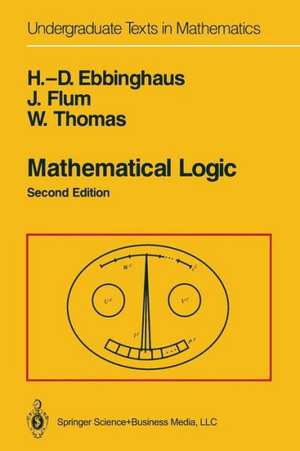
Mathematical Logic: Undergraduate Texts in Mathematics
Autor H.-D. Ebbinghaus, J. Flum, Wolfgang Thomasen Limba Engleză Paperback – 11 dec 2012
Acest manual academic, publicat de Springer în prestigioasa serie Undergraduate Texts in Mathematics, reprezintă o introducere sistematică în fundamentele logicii matematice. Observăm o structură riguroasă, concepută pentru a ghida studenții de la conceptele de bază ale sintaxei și semanticii limbajelor de ordinul întâi, până la rezultate profunde care au definit matematica secolului XX. Mathematical Logic nu se limitează la prezentarea regulilor de inferență, ci explorează natura demonstrației matematice și limitele de demonstrabilitate, oferind răspunsuri la întrebări esențiale despre capacitatea mașinilor de a executa raționamente matematice.
Descoperim în prima parte a volumului o pregătire atentă pentru Teorema de Completitudine a lui Gödel, demonstrând cum un calcul bazat pe reguli simple de inferență poate genera toate consecințele unui sistem de axiome. Comparabil cu An Introduction to Mathematical Logic and Type Theory de Peter B. Andrews în ceea ce privește rigoarea tratării sistemelor formale, manualul de față se distinge prin integrarea subtilă a teoriei mulțimilor ca fundament pentru depășirea limitelor limbajului de ordinul întâi în aritmetică sau analiză.
În a doua parte, autorii H.-D. Ebbinghaus, J. Flum și Wolfgang Thomas extind analiza către teme de actualitate, precum modelele libere și programarea logică, oferind o perspectivă modernă asupra relevanței logicii în informatică. Față de Sets, Models and Proofs de Ieke Moerdijk, care pune accent pe aplicații în algebră, lucrarea de față prioritizează o caracterizare algebrică a echivalenței elementare și teoremele lui Lindström, menținând un echilibru între profunzimea teoretică și accesibilitatea pedagogică.
Din seria Undergraduate Texts in Mathematics
- 15%
 Preț: 409.62 lei
 -
 Preț: 442.25 lei
 - 15%
 Preț: 414.11 lei
 - 15%
 Preț: 409.46 lei
 -
 Preț: 445.70 lei
 - 15%
 Preț: 487.89 lei
 - 15%
 Preț: 409.72 lei
 -
 Preț: 405.09 lei
 -
 Preț: 403.29 lei
 -
 Preț: 427.91 lei
 - 15%
 Preț: 469.14 lei
 -
 Preț: 548.54 lei
 -
 Preț: 382.22 lei
 -
 Preț: 440.44 lei
 - 15%
 Preț: 507.99 lei
 -
 Preț: 377.12 lei
 - 12%
 Preț: 320.18 lei
 - 24%
 Preț: 389.19 lei
 -
 Preț: 405.42 lei
 -
 Preț: 404.41 lei
 - 15%
 Preț: 440.08 lei
 - 15%
 Preț: 463.77 lei
 -
 Preț: 320.86 lei
 - 20%
 Preț: 326.42 lei
 -
 Preț: 430.31 lei
 -
 Preț: 435.26 lei
 - 15%
 Preț: 470.34 lei
 - 20%
 Preț: 494.55 lei
 -
 Preț: 504.79 lei
 -
 Preț: 440.55 lei
 - 15%
 Preț: 480.13 lei
 - 15%
 Preț: 552.56 lei
 -
 Preț: 383.31 lei
 -
 Preț: 379.51 lei
 - 15%
 Preț: 461.97 lei
 -
 Preț: 449.07 lei
 -
 Preț: 367.33 lei
 -
 Preț: 394.72 lei
 - 17%
 Preț: 415.37 lei
 -
 Preț: 380.99 lei
 -
 Preț: 388.04 lei
 -
 Preț: 470.42 lei
 -
 Preț: 370.46 lei
 -
 Preț: 366.56 lei
Preț: 390.93 lei
Preț vechi: 482.63 lei
-19%
Carte indisponibilă temporar
Specificații
ISBN-10: 1475723571
Pagini: 304
Dimensiuni: 155 x 235 x 20 mm
Greutate: 0.43 kg
Ediția:2nd ed. 1994. Softcover reprint of the original 2nd ed. 1994
Editura: Springer
Colecția Springer
Seria Undergraduate Texts in Mathematics
Locul publicării:New York, NY, United States
V-ar putea interesa
-
 Elements of Set TheoryHerbert B. Enderton-31%Preț: 382.75 lei558.35 lei
 -
 -33%Preț: 693.34 lei1029.54 lei
 -
 Twenty Five Years of Constructive Type TheoryGiovanni Sambin-37%Preț: 703.45 lei1123.30 lei
 -
 -28%Preț: 471.91 lei659.32 lei
 -
 A Course in Model TheoryBruno Poizat-15%Preț: 612.43 lei720.50 lei
 -
 Godel's ProofErnest NagelPreț: 138.96 lei
 -
 -36%Preț: 66.83 lei104.45 lei
 -
 TopoiRobert Goldblatt-23%Preț: 162.04 lei211.69 lei
 -
 Axiomatic Set TheoryPatrick SuppesPreț: 104.50 lei
 -
 First-Order LogicRaymond M. SmullyanPreț: 64.77 lei
 -
 Principia Mathematica to *56Alfred North Whitehead-14%Preț: 799.94 lei930.17 lei
 -
 Mathematical Logic for Computer ScienceMordechai Ben-Ari-20%Preț: 395.53 lei494.41 lei
 -
 The Joy of SetsKeith Devlin-15%Preț: 443.91 lei522.24 lei
 -
 Preț: 497.59 lei
 -
 Sets, Logic and CategoriesPeter J. CameronPreț: 280.57 lei
 -
 Incompleteness in the Land of SetsM. FittingPreț: 237.44 lei
 -
 Lattice Theory: Special Topics and ApplicationsGeorge Grätzer-15%Preț: 656.38 lei772.20 lei
 -
 -15%Preț: 735.59 lei865.39 lei
Public țintă
Lower undergraduateDe ce să citești această carte
Recomandăm această carte studenților la matematică și informatică ce doresc o bază solidă în teoria demonstrației. Cititorul câștigă o înțelegere clară a relației dintre logică și teoria mulțimilor, esențială pentru studiul fundamentelor matematicii. Este un text de referință care transformă concepte abstracte precum completitudinea sau compactitatea în instrumente de lucru riguroase, fiind ideal pentru pregătirea examenelor și cercetare incipientă.
Despre autor
Autorii acestui volum, H.-D. Ebbinghaus, J. Flum și Wolfgang Thomas, sunt academicieni recunoscuți pentru contribuțiile lor în domeniul logicii matematice și al informaticii teoretice. Experiența lor pedagogică se reflectă în claritatea expunerii din seria de manuale Springer. Wolfgang Thomas este renumit pentru cercetările sale în teoria automatelor și logica sistemelor infinite, în timp ce Ebbinghaus și Flum au publicat extensiv despre teoria modelelor și teoria mulțimilor. Împreună, aceștia au creat unul dintre cele mai longevive și respectate manuale de logică pentru nivelul universitar.