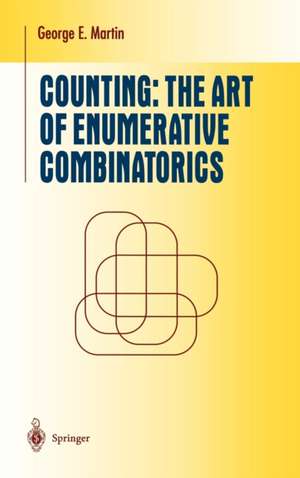
Counting: The Art of Enumerative Combinatorics: Undergraduate Texts in Mathematics
Autor George E. Martinen Limba Engleză Hardback – 21 iun 2001
Considerăm că lucrarea Counting: The Art of Enumerative Combinatorics reușește să transforme un domeniu adesea perceput ca arid într-o explorare accesibilă și riguroasă a matematicii discrete. Publicată în prestigioasa serie Undergraduate Texts in Mathematics, această ediție aduce o claritate didactică remarcabilă, fiind structurată special pentru a ghida cititorul de la întrebări fundamentale de tipul „în câte moduri?” către rezolvarea unor probleme complexe de combinatorică enumerativă. Apreciem în mod deosebit progresia logică a materiei: primele capitole stabilesc baza prin enumerarea elementară și principiul includerii și excluderii, pentru ca ulterior să introducă instrumente avansate precum funcțiile generatoare și teoria grupurilor.
Comparabil cu How to Count de Robert A. Beeler în ceea ce privește accentul pus pe tehnica demonstrației, volumul lui George E. Martin se distinge printr-un ton mai narativ și o aplicabilitate imediată pentru studenții de la matematică, statistică și informatică. Față de alte lucrări ale autorului, cum ar fi Geometric Constructions sau Transformation Geometry, unde acesta explora intersecția dintre algebră și geometria euclidiană, aici Martin se concentrează pe structurile discrete, păstrând însă aceeași eleganță a expunerii care l-a consacrat.
Structura celor opt capitole, completată de secțiunea „The Back of the Book”, oferă un parcurs complet. De la studiul relațiilor de recurență până la fundamentele grafurilor, textul este presărat cu exerciții care nu doar testează cunoștințele, ci invită la o înțelegere profundă a fenomenelor combinatorice. Este o resursă care elimină barierele de intrare în domeniu, necesitând doar o maturitate matematică de bază, fără a face rabat de la rigoarea academică specifică editurii Springer.
Din seria Undergraduate Texts in Mathematics
- 15%
 Preț: 395.35 lei
 -
 Preț: 432.88 lei
 - 15%
 Preț: 465.56 lei
 - 15%
 Preț: 391.13 lei
 -
 Preț: 425.54 lei
 - 19%
 Preț: 509.25 lei
 -
 Preț: 386.76 lei
 - 15%
 Preț: 512.22 lei
 -
 Preț: 407.65 lei
 -
 Preț: 407.89 lei
 - 15%
 Preț: 484.12 lei
 -
 Preț: 446.10 lei
 - 15%
 Preț: 577.17 lei
 -
 Preț: 375.27 lei
 - 15%
 Preț: 511.16 lei
 - 15%
 Preț: 438.38 lei
 - 15%
 Preț: 430.36 lei
 - 15%
 Preț: 578.32 lei
 - 17%
 Preț: 386.69 lei
 -
 Preț: 471.98 lei
 - 15%
 Preț: 491.10 lei
 -
 Preț: 387.67 lei
 - 15%
 Preț: 468.62 lei
 - 15%
 Preț: 437.10 lei
 - 15%
 Preț: 470.34 lei
 -
 Preț: 371.20 lei
 -
 Preț: 371.20 lei
 - 15%
 Preț: 512.18 lei
 - 15%
 Preț: 516.62 lei
 - 15%
 Preț: 465.01 lei
 - 17%
 Preț: 335.06 lei
 - 19%
 Preț: 500.33 lei
 - 20%
 Preț: 481.13 lei
 -
 Preț: 283.12 lei
 - 15%
 Preț: 448.05 lei
 - 15%
 Preț: 395.17 lei
 -
 Preț: 309.60 lei
 -
 Preț: 388.78 lei
 - 15%
 Preț: 433.19 lei
 - 15%
 Preț: 509.21 lei
 - 15%
 Preț: 430.20 lei
 -
 Preț: 470.88 lei
 - 15%
 Preț: 431.63 lei
 - 15%
 Preț: 445.93 lei
Preț: 511.29 lei
Preț vechi: 601.51 lei
-15%
Carte tipărită la comandă
Livrare economică 15-29 iunie
Specificații
ISBN-10: 038795225X
Pagini: 252
Ilustrații: XII, 252 p.
Dimensiuni: 156 x 234 x 18 mm
Greutate: 0.54 kg
Ediția:2001
Editura: Springer
Colecția Springer
Seria Undergraduate Texts in Mathematics
Locul publicării:New York, NY, United States
V-ar putea interesa
-
 -23%Preț: 291.95 lei379.90 lei
 -
 Graph TheoryRussell Merris-9%Preț: 1139.57 lei1252.28 lei
 -
 More Games of No ChanceRichard NowakowskiPreț: 441.82 lei
 -
 Combinatorial Methods in Discrete MathematicsVladimir N. Sachkov-11%Preț: 409.12 lei459.68 lei
 -
 Probabilistic Methods in Combinatorial AnalysisVladimir N. SachkovPreț: 418.21 lei
 -
 How to Ace Calculus: The Streetwise GuideColin C. AdamsPreț: 136.92 lei
 -
 Enumerative Combinatorics: Volume 1Richard P. Stanley-11%Preț: 434.23 lei487.90 lei
 -
 CombinatoricsTheodore G. Faticoni-23%Preț: 593.98 lei771.41 lei
 -
 Elliptic Curves: Number Theory and Cryptography, Second EditionLawrence C. Washington-18%Preț: 1419.63 lei1731.26 lei
 -
 Combinatorics of Set PartitionsToufik Mansour-18%Preț: 1423.74 lei1736.27 lei
 -
 Combinatorics and Graph TheoryJohn HarrisPreț: 380.96 lei
 -
 Calculus: A Liberal ArtW. M. PriestleyPreț: 380.53 lei
 -
 Mathematics and Its HistoryJohn StillwellPreț: 328.93 lei
 -
 -15%Preț: 672.74 lei791.45 lei
 -
 Principia Mathematica - Volume ThreeAlfred North WhiteheadPreț: 191.35 lei
 -
 Graph TheoryAdrian BondyPreț: 322.73 lei
 -
 Looking at NumbersTom Johnson-15%Preț: 667.23 lei784.98 lei
Public țintă
Lower undergraduateDe ce să citești această carte
Recomandăm această carte studenților și profesorilor care caută o introducere logică și bine structurată în matematica discretă. Dincolo de formule, cititorul câștigă o metodologie de gândire pentru a aborda probleme non-triviale de numărare. Este un instrument esențial pentru viitorii informaticieni, oferind baza teoretică necesară pentru algoritmică, totul într-un format prietenos care include soluții explicate pentru auto-evaluare.
Despre autor
George E. Martin este un autor respectat în domeniul matematicii academice, cunoscut pentru capacitatea sa de a prezenta subiecte complexe într-o manieră accesibilă. Opera sa se întinde pe mai multe ramuri ale matematicii, fiind autorul unor volume de referință precum Geometric Constructions și Transformation Geometry. În lucrările sale, Martin pune accent pe legătura dintre rigoarea demonstrației și frumusețea estetică a structurilor matematice. Experiența sa didactică este evidentă în modul în care își structurează cursurile, fiind capabil să scrie atât pentru studenți la început de drum, cât și pentru profesori sau matematicieni avansați.
Descriere scurtă
Cuprins
Recenzii
"Much of Martin’s charming and accessible text could be used with bright school students. … The book is rounded off by a section called ‘The back of the book’ which includes solutions and discussion of many exercises. George E. Martin is a remarkable writer who brings combinatorics alive. He has written a splendid introduction that requires very few prerequisites, yet soon delivers the reader into some highly effective methods of counting. The book is highly recommended." (S. C. Russen, The Mathematical Gazette, Vol. 88 (551), 2004)
"This truly is an undergraduate mathematics text; parts of it could be the text for a high school combinatorics course. The author has made a successful effort to illuminate and teach the elementary parts of combinatorics. He uses examples and problems to teach; there are 245 problems in Chapter 1! … If I were not retired and had been asked to teach an undergraduate course in combinatorics, I would have liked to use this book." (W. Moser, Mathematical Reviews, Issue 2002 g)
"This book is a nice textbook on enumerative combinatorics to undergraduates. It introduces the most important ideas … . A lot of ‘easy’ applications are given and homework is listed (with hints). The book also touches some elementary graph enumeration problems. The text is clear and easy to follow. It is even suitable to learn it alone, which is also aided by nice exam problems." (Péter L. Erdös, Zentralblatt MATH, Vol. 968, 2001)
"The teaching of topics in discrete mathematics is becoming increasingly popular and this text contains chapters on a number of pertinent areas for exposure at an elementary level. … The author uses non-worked discovery-type examples to lead into observations about the material. … There are many interesting exercises for the student to attempt. These are spread throughout the various chapters and are effective in developing interest in the topics. The book contains a‘Back of the Book’ section rather than an Answers section." (M. J. Williams, The Australian Mathematical Society Gazette, Vol. 29 (1), 2002)
Notă biografică
"Much of Martin’s charming and accessible text could be used with bright school students. … The book is rounded off by a section called ‘The back of the book’ which includes solutions and discussion of many exercises. George E. Martin is a remarkable writer who brings combinatorics alive. He has written a splendid introduction that requires very few prerequisites, yet soon delivers the reader into some highly effective methods of counting. The book is highly recommended." (S. C. Russen, The Mathematical Gazette, Vol. 88 (551), 2004)
"This truly is an undergraduate mathematics text; parts of it could be the text for a high school combinatorics course. The author has made a successful effort to illuminate and teach the elementary parts of combinatorics. He uses examples and problems to teach; there are 245 problems in Chapter 1! … If I were not retired and had been asked to teach an undergraduate course in combinatorics, I would have liked to use this book." (W. Moser, Mathematical Reviews, Issue 2002 g)
"This book is a nice textbook on enumerative combinatorics to undergraduates. It introduces the most important ideas … . A lot of ‘easy’ applications are given and homework is listed (with hints). The book also touches some elementary graph enumeration problems. The text is clear and easy to follow. It is even suitable to learn it alone, which is also aided by nice exam problems." (Péter L. Erdös, Zentralblatt MATH, Vol. 968, 2001)
"The teaching of topics in discrete mathematics is becoming increasingly popular and this text contains chapters on a number of pertinent areas for exposure at an elementary level. … The author uses non-worked discovery-type examples to lead into observations about the material. … There are many interesting exercises for the student to attempt. These are spread throughout the various chapters and are effective in developing interest in the topics. The book contains a‘Back of the Book’ section rather than an Answers section." (M. J. Williams, The Australian Mathematical Society Gazette, Vol. 29 (1), 2002)