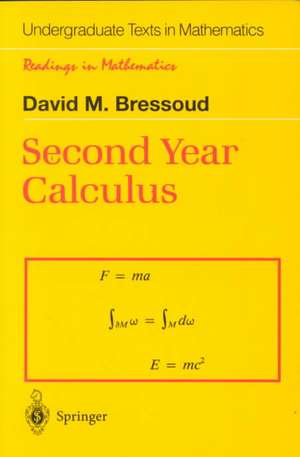
Second Year Calculus
Autor David M. Bressouden Limba Engleză Paperback – 8 aug 1991
Apreciem în Second Year Calculus capacitatea autorului David M. Bressoud de a transforma un curs tehnic de analiză matematică într-o narațiune coerentă despre evoluția științei. David M. Bressoud, o autoritate recunoscută în pedagogia matematică și președinte în cadrul Mathematical Association of America (MAA), își fundamentează lucrarea pe ideea că rigoarea matematică nu poate fi separată de contextul fizic care a generat-o. Reținem abordarea sa distinctivă: în loc să prezinte calculul multivariabil ca pe un set abstract de reguli, volumul urmărește tranziția de la viziunea mecanizată a lumii din „Principia” lui Newton până la intuițiile radicale ale lui Einstein. Cititorii familiarizați cu Multivariable Calculus with Applications de Peter D. Lax vor aprecia aici o perspectivă mult mai ancorată în istoria ideilor. În timp ce Lax se concentrează pe tehnici de rezolvare a problemelor, David M. Bressoud introduce formele diferențiale ca instrument central pentru a modela fluxuri, câmpuri de forțe și legi electromagnetice. Această metodă oferă o profunzime conceptuală pe care cursurile standard o omit adesea. În contextul operei sale, volumul se aliniază perfect cu Calculus Reordered și A Radical Approach to Lebesgue's Theory of Integration, confirmând predilecția autorului pentru o pedagogie bazată pe „abordarea radicală” a genezei conceptelor. Structura cărții este riguros organizată, pornind de la mecanica cerească și algebra vectorială, trecând prin integrale de linie și multiple, pentru a culmina cu transformările liniare și calculul diferențial aplicat. Această progresie nu este doar matematică, ci și istorică, permițând studenților de la facultățile de profil să înțeleagă simetria dintre realitatea fizică și modelele matematice care o descriu.
Preț: 463.99 lei
Preț vechi: 545.88 lei
-15%
Carte tipărită la comandă
Livrare economică 30 noiembrie-14 decembrie
Specificații
ISBN-10: 038797606X
Pagini: 404
Ilustrații: 404 p.
Dimensiuni: 155 x 235 x 22 mm
Greutate: 0.61 kg
Ediția:1991
Editura: Springer
Locul publicării:New York, NY, United States
V-ar putea interesa
-
 -9%Preț: 857.85 lei942.69 lei
 -
 The Mathematica GuideBook for ProgrammingMichael TrottPreț: 555.02 lei
 -
 Implicit Functions and Solution MappingsAsen L. Dontchev-15%Preț: 622.04 lei731.81 lei
 -
 More Calculus of a Single VariablePeter R. MercerPreț: 174.85 lei
 -
 Integral and MeasureVigirdas Mackevicius-9%Preț: 1021.30 lei1122.31 lei
 -
 Mathematical Cardiac ElectrophysiologyPiero Colli Franzone-15%Preț: 676.20 lei795.53 lei
 -
 Dynamics and Control of Trajectory TubesAlexander B. KurzhanskiPreț: 419.78 lei
 -
 Tensor Spaces and Numerical Tensor CalculusWolfgang Hackbusch-24%Preț: 759.08 lei998.80 lei
 -
 Real Analysis on IntervalsA. D. R. ChoudaryPreț: 424.67 lei
 -
 Wiener Chaos: Moments, Cumulants and DiagramsGiovanni PeccatiPreț: 390.72 lei
 -
 ASYMPTOTIC METHODS FOR INTEGRALSTemme Nico M-18%Preț: 1297.75 lei1582.62 lei
Public țintă
Lower undergraduateDe ce să citești această carte
Această carte este ideală pentru studenții la matematică sau fizică care doresc să înțeleagă „de ce” în spatele formulelor de calcul multivariabil. David M. Bressoud reușește să explice concepte dificile, precum formele diferențiale, prin aplicații concrete în mecanica orbitală și electromagnetism. Este o resursă valoroasă pentru cei care vor să vadă cum matematica a devenit instrumentul suprem de modelare a realității fizice.
Despre autor
David M. Bressoud este profesor de matematică (DeWitt Wallace Professor) la Macalester College, Minnesota. Are o carieră dedicată îmbunătățirii educației matematice la nivel universitar, ocupând funcții de conducere în Mathematical Association of America (MAA). Este recunoscut pentru abordările sale inovatoare care integrează istoria matematicii în predarea analizei și integrării Lebesgue. Lucrările sale, publicate adesea la Springer, sunt puncte de referință pentru studenții care caută o înțelegere conceptuală profundă, dincolo de simpla aplicare a unor algoritmi de calcul.