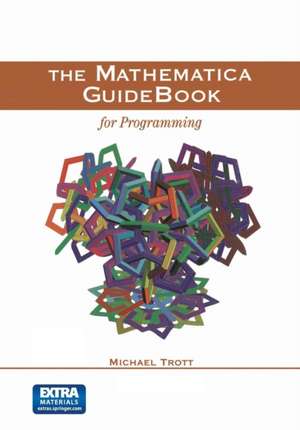
The Mathematica GuideBook for Programming
Autor Michael Trotten Limba Engleză Paperback – 2 ian 2014
Recomandăm The Mathematica GuideBook for Programming ca pe o resursă fundamentală pentru obținerea certificărilor profesionale și atingerea unui nivel avansat de competență în utilizarea sistemului Wolfram. Fiind prima parte dintr-o serie de patru volume, acest manual publicat de Springer nu se limitează la o simplă prezentare a funcțiilor, ci construiește o bază riguroasă pentru programarea tehnică de înalt nivel. Găsim în cele peste 1000 de pagini o analiză exhaustivă a structurii expresiilor și a evaluării acestora, elemente critice pentru orice utilizator care dorește să depășească stadiul de calcul numeric elementar.
Subliniem organizarea logică a volumului, care debutează cu o introducere în limbaj, explorând capacitățile și limitările versiunii 4.0, pentru ca ulterior să detalieze definirea funcțiilor, atributele acestora și concepte avansate de „Meta-Mathematica”, precum depanarea (debugging) și localizarea variabilelor. Această structură indică o progresie clară, menită să transforme un novice într-un programator capabil să gestioneze algoritmi complecși. Acoperă aceeași arie tematică precum An Introduction to Programming with Mathematica® de Richard J. Gaylord, dar cu o abordare mult mai tehnică și orientată spre detaliul arhitectural al limbajului, fiind mai degrabă un ghid de referință pentru experți decât o simplă introducere.
În contextul operei sale, această lucrare completează perfect The Mathematica GuideBook for Symbolics, transferând accentul de pe manipularea simbolică spre logica internă de programare. Experiența lui Michael Trott în cadrul Wolfram Research este vizibilă în precizia explicațiilor privind modul în care kernel-ul procesează instrucțiunile, oferind cititorului acele „trucuri sofisticate” menționate de critică pentru a utiliza programul la capacitate maximă.
Preț: 555.02 lei
Carte tipărită la comandă
Livrare economică 26 noiembrie-10 decembrie
Specificații
ISBN-10: 1461264219
Pagini: 1068
Ilustrații: XXXVIII, 1028 p.
Dimensiuni: 178 x 254 x 57 mm
Greutate: 1.96 kg
Ediția:2004
Editura: Springer
Locul publicării:New York, NY, United States
V-ar putea interesa
-
 Principles of Mathematical Analysis (Int'l Ed)Walter Rudin-27%Preț: 375.39 lei516.26 lei
 -
 An Introduction to Infinite-Dimensional Linear Systems TheoryRuth F. Curtain-15%Preț: 683.78 lei804.45 lei
 -
 Matrix AnalysisRajendra Bhatia-15%Preț: 495.63 lei583.09 lei
 -
 A Short Course on Spectral TheoryWilliam Arveson-18%Preț: 940.99 lei1147.55 lei
 -
 A Course in Functional AnalysisJohn B. Conway-15%Preț: 498.70 lei586.70 lei
 -
 An Introduction to Banach Space TheoryRobert E. Megginson-15%Preț: 687.58 lei808.91 lei
 -
 Fundamental Ideas of AnalysisMichael C. Reed-27%Preț: 1352.22 lei1852.36 lei
 -
 Practical Methods of Optimization 2eFletcher-9%Preț: 695.79 lei764.60 lei
 -
 An Introduction to Numerical AnalysisKendall E. Atkinson-27%Preț: 1446.35 lei1981.31 lei
 -
 Nosql for DummiesAdam Fowler-20%Preț: 182.24 lei227.81 lei
 -
 Android App Development For DummiesMichael Burton-20%Preț: 144.04 lei180.05 lei
 -
 Pro Asynchronous Programming with .NETRichard Blewett-20%Preț: 576.48 lei720.60 lei
 -
 More Calculus of a Single VariablePeter R. MercerPreț: 174.85 lei
 -
 LEGO SpacePeter Reid-32%Preț: 126.86 lei185.41 lei
 -
 Programming in PrologWilliam F. Clocksin-20%Preț: 478.60 lei598.25 lei
 -
 Successful Test ManagementIris Pinkster-20%Preț: 355.40 lei444.26 lei
 -
 Principles of Program AnalysisFlemming Nielson-20%Preț: 567.08 lei708.85 lei
 -
 Spectral Analysis on Graph-like SpacesOlaf PostPreț: 500.57 lei
 -
 -20%Preț: 410.80 lei513.50 lei
 -
 An Introduction to Teichmüller SpacesYoichi Imayoshi-15%Preț: 638.90 lei751.66 lei
Public țintă
Professional/practitionerDe ce să citești această carte
Apreciem această carte pentru rigoarea cu care tratează programarea funcțională și pe bază de reguli în Mathematica. Este o investiție esențială pentru cercetători și ingineri care au nevoie să dezvolte aplicații robuste. Cititorul câștigă nu doar o listă de comenzi, ci o înțelegere profundă a modului în care funcționează evaluarea expresiilor, totul prin sute de exemple practice și soluții detaliate care facilitează învățarea autodidactă.
Despre autor
Michael Trott este un expert recunoscut la nivel internațional în calcul simbolic și grafică computerizată, deținând un doctorat în fizică teoretică. Din 1994, face parte din echipa de cercetare și dezvoltare de la Wolfram Research, contribuind direct la evoluția sistemului Mathematica. Din 1998, coordonează dezvoltarea Wolfram Functions Site, o resursă monumentală ce cuprinde peste 80.000 de formule și mii de vizualizări matematice. Expertiza sa vastă în fizică și algoritmi se reflectă în profunzimea și acuratețea seriei sale de ghiduri dedicate mediului Mathematica.
Descriere scurtă
The Mathematica Guidebook for Programming provides a comprehensive, step-by-step development of Mathematica programming capabilities and contains an enormous collection of examples and worked exercises. It guides the reader to become fluent in the structure of Mathematica expressions, expression evaluation, pure and named functions, and in procedural, rule-based, and functional programming constructs. Each Mathematica function is discussed in detail, explained in numerous examples. The programs for this book are available to download at the link below:
http://extras.springer.com
Unique Features:
* Step-by-step presentation of Mathematica functions assuming no prior Mathematica programming experience
* Clear organization, complete topic coverage, and an accessible writing style for both novices and experts
* Detailed discussion of procedural, rule-based, and functional programming
* Hundreds of worked examples, illustrations, programs, and fully worked self-study exercises for understanding concepts and learning how to solve real-life problems
* Website for book with additional materials:
http://www.MathematicaGuideBooks.org
Michael Trott is a symbolic computation and computer graphics expert. He holds a Ph.D. in theoretical physics and joined the R&D team at Wolfram Research in 1994, the creators of Mathematica. Since 1998, he has been leading development of the Wolfram Functions Site http://functions.wolfram.com, which currently features more that 80,000 formulas and identities, and thousands of visualizations.
Cuprins
2. Structure of Mathematica Expressions
3. Definitons and Properties of Functions
4. Meta-Mathematica
5. Restricted Patterns and Replacement Rules
6. Operations on Lists, and Linear Algebra
Recenzii
"This volume is the first one in a series of four books on the Mathematica programming language. It is best suited for those who … want to learn the sophisticated tricks of the advanced programming and to use Mathematica up to its full capacity. … The book addresses many features of human-computer interaction. … This book is one of the most valuable sources for the advanced users of Mathematica. … all the science/engineering/computer science/mathematics libraries should have this book and its companion volumes." (Matti Vuorinen, Zentralblatt MATH, Vol. 1080, 2006)
"The Mathematica GuideBook for Programming provided this reviewer with insights into solving and visualizing problems by using Mathematica … . Its wealth of exercises, annotated solutions and integrated bibliographic references should make this set a valuable part of the library of any Mathematica user. I highly recommend it." (Marvin Schaefer, MathDL, August, 2006)
"On the whole, the programming GuideBook provides a comprehensive, step-by-step development of Mathematica programming capabilities and contains an impressive collection of examples and worked exercises. Key Mathematica functions are discussed in detail, using interesting examples and put to the test in real programs." (Willy Hereman, SIAM Review, Vol. 47 (4), 2005)