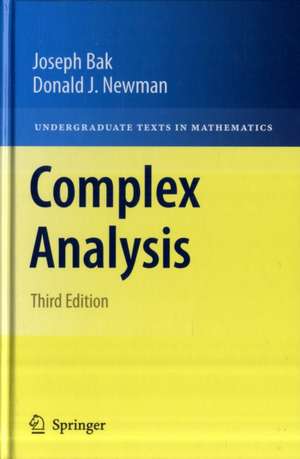
Complex Analysis
Autor Joseph Bak, Donald J. Newmanen Limba Engleză Hardback – 6 aug 2010
Observăm că literatura academică dedicată analizei complexe oscilează adesea între rigoarea abstractă excesivă și manualele pur computaționale, lăsând o lacună în ceea ce privește intuiția geometrică și contextul istoric al conceptelor. Complex Analysis, aflat la a treia ediție, vine să completeze exact acest spațiu, propunând o prezentare a teoriei clasice a variabilelor complexe într-o formă care prioritizează claritatea și înțelegerea vizuală. Față de edițiile anterioare, autorii Joseph Bak și Donald J. Newman au extins conținutul în zece din cele nouăsprezece capitole, aducând noi perspective asupra modului în care funcțiile analitice mapează planul complex. Structura volumului urmează o progresie logică, pornind de la natura numerelor complexe și evoluând spre proprietățile funcțiilor întregi, singularități izolate și teorema reziduurilor. Remarcăm includerea unor secțiuni valoroase despre metoda lui Newton și teorema Gauss-Lucas, care oferă cititorului instrumente practice pentru localizarea zerourilor polinoamelor. Volumul culminează cu explorarea funcțiilor Gamma și Zeta, demonstrând aplicabilitatea analizei complexe în alte ramuri ale matematicii. Această abordare completează perspectiva oferită de An Introduction to Complex Analysis de Ravi P. Agarwal, adăugând o dimensiune istorică mai profundă prin analiza ecuației cubice și o tratare mai detaliată a transformărilor Schwarz-Christoffel, elemente esențiale pentru înțelegerea evoluției disciplinei. Stilul este direct, iar demonstrațiile sunt calibrate pentru a fi accesibile studenților aflați la prima interacțiune serioasă cu analiza matematică superioară, fără a sacrifica precizia necesară unui text publicat de Springer.
Preț: 442.41 lei
Carte disponibilă
Livrare economică 04-18 noiembrie
Livrare express 21-27 octombrie pentru 46.70 lei
Specificații
ISBN-10: 1441972870
Pagini: 340
Ilustrații: XII, 328 p. 77 illus.
Dimensiuni: 160 x 241 x 24 mm
Greutate: 0.62 kg
Ediția:3rd edition 2010
Editura: Springer
Locul publicării:New York, NY, United States
V-ar putea interesa
-
 A Course in Real AnalysisJohn N. McDonald-31%Preț: 448.24 lei650.76 lei
 -
 Products of GroupsBernhard Amberg-33%Preț: 633.53 lei939.65 lei
 -
 How to Think About AnalysisLara Alcock-16%Preț: 167.95 lei200.24 lei
 -
 Introduction to Metric and Topological SpacesWilson A Sutherland-11%Preț: 374.36 lei420.86 lei
 -
 Limits, Limits Everywhere: The Tools of Mathematical AnalysisDavid Applebaum-14%Preț: 290.35 lei338.49 lei
 -
 Real AnalysisN. L. Carothers-19%Preț: 460.04 lei567.95 lei
 -
 Real Analysis Through Modern InfinitesimalsNader Vakil-14%Preț: 1191.60 lei1385.58 lei
 -
 A Course in Mathematical AnalysisD. J. H. GarlingPreț: 416.67 lei
 -
 The How and Why of One Variable CalculusAmol Sasane-11%Preț: 537.89 lei604.37 lei
 -
 A Problem Book in Real AnalysisAsuman G. Aksoy-8%Preț: 493.14 lei536.02 lei
 -
 A First Course in Real AnalysisMurray H. Protter-15%Preț: 459.26 lei540.31 lei
 -
 Elementary AnalysisKenneth A. RossPreț: 392.71 lei
 -
 Real AnalysisJohn M. HowiePreț: 359.53 lei
 -
 Sobolev SpacesVladimir Maz'ya-18%Preț: 1186.04 lei1446.39 lei
Public țintă
Lower undergraduateDe ce să citești această carte
Recomandăm acest volum studenților de la facultățile de matematică și fizică care doresc o introducere echilibrată în teoria funcțiilor de o variabilă complexă. Cititorul câștigă nu doar o bază teoretică solidă prin cele 19 capitole structurate pedagogic, ci și o înțelegere a aplicabilității practice a teoremelor. Este o resursă esențială pentru pregătirea examenelor de analiză matematică, oferind exemple clare pentru calculul integralelor prin metoda reziduurilor.
Despre autor
Joseph Bak și Donald J. Newman sunt matematicieni recunoscuți pentru contribuțiile lor în domeniul analizei. Donald J. Newman a fost un matematician american de prestigiu, cunoscut pentru munca sa în teoria aproximării și analiza complexă, având o carieră marcată de eleganța soluțiilor propuse pentru probleme dificile. Joseph Bak, prin experiența sa didactică, a reușit să rafineze materialul acestui curs de-a lungul a trei ediții, transformându-l într-un text de referință pentru universitățile din întreaga lume. Colaborarea lor îmbină rigoarea cercetării de nivel înalt cu o metodologie de predare accesibilă nivelului universitar licență.
Descriere scurtă
Cuprins
Recenzii
“The book of the known mathematicians J. Bak and D. Newman is an excellent introduction into the theory of analytic functions of one complex variable. The book is written on an elementary level and so it supports students in the early stages of their mathematical studies. … The book also contains many illustrations, examples and exercises, which give additional information and explanations.” (Konstantin Malyutin, Zentralblatt MATH, Vol. 1205, 2011)