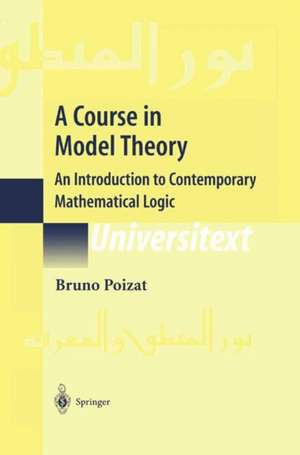
A Course in Model Theory: Universitext
Autor Bruno Poizat Traducere de M. Kleinen Limba Engleză Hardback – 25 mai 2000
Observăm că literatura academică în limba română și chiar cea internațională a resimțit multă vreme lipsa unei punți accesibile între logica matematică clasică și teoria modelelor contemporană, care să păstreze totodată un stil narativ personal. A Course in Model Theory de Bruno Poizat, publicat în prestigioasa serie Universitext la Springer, vine să completeze exact acest gol. Volumul reprezintă traducerea mult așteptată a lucrării fundamentale din 1985, fiind actualizat cu o secțiune nouă despre numerele reale și note de subsol care clarifică evoluția disciplinei. Remarcăm structura riguroasă a celor 20 de capitole, care ghidează cititorul de la fundamentele claselor elementare de relații și metoda „back-and-forth”, până la subiecte de o complexitate ridicată precum stabilitatea, „forking”-ul și teoriile total transcendente. Această ediție din 2000 se distinge prin modul în care Bruno Poizat reușește să integreze rigoarea matematică cu o perspectivă conceptuală asupra structurilor. Subliniem că, spre deosebire de alte manuale tehnice, autorul își păstrează vocea distinctă, oferind o lectură care nu este doar un șir de teoreme, ci o explorare a logicii matematice ca limbaj universal de comunicare. Ca alternativă la Model Theory de Wilfrid Hodges pentru cursurile de logică matematică la nivel de masterat, volumul lui Poizat aduce avantajul unei abordări mai compacte și mai concentrate pe teoria stabilității, fiind mai puțin enciclopedic, dar mai axat pe mecanismele interne ale modelelor saturate. De asemenea, dacă Introduction to Model Theory de Philipp Rothmaler pune accent pe tehnica ultraproduselor pentru aplicații algebrice, lucrarea de față oferă o perspectivă mai profundă asupra fundamentelor teoretice ale ierarhiilor de stabilitate.
Din seria Universitext
-
 Preț: 415.00 lei
 - 15%
 Preț: 522.85 lei
 -
 Preț: 508.41 lei
 -
 Preț: 438.43 lei
 -
 Preț: 376.18 lei
 - 15%
 Preț: 576.20 lei
 -
 Preț: 433.98 lei
 -
 Preț: 469.31 lei
 -
 Preț: 406.96 lei
 -
 Preț: 446.52 lei
 - 15%
 Preț: 511.22 lei
 -
 Preț: 458.21 lei
 - 15%
 Preț: 555.16 lei
 - 19%
 Preț: 477.26 lei
 -
 Preț: 490.45 lei
 - 15%
 Preț: 603.75 lei
 - 15%
 Preț: 459.73 lei
 -
 Preț: 491.89 lei
 -
 Preț: 383.79 lei
 - 20%
 Preț: 319.60 lei
 - 15%
 Preț: 620.17 lei
 - 15%
 Preț: 504.56 lei
 -
 Preț: 482.65 lei
 - 15%
 Preț: 609.03 lei
 - 15%
 Preț: 534.10 lei
 - 15%
 Preț: 529.04 lei
 - 15%
 Preț: 544.31 lei
 -
 Preț: 383.03 lei
 - 15%
 Preț: 477.44 lei
 -
 Preț: 402.52 lei
 - 15%
 Preț: 525.92 lei
 - 15%
 Preț: 616.59 lei
 - 20%
 Preț: 533.29 lei
 - 15%
 Preț: 605.99 lei
 -
 Preț: 401.63 lei
 -
 Preț: 476.65 lei
 -
 Preț: 442.80 lei
 - 15%
 Preț: 529.50 lei
 - 15%
 Preț: 476.18 lei
 - 15%
 Preț: 599.27 lei
 - 15%
 Preț: 656.08 lei
 -
 Preț: 494.60 lei
 -
 Preț: 454.23 lei
 - 15%
 Preț: 453.29 lei
 -
 Preț: 395.89 lei
 -
 Preț: 404.56 lei
 -
 Preț: 392.51 lei
 -
 Preț: 411.21 lei
 -
 Preț: 490.14 lei
 -
 Preț: 462.06 lei
Preț: 612.43 lei
Preț vechi: 720.50 lei
-15%
Carte tipărită la comandă
Livrare economică 07-21 decembrie
Specificații
ISBN-10: 0387986553
Pagini: 484
Ilustrații: XXXI, 443 p.
Dimensiuni: 160 x 241 x 31 mm
Greutate: 0.84 kg
Ediția:2000
Editura: Springer
Colecția Universitext
Seria Universitext
Locul publicării:New York, NY, United States
V-ar putea interesa
-
 The Nature of ComputationCristopher Moore-21%Preț: 644.75 lei820.35 lei
 -
 Computing with Cells: Advances in Membrane ComputingPierluigi Frisco-31%Preț: 823.26 lei1194.33 lei
 -
 Not Exactly: In Praise of VaguenessKees van Deemter-16%Preț: 123.57 lei147.89 lei
 -
 Mathematical LogicGeorge Tourlakis-9%Preț: 726.68 lei798.56 lei
 -
 -27%Preț: 683.97 lei936.94 lei
 -
 Undecidable TheoriesAlfred TarskiPreț: 78.03 lei
 -
 Forcing with Random Variables and Proof ComplexityJan Krají¿ek-11%Preț: 415.81 lei467.20 lei
 -
 Conceptual MathematicsF. William Lawvere-19%Preț: 438.13 lei540.90 lei
 -
 Combinatorial Set Theory: With a Gentle Introduction to ForcingLorenz J. Halbeisen-19%Preț: 557.87 lei688.73 lei
 -
 Preț: 382.05 lei
 -
 Logic, Mathematics, and Computer ScienceYves NievergeltPreț: 410.91 lei
 -
 Preț: 486.40 lei
 -
 -18%Preț: 1176.29 lei1434.50 lei
 -
 Duality Theories for Boolean Algebras with OperatorsSteven GivantPreț: 405.84 lei
 -
 The Life and Work of Leon HenkinMaría ManzanoPreț: 398.56 lei
 -
 -15%Preț: 610.92 lei718.74 lei
 -
 -15%Preț: 489.85 lei576.30 lei
Public țintă
GraduateDe ce să citești această carte
Recomandăm această lucrare studenților de la facultățile de matematică și cercetătorilor care doresc să stăpânească fundamentele teoriei modelelor. A Course in Model Theory nu este doar un manual, ci o piesă de referință care explică sintaxa și semantica structurilor matematice moderne. Cititorul câștigă o înțelegere clară a conceptelor de stabilitate și modele saturate, esențiale pentru cercetarea actuală în logică și algebră.