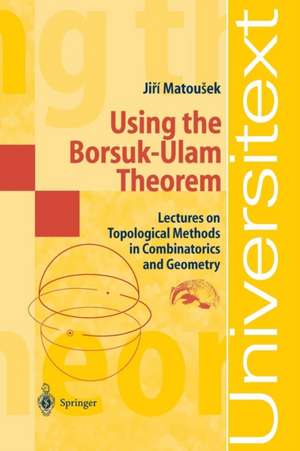
Using the Borsuk-Ulam Theorem: Universitext
Autor Jiri Matouseken Limba Engleză Paperback – 17 apr 2003
Găsim în Using the Borsuk-Ulam Theorem un material de referință pentru nivelul de master și doctorat, conceput special pentru cercetătorii din matematică discretă și informatică teoretică. Deși rezultatele obținute prin topologie algebrică în aceste domenii sunt celebre, demonstrațiile lor sunt adesea inaccesibile din cauza limbajului tehnic avansat. Autorul Jiri Matousek reușește să democratizeze acest subiect, oferind prima tratare de tip manual care explică metodele echivariante fără a recurge la concepte dificile precum omologia. Observăm o structură pedagogică riguroasă: primele două capitole pun bazele complexelor simpliciale și introduc teorema Borsuk-Ulam prin demonstrații geometrice și discrete (Lema lui Tucker). Progresia continuă natural spre aplicații directe, analizând teoreme precum cea a „sandvișului cu șuncă” sau partițiile multicolore. Merită menționat că autorul a inclus numeroase exerciții care nu sunt simple teste de verificare, ci schițează rezultate suplimentare ce completează corpul principal al textului. Ediția din 2003, publicată în seria Universitext de la Springer, acoperă aceeași arie ca A Course in Topological Combinatorics de Mark De Longueville, dar se diferențiază printr-o abordare mai axată pe eliminarea barierelor de intrare în topologia algebrică, fiind accesibilă oricărui student cu un fundal solid de licență. Cartea se aliniază preocupărilor constante ale lui Jiri Matousek pentru geometria discretă, vizibile și în lucrarea sa anterioară Lectures on Discrete Geometry, dar aici accentul se mută decisiv pe intersecția cu metodele topologice.
Din seria Universitext
-
 Preț: 415.00 lei
 - 15%
 Preț: 522.85 lei
 -
 Preț: 508.41 lei
 -
 Preț: 438.43 lei
 -
 Preț: 376.18 lei
 - 15%
 Preț: 576.20 lei
 -
 Preț: 433.98 lei
 -
 Preț: 469.31 lei
 -
 Preț: 406.96 lei
 -
 Preț: 446.52 lei
 - 15%
 Preț: 511.22 lei
 -
 Preț: 458.21 lei
 - 15%
 Preț: 555.16 lei
 - 19%
 Preț: 477.26 lei
 -
 Preț: 490.45 lei
 - 15%
 Preț: 603.75 lei
 - 15%
 Preț: 459.73 lei
 -
 Preț: 491.89 lei
 -
 Preț: 383.79 lei
 - 20%
 Preț: 319.60 lei
 - 15%
 Preț: 620.17 lei
 - 15%
 Preț: 504.56 lei
 -
 Preț: 482.65 lei
 - 15%
 Preț: 609.03 lei
 - 15%
 Preț: 534.10 lei
 - 15%
 Preț: 529.04 lei
 -
 Preț: 383.03 lei
 - 15%
 Preț: 477.44 lei
 -
 Preț: 402.52 lei
 - 15%
 Preț: 525.92 lei
 - 15%
 Preț: 616.59 lei
 - 20%
 Preț: 533.29 lei
 - 15%
 Preț: 605.99 lei
 -
 Preț: 401.63 lei
 -
 Preț: 476.65 lei
 -
 Preț: 442.80 lei
 - 15%
 Preț: 529.50 lei
 - 15%
 Preț: 476.18 lei
 - 15%
 Preț: 599.27 lei
 - 15%
 Preț: 656.08 lei
 -
 Preț: 494.60 lei
 -
 Preț: 454.23 lei
 - 15%
 Preț: 453.29 lei
 -
 Preț: 395.89 lei
 -
 Preț: 404.56 lei
 -
 Preț: 392.51 lei
 -
 Preț: 411.21 lei
 -
 Preț: 490.14 lei
 -
 Preț: 462.06 lei
Preț: 544.31 lei
Preț vechi: 640.36 lei
-15%
Carte tipărită la comandă
Livrare economică 08-22 decembrie
Specificații
ISBN-10: 3540003622
Pagini: 228
Ilustrații: XII, 214 p.
Dimensiuni: 155 x 235 x 15 mm
Greutate: 0.34 kg
Ediția:2003
Editura: Springer
Colecția Universitext
Seria Universitext
Locul publicării:Berlin, Heidelberg, Germany
V-ar putea interesa
-
 Graphs, Colourings and the Four-Colour TheoremRobert A. Wilson-28%Preț: 511.75 lei715.08 lei
 -
 -19%Preț: 337.88 lei417.25 lei
 -
 Combinatorics: Ancient & ModernRobin Wilson-23%Preț: 813.52 lei1056.52 lei
 -
 Random GraphsSvante Janson-9%Preț: 1124.51 lei1235.72 lei
 -
 CombinatoricsRussell Merris-9%Preț: 1193.27 lei1311.29 lei
 -
 -17%Preț: 284.74 lei344.46 lei
 -
 -23%Preț: 636.84 lei827.07 lei
 -
 Preț: 288.11 lei
 -
 Combinatorics of Set PartitionsToufik Mansour-18%Preț: 1490.34 lei1817.49 lei
 -
 -15%Preț: 724.43 lei852.27 lei
 -
 Graph TheoryAdrian BondyPreț: 414.96 lei
 -
 Looking at NumbersTom Johnson-15%Preț: 667.23 lei784.98 lei
Public țintă
ResearchDe ce să citești această carte
Această carte este esențială pentru matematicienii și informaticienii care doresc să utilizeze instrumente topologice fără a parcurge un întreg curriculum de topologie algebrică. Veți câștiga o înțelegere profundă a teoremei Borsuk-Ulam și a aplicațiilor sale practice în combinatorică și geometrie discretă. Este un ghid clar, bogat ilustrat, care transformă demonstrații complexe în pași logici, accesibili nivelului de cercetare incipientă.
Despre autor
Jiri Matousek (1963–2015) a fost un distins profesor de informatică la Universitatea Carolină din Praga și un cercetător recunoscut internațional în domeniul matematicii discrete și geometriei computaționale. Cu un doctorat obținut în 1990, Matousek a deținut poziții de invitat la instituții prestigioase precum ETH Zurich și Universitatea Liberă din Berlin. A fost distins cu Premiul pentru Tineri Matematicieni la al doilea Congres European de Matematică (1996) și a fost vorbitor la ICM 1998. Opera sa cuprinde lucrări fundamentale care fac legătura între optimizarea liniară, algoritmi de aproximare și geometrie discretă.
Descriere scurtă
This book is the first textbook treatment of a significant part of such results. It focuses on so-called equivariant methods, based on the Borsuk-Ulam theorem and its generalizations. The topological tools are intentionally kept on a very elementary level (for example, homology theory and homotopy groups are completely avoided). No prior knowledge of algebraic topology is assumed, only a background in undergraduate mathematics, and the required topological notions and results are gradually explained.
At the same time, many substantial combinatorial results are covered, sometimes with some of the most important results, such as Kneser's conjecture, showing them from various points of view.
The history of the presented material, references, related results, and more advanced methods are surveyed in separate subsections. The text is accompanied by numerous exercises, of varying difficulty. Many of the exercises actually outline additional results that did not fit in the main text. The book is richly illustrated, and it has a detailed index and an extensive bibliography.
This text started with a one-semester graduate course the author taught in fall 1993 in Prague. The transcripts of the lectures by the participants served as a basis of the first version. Some years later, a course partially based on that text was taught by Günter M. Ziegler in Berlin. The book is based on a thoroughly rewritten version prepared during a pre-doctoral course the author taught at the ETH Zurich in fall 2001.
Most of the material was covered in the course:Chapter 1 was assigned as an introductory reading text, and the other chapters were presented in approximately 30 hours of teaching (by 45 minutes), with some omissions throughout and with only a sketchy presentation of the last chapter.
Cuprins
Recenzii
[...]Matousek's lively little textbook now shows that Lovász' insight as well as beautiful work of many others (such as Vreci´ca and Zivaljevi´c, and Sarkaria) have opened up an exciting area of matheamtics that connects combinatorics, graph theory, algebraic topology and discrete geometry. What seemed like an ingenious trick in 1978 now presents itself as an instance of the "test set paradigm": to construct configuration spaces for combinatorial problems such that coloring, incidence or transversal problems may be translated into the (non-)existence of suitable equivariant maps.
The vivid account of this area and its ramifications by Matousek is an exciting, a coherent account of this area of topological combinatorics. It features a collection of mathematical gems written with a broad view of the subject and still with loving care for details. Recommended reading! [..]
Günter M. Ziegler (Berlin)
Zbl. MATH Volume 1060 Productions-no.: 05001
...."The book contains more than 100 exercises, many of them being compressed outlines of interesting results. As such, most of them are both challenging and interesting.
I think this book will be of interest mostly for mathematicians and graduate students. It can certainly be used in a graduate course or seminar. It has an extensive list of references and it covers many interesting and not-so-easy results, with proofs that are sometimes easier than in the original papers. I wouldn't say that this book is an "easy read", but it is very well written, very interesting, and very informative".
Mihaela Poplicher, MAA Online
"This book is intended to make elementary topological methods more accessible to those who work in other areas of mathematics. … This excellent book is useful for specialists in discrete geometry, combinatorics and computer science who want to learn how algebraic topology can be used in theirdiscipline. It is also very suitable as a textbook for such a course." (Ferenc Fodor, Acta Scientiarum Mathematicarum, Vol. 71, 2005)
"The book is addressed to mathematicians, scientists, and engineers working on signal and image processing and medical imaging. It is written by experts and for experts, but each chapter has an introductory part written for non-specialists, giving them the possibility to find what the chapter is dealing with. The book contains important contributions to the areas mentioned in the title: sampling, wavelets and tomography." (S. Cobzas, Studia universitatis Babes-Bolyai Mathematica, Vol. XLIX (2), 2004)
"This book … is based on a couple of graduate courses in ‘topological combinatorics’ taught by the author … . The book contains more than 100 exercises, many of them being compressed outlines of interesting results. As such, most of them are both challenging and interesting. … It has an extensive list of references and it covers many interesting and no-so-easy results, with proofs that are sometimes easier than in the original papers. … it is very well written, very interesting, and very informative." (Mihaela Poplicher, MAA Online, January, 2005)
"This excellent textbook is based on lecture notes by the author on applications of some topological methods in combinatorics and geometry. … All chapters include exercises and historical and bibliographical notes. Many hints for further reading are given. … topologists will find here some nice applications for their lectures." (Zdzislaw Dzedzej, Mathematical Reviews, 2004 i)
"Matoušek’s lively little textbook now shows that Lovász’ insight as well as beautiful work of many others … have opened up an exciting area of mathematics that connects combinatorics, graph theory, algebraic topology and discrete geometry. … The vivid account of this area and its ramifications by Matoušek is an exciting, a coherent account of this area oftopological combinatorics. It features a collection of mathematical gems written with a broad view of the subject and still with loving care for details. Recommended reading!" (Günter M. Ziegler, Zentralblatt MATH, Vol. 1016, 2003)
"This textbook explains elementary but powerful topological methods based on the Borsuk-Ulam theorem and its generalizations. It covers many substantial results, sometimes with proofs simpler than those in the original papers." (L'ENSEIGNEMENT MATHEMATIQUE, Vol. 49 (1-2), 2003)
Textul de pe ultima copertă
Matousek's lively little textbook now shows that Lovász' insight as well as beautiful work of many others (such as Vrecica and Zivaljevic, and Sarkaria) have opened up an exciting area of mathematics that connects combinatorics, graph theory, algebraic topology and discrete geometry. What seemed like an ingenious trick in 1978 now presents itself as an instance of the "test set paradigm": to construct configuration spaces for combinatorial problems such that coloring, incidence or transversal problems may be translated into the (non-)existence of suitable equivariant maps.
The vivid account of this area and its ramifications by Matousek is an exciting, a coherent account of this area of topological combinatorics. It features a collection of mathematical gems written with a broad view of the subject and still with loving care for details. Recommended reading! […]"
Günter M.Ziegler (Berlin)
Zbl. MATH Volume 1060 Productions-no.: 05001