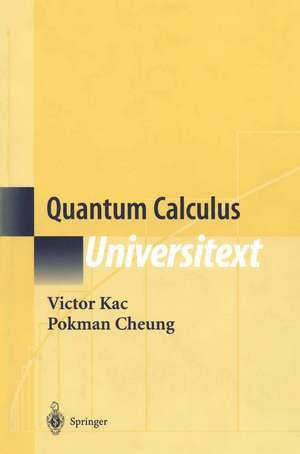
Quantum Calculus: Universitext
Autor Victor Kac, Pokman Cheungen Limba Engleză Paperback – 16 noi 2001
Descoperim în Quantum Calculus o abordare pedagogică riguroasă a unui domeniu care, deși își are rădăcinile în lucrările lui Euler și Jacobi, a devenit esențial în contextul actual al informaticii cuantice și al fizicii particulelor. Reținem premisa centrală a volumului: posibilitatea de a construi un sistem de calcul diferențial și integral fără a recurge la conceptul de limită. Această ediție, publicată de Springer în seria Universitext, transformă notele de curs de la MIT ale lui Pokman Cheung într-un instrument de lucru structurat, care ghidează cititorul prin mecanismele fundamentale ale q-calculului și h-calculului.
Remarcăm progresia logică a conținutului, care începe cu definițiile derivatelor q și h și avansează natural către subiecte complexe precum identitatea triplului produs a lui Jacobi, funcțiile hipergeometrice q și formula produsului lui Ramanujan. Deși Victor Kac este cunoscut pentru lucrări teoretice de anvergură, precum Infinite Dimensional Groups with Applications, aici adoptă un stil mult mai accesibil, axat pe aplicabilitatea imediată. Cartea este comparabilă cu Generalized Quantum Calculus with Applications de Svetlin G. Georgiev în ceea ce privește rigurozitatea, dar se distinge prin faptul că este actualizată special pentru nivelul de licență, oferind o punte între algebra liniară de bază și analiza matematică avansată. În timp ce alte tratate, precum cel al lui Thomas Ernst, încearcă să rezolve inconsecvențele de notație din domeniu, Kac și Cheung aleg să urmeze liniile calculului tradițional, făcând descoperirea rezultatelor clasice să pară o inevitabilitate matematică.
Din seria Universitext
- 13%
 Preț: 398.41 lei
 - 15%
 Preț: 576.20 lei
 - 15%
 Preț: 402.83 lei
 -
 Preț: 404.03 lei
 -
 Preț: 433.98 lei
 - 15%
 Preț: 522.85 lei
 -
 Preț: 406.96 lei
 -
 Preț: 415.00 lei
 - 13%
 Preț: 395.54 lei
 -
 Preț: 376.18 lei
 -
 Preț: 508.41 lei
 -
 Preț: 469.31 lei
 - 15%
 Preț: 511.22 lei
 -
 Preț: 458.21 lei
 - 15%
 Preț: 555.16 lei
 - 19%
 Preț: 469.00 lei
 -
 Preț: 490.45 lei
 - 15%
 Preț: 603.75 lei
 - 15%
 Preț: 459.73 lei
 -
 Preț: 491.89 lei
 -
 Preț: 383.79 lei
 - 20%
 Preț: 319.60 lei
 - 15%
 Preț: 620.17 lei
 - 15%
 Preț: 504.56 lei
 -
 Preț: 482.65 lei
 - 15%
 Preț: 609.03 lei
 - 15%
 Preț: 534.10 lei
 - 15%
 Preț: 529.04 lei
 - 15%
 Preț: 544.31 lei
 -
 Preț: 383.03 lei
 - 15%
 Preț: 477.44 lei
 -
 Preț: 402.52 lei
 - 15%
 Preț: 525.92 lei
 - 15%
 Preț: 616.59 lei
 - 20%
 Preț: 533.29 lei
 - 15%
 Preț: 605.99 lei
 -
 Preț: 401.63 lei
 -
 Preț: 476.65 lei
 -
 Preț: 442.80 lei
 - 15%
 Preț: 529.50 lei
 - 15%
 Preț: 476.18 lei
 - 15%
 Preț: 563.39 lei
 - 15%
 Preț: 656.08 lei
 -
 Preț: 494.60 lei
 -
 Preț: 454.23 lei
 - 15%
 Preț: 453.29 lei
 -
 Preț: 395.89 lei
 -
 Preț: 404.56 lei
 -
 Preț: 392.51 lei
 -
 Preț: 411.21 lei
Preț: 462.06 lei
Carte tipărită la comandă
Livrare economică 28 noiembrie-12 decembrie
Specificații
ISBN-10: 0387953418
Pagini: 124
Ilustrații: IX, 112 p.
Dimensiuni: 155 x 235 x 8 mm
Greutate: 0.2 kg
Ediția:Softcover reprint of the original 1st ed. 2002
Editura: Springer
Colecția Universitext
Seria Universitext
Locul publicării:New York, NY, United States
V-ar putea interesa
-
 Stochastic Calculus for Finance ISteven Shreve-17%Preț: 409.92 lei493.88 lei
 -
 Animating CalculusEd Packel-15%Preț: 604.62 lei711.31 lei
 -
 -18%Preț: 985.08 lei1201.32 lei
 -
 -18%Preț: 987.43 lei1204.18 lei
 -
 CalculusMorris KlinePreț: 334.98 lei
 -
 Preț: 90.15 lei
 -
 Lie Theory and GeometryJean-Luc Brylinski-18%Preț: 1174.56 lei1432.39 lei
 -
 Preț: 113.94 lei
 -
 Calculus For Dummies, 2nd EditionMark RyanPreț: 109.93 lei
 -
 Nonlinear Analysis and Variational ProblemsPanos M. Pardalos-18%Preț: 960.75 lei1171.65 lei
 -
 Introduction to Stochastic Calculus Applied to FinanceDamien Lamberton-18%Preț: 715.44 lei872.49 lei
 -
 Functional Calculi: Theory and Empirical EvidenceCARLOS BOSCH-15%Preț: 562.12 lei661.32 lei
Public țintă
Lower undergraduateDe ce să citești această carte
Această lucrare este ideală pentru studenții de la facultățile de matematică sau fizică care doresc să înțeleagă bazele calculului cuantic fără complexitatea analizei matematice tradiționale. Cititorul câștigă o perspectivă nouă asupra identităților Euler și a funcțiilor trigonometrice, totul într-un format compact. Este un punct de plecare excelent pentru oricine vizează o carieră în cercetarea matematică sau în dezvoltarea tehnologiilor cuantice, fiind scrisă într-un limbaj clar și bine organizat.
Cuprins
Recenzii
MATHEMATICAL REVIEWS
"The authors have written a very accessible book. They have deviated from the classical approach and notation in a way that should prove quite successful."
AMERICAN MATHEMATICAL MONTHLY
"Kac and Cheung’s book may be welcomed as a succinct, well-organized, and well-motivated account, accessible to undergraduate students, of an important are of mathematics that has found numerous applications in the last twenty years. The authors have given a unified treatment of q-calculus and h-calculus by treating these two areas within the same framework. The prerequisites of the book are essentially a knowledge of elementary calculus and linear algebra, though an acquaintance with infinite products would be useful. It could easily be used as a text for a junior- or senior-level topics course if the instructor supplied background on infinite products. Since the authors have also given complete computational details, it is also possible for an undergraduate to study the book independently. I recommend this book as a concise introduction to a subject that is not only of lively current interest, but also has roots in the works of our great mathematical ancestors."
"During the course of quantum calculus along the lines of traditional calculus, many important results and notions of combinatorics, number theory and other fields of mathematics are introduced. … many results from the 18-th and 19-th centuries are treated in detail … . The book is based on lectures and seminars given by the first author at MIT; it is addressed mainly to undergraduate students." (European Mathematical Society Newsletter, March, 2004)
"Quantum calculus is essentially ordinary calculus without limits. The book … is based on the lectures and seminars given by Professor Kac … . proofs and calculations are succinct but eminently clear. … This book is compact and covers a lot of material in its hundreds or sopages. On the whole, it is accessible to anyone with an undergraduate knowledge of calculus … . the logically constructed exposition makes it an intellectually satisfying read. I recommend it warmly." (James Gazet, The Mathematical Gazette, Vol. 88 (512), 2004)
"Kac and Cheung’s book may be welcomed as a succinct, well-organized, and well-motivated account, accessible to undergraduate students, of an important area of mathematics that has found numerous applications in the last twenty years. … It could easily be used as a text for a junior- or senior-level topics course … . I recommend this book as a concise introduction to a subject that is not only of lively current interest, but also has roots in the works of our great mathematical ancestors." (Ranjan Roy, American Mathematical Monthly, August/September, 2003)
"This is a book written to be useable as an undergraduate textbook … . Its subject is what used to be known as the calculus of finite differences, in both additive and scaling (or multiplicative) forms. Its point of view on the subject is not classical but modern and ‘quantum’ … . The authors have written a very accessible book. They have deviated from the classical approach and notation in a way that should prove quite successful." (P. D. F. Ion, Mathematical Reviews, Issue 2003 i)
"This little book deals with three main themes. First it gives a very clear and rather complete introduction to q-analogues of elementary calculus, which the authors call ‘quantum-calculus’. … The second theme is an application to number theory … . Finally they show how the calculus of finite differences … can be derived in an analogous manner. All things considered in the book can be recommended to undergraduate students as a good readable introduction to the fascinating world of q-analysis." (J. Cigler, Monatshefte für Mathematik, Vol. 138 (3), 2003)
"Simply put, quantum calculus is ordinary calculus without takinglimits. This undergraduate text develops two types of quantum calculi, the q-calculus and the h-calculus. As this book develops quantum calculus along the lines of traditional calculus, the reader discovers, with a remarkable inevitability, many important notions and results of classical mathematics. This book is based on lectures and seminars given by Professor Kac over the last few years at MIT." (L’Enseignemanet Mathematique, Vol. 48 (1-2), 2002)
Textul de pe ultima copertă
This book is written at the level of a first course in calculus and linear algebra and is aimed at undergraduate and beginning graduate students in mathematics, computer science, and physics. It is based on lectures and seminars given by Professor Kac over the last few years at MIT.
Victor Kac is Professor of Mathematics at MIT. He is an author of 4 books and over a hundred research papers. He was awarded the Wigner Medal for his work on Kac-Moody algebras that has numerous applications to mathematics and theoretical physics. He is a honorary member of the Moscow Mathematical Society.
Pokman Cheung graduated from MIT in 2001 after three years of undergraduate studies. He is presently a graduate student at Stanford University.