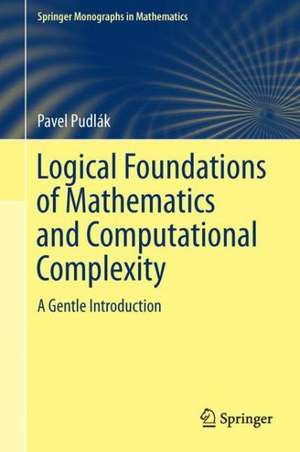
Logical Foundations of Mathematics and Computational Complexity: Springer Monographs in Mathematics
Autor Pavel Pudláken Limba Engleză Hardback – 31 mai 2013
Bazându-ne pe datele bibliografice furnizate de Springer și pe recenziile de specialitate, observăm că Logical Foundations of Mathematics and Computational Complexity reprezintă o sinteză de anvergură care redefinește fundamentele matematicii prin prisma complexității computaționale. Pavel Pudlák, o figură marcantă în logica matematică, propune aici o teză curajoasă: complexitatea este la fel de esențială pentru fundamentele matematicii precum sunt conceptele tradiționale de computabilitate și demonstrabilitate. Subliniem că această ediție din Springer Monographs in Mathematics nu se limitează la o expunere teoretică rigidă, ci pune accent pe esența conceptelor, oferind o progresie didactică de la intuiții accesibile la rigoare formală în cele peste 700 de pagini. Structura volumului este organizată tematic, pornind de la lumea matematicianului și limbajul logic, trecând prin teoria mulțimilor și ajungând la nucleul dur al cercetării actuale: complexitatea demonstrațiilor și relația dintre consistență, adevăr și existență. Recomandăm atenție sporită capitolelor dedicate demonstrațiilor de imposibilitate, o temă recurentă în opera autorului. Această lucrare continuă și extinde preocupările din Metamathematics of First-Order Arithmetic, unde Pavel Pudlák a sistematizat rezultatele fundamentale ale aritmeticii, însă aici accentul se mută decisiv către intersecția cu informatica teoretică. În comparație cu Arithmetic, Proof Theory, and Computational Complexity de Peter Clote, care se concentrează pe aritmetica mărginită și sisteme propoziționale într-un format de articole colectate, monografia lui Pudlák oferă o abordare mult mai unitară și narativă. Dacă lucrarea lui Clote este un compendiu tehnic, volumul de față este o explorare conceptuală integrată, fiind ideală pentru cercetătorii care caută să înțeleagă mizele filosofice și matematice ale complexității, nu doar rezultatele brute.
Din seria Springer Monographs in Mathematics
- 18%
 Preț: 947.92 lei
 - 20%
 Preț: 652.66 lei
 - 17%
 Preț: 591.81 lei
 - 18%
 Preț: 1008.68 lei
 - 18%
 Preț: 1004.09 lei
 - 15%
 Preț: 670.80 lei
 -
 Preț: 437.04 lei
 - 18%
 Preț: 1451.24 lei
 -
 Preț: 408.29 lei
 - 15%
 Preț: 667.74 lei
 -
 Preț: 411.61 lei
 -
 Preț: 405.36 lei
 -
 Preț: 407.89 lei
 - 18%
 Preț: 817.79 lei
 - 18%
 Preț: 1280.82 lei
 - 15%
 Preț: 514.29 lei
 - 18%
 Preț: 828.30 lei
 - 18%
 Preț: 950.75 lei
 - 15%
 Preț: 677.75 lei
 - 15%
 Preț: 486.27 lei
 - 15%
 Preț: 667.47 lei
 - 15%
 Preț: 659.45 lei
 - 18%
 Preț: 824.96 lei
 -
 Preț: 399.46 lei
 - 18%
 Preț: 996.04 lei
 - 15%
 Preț: 668.60 lei
 - 15%
 Preț: 671.43 lei
 - 15%
 Preț: 669.50 lei
 - 15%
 Preț: 599.00 lei
 - 15%
 Preț: 667.47 lei
 - 15%
 Preț: 671.56 lei
 - 18%
 Preț: 939.80 lei
 - 15%
 Preț: 673.39 lei
 - 18%
 Preț: 937.71 lei
 - 18%
 Preț: 935.01 lei
 - 18%
 Preț: 920.90 lei
 - 15%
 Preț: 679.94 lei
 - 18%
 Preț: 827.90 lei
 - 15%
 Preț: 687.80 lei
 - 15%
 Preț: 671.39 lei
 -
 Preț: 399.14 lei
 - 15%
 Preț: 729.48 lei
 - 18%
 Preț: 1288.17 lei
 - 18%
 Preț: 1069.40 lei
 -
 Preț: 429.87 lei
 - 18%
 Preț: 988.46 lei
 - 18%
 Preț: 997.15 lei
 -
 Preț: 402.25 lei
 - 18%
 Preț: 924.14 lei
 - 15%
 Preț: 674.92 lei
Preț: 1176.29 lei
Preț vechi: 1434.50 lei
-18%
Carte tipărită la comandă
Livrare economică 28 noiembrie-12 decembrie
Specificații
ISBN-10: 3319001183
Pagini: 712
Ilustrații: XIV, 695 p. 49 illus., 4 illus. in color.
Dimensiuni: 160 x 241 x 44 mm
Greutate: 1.17 kg
Ediția:2013
Editura: Springer
Colecția Springer Monographs in Mathematics
Seria Springer Monographs in Mathematics
Locul publicării:Cham, Switzerland
V-ar putea interesa
-
 Elements of Set TheoryHerbert B. Enderton-31%Preț: 382.75 lei558.35 lei
 -
 Constructibility and Mathematical ExistenceCharles S. Chihara-19%Preț: 358.99 lei445.07 lei
 -
 Conceptual Notation and Related ArticlesGottlob Frege-33%Preț: 851.94 lei1266.73 lei
 -
 -33%Preț: 693.34 lei1029.54 lei
 -
 -28%Preț: 471.91 lei659.32 lei
 -
 In Defence of Objective BayesianismJon Williamson-31%Preț: 709.08 lei1023.99 lei
 -
 A Course in Model TheoryBruno Poizat-15%Preț: 612.43 lei720.50 lei
 -
 Godel's ProofErnest NagelPreț: 138.96 lei
 -
 TopoiRobert Goldblatt-23%Preț: 162.04 lei211.69 lei
 -
 Axiomatic Set TheoryPatrick SuppesPreț: 104.50 lei
 -
 First-Order LogicRaymond M. SmullyanPreț: 64.77 lei
 -
 Lectures in Logic and Set TheoryGeorge TourlakisPreț: 438.01 lei
 -
 Mathematical Logic for Computer ScienceMordechai Ben-Ari-20%Preț: 395.53 lei494.41 lei
 -
 The Joy of SetsKeith Devlin-15%Preț: 443.91 lei522.24 lei
 -
 Preț: 497.59 lei
 -
 Sets, Logic and CategoriesPeter J. CameronPreț: 280.57 lei
 -
 Lattice Theory: Special Topics and ApplicationsGeorge Grätzer-15%Preț: 656.38 lei772.20 lei
 -
 -15%Preț: 735.59 lei865.39 lei
Public țintă
ResearchDe ce să citești această carte
Recomandăm această carte pentru perspectiva sa integrată asupra logicii și complexității. Cititorul câștigă o înțelegere profundă a modului în care limitările computaționale definesc posibilitățile matematice. Este o resursă esențială pentru doctoranzi și cercetători, oferind claritate conceptuală într-un domeniu tehnic vast, fiind scrisă de unul dintre cei mai respectați logicieni contemporani.
Descriere scurtă
Emphasis is on explaining the essence of concepts and the ideas of proofs, rather than presenting precise formal statements and full proofs. Each section starts with concepts and results easily explained, and gradually proceeds to more difficult ones. The notes after each section present some formal definitions, theorems and proofs.
Logical Foundations of Mathematics and Computational Complexity is aimed at graduate students of all fields of mathematics who are interested in logic, complexity and foundations. It will also be of interest for both physicists and philosophers who are curious to learn the basics of logic and complexity theory.
Cuprins
Recenzii
“For the non-expert it offers indeed a ‘gentle introduction’ to logic that is well selected and excellently explained. And for the logician it certainly offers some of the best introductions to those topics outside their area of direct expertise. … it contains plenty of informal explanations, intuition and motivation. … It is truly a gift to the logic and wider communities … . This book is very enjoyable to read and I wish it all success.” (Olaf Beyersdorff, Mathematical Reviews, August, 2014)
“It spans the historical, logical, and at times philosophical underpinnings of the theory of computational complexity. Students of mathematics seeking a transition to higher mathematics will find it helpful, as will mathematicians with expertise in other areas. … an excellent choice for a first text in studying complexity, or as a clarifying adjunct to any assigned text in this area. … a compact guide for graduate students with a need for or interest in computational complexity and its foundations.” (Tom Schulte, MAA Reviews, July, 2014)
“This book, exactly as indicated by its title, deals with the main philosophical, historical, logical and mathematical aspects … in a quite approachable and attractive way. … the prospective readers of this book are mathematicians with an interest in the foundations, philosophers with a good background in mathematics, and also philosophically minded scientists. Due to the author’s nice style, the book will be a very good choice for the first text in studying this subject.” (Branislav Boričić, zbMATH, Vol. 1270, 2013)