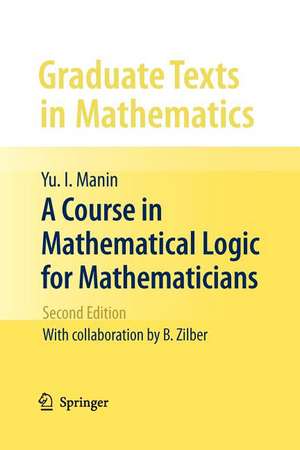
A Course in Mathematical Logic for Mathematicians: Graduate Texts in Mathematics, cartea 53
Autor Yu I. Manin Traducere de Neal Koblitzen Limba Engleză Paperback – 3 mar 2012
Recomandăm A Course in Mathematical Logic for Mathematicians ca o resursă fundamentală pentru programele de masterat și doctorat în matematică pură, fiind concepută special pentru a răspunde nevoilor de rigoare ale cercetătorilor. Considerăm că relevanța acestui curs pentru examenele de grad și pentru fundamentarea cercetării în bazele matematicii este dublată de perspectiva unică a lui Yu I. Manin, un matematician care abordează logica nu ca pe o ramură izolată, ci ca pe un instrument viu, integrat în algebra modernă și geometria algebrică. Această a doua ediție aduce actualizări esențiale într-un domeniu care a evoluat spectaculos din 1977. În timp ce primele opt capitole păstrează nucleul solid despre limbaje formale, deductibilitate și teoremele de incompletitudine ale lui Gödel, noutatea absolută constă în Partea a IV-a, dedicată Teoriei Modelelor. Această secțiune, semnată de Boris I. Zilber, demonstrează cum perspectivele din logica formală pot soluționa probleme clasice de matematică convențională. Structura este riguros organizată pe patru direcții: Demonstrabilitate, Calculabilitate, sinteza acestora și Teoria Modelelor, culminând cu discuții despre problemele P/NP și aspectele cuantice ale computației. În contextul operei sale, A Course in Mathematical Logic for Mathematicians reflectă aceeași rigoare structurală pe care o regăsim în Homological Algebra, unde Yu I. Manin explorează categoriile derivate. Spre deosebire de manualele introductive, această lucrare face tranziția de la limbajul set-teoretic spre intuiția categoriilor superioare. Considerăm volumul o alternativă sofisticată la A Course on Mathematical Logic de Shashi Mohan Srivastava pentru cursurile de fundamentele matematicii, având avantajul unei profunzimi teoretice superioare și al unei conexiuni directe cu cercetarea actuală din model theory și calculabilitate cuantică.
Din seria Graduate Texts in Mathematics
- 13%
 Preț: 407.97 lei
 -
 Preț: 401.21 lei
 -
 Preț: 526.10 lei
 - 15%
 Preț: 414.37 lei
 - 15%
 Preț: 403.03 lei
 - 15%
 Preț: 413.96 lei
 - 15%
 Preț: 530.03 lei
 - 15%
 Preț: 449.14 lei
 - 15%
 Preț: 532.83 lei
 - 15%
 Preț: 530.66 lei
 - 15%
 Preț: 501.17 lei
 - 15%
 Preț: 543.00 lei
 - 13%
 Preț: 406.00 lei
 -
 Preț: 446.38 lei
 - 15%
 Preț: 579.99 lei
 -
 Preț: 381.34 lei
 - 15%
 Preț: 455.36 lei
 - 15%
 Preț: 560.82 lei
 - 17%
 Preț: 453.24 lei
 - 15%
 Preț: 590.39 lei
 -
 Preț: 500.30 lei
 -
 Preț: 451.05 lei
 -
 Preț: 386.90 lei
 - 15%
 Preț: 614.52 lei
 - 15%
 Preț: 477.57 lei
 -
 Preț: 460.05 lei
 - 15%
 Preț: 498.36 lei
 -
 Preț: 504.56 lei
 - 18%
 Preț: 808.24 lei
 -
 Preț: 472.04 lei
 - 15%
 Preț: 621.81 lei
 -
 Preț: 398.40 lei
 - 15%
 Preț: 656.51 lei
 - 15%
 Preț: 602.39 lei
 - 15%
 Preț: 531.78 lei
Preț: 497.59 lei
Carte tipărită la comandă
Livrare economică 08-22 decembrie
Specificații
ISBN-10: 1461424798
Pagini: 404
Ilustrații: XVIII, 384 p. 12 illus.
Dimensiuni: 155 x 235 x 22 mm
Greutate: 0.61 kg
Ediția:2nd edition 2010
Editura: Springer
Colecția Graduate Texts in Mathematics
Seria Graduate Texts in Mathematics
Locul publicării:New York, NY, United States
V-ar putea interesa
-
 -15%Preț: 213.79 lei252.46 lei
 -
 Introduction to Boolean AlgebrasSteven GivantPreț: 462.91 lei
 -
 Classical Descriptive Set TheoryAlexander Kechris-15%Preț: 406.68 lei478.45 lei
 -
 A Course on Borel SetsS. M. Srivastava-15%Preț: 604.88 lei711.62 lei
 -
 P-Adic AnalysisNeal KoblitzPreț: 404.25 lei
 -
 Model Theory with Applications to Algebra and AnalysisZoé Chatzidakis-11%Preț: 478.24 lei537.35 lei
 -
 A Primer of Infinistesimal AnalysisJohn. L Bell-11%Preț: 538.27 lei604.79 lei
 -
 A Course of Modern AnalysisE. T. WhittakerPreț: 280.51 lei
 -
 A Concise Introduction to Mathematical LogicWolfgang Rautenberg-15%Preț: 506.81 lei596.25 lei
 -
 p-adic Numbers, p-adic Analysis, and Zeta-FunctionsNeal KoblitzPreț: 383.03 lei
 -
 Towards Higher CategoriesJohn C. Baez-15%Preț: 643.87 lei757.49 lei
 -
 Proofs and FundamentalsEthan D. BlochPreț: 431.78 lei
 -
 Reading, Writing, and ProvingUlrich Daepp-15%Preț: 450.42 lei529.90 lei
 -
 An Algebraic Introduction to Mathematical LogicD. W. Barnes-15%Preț: 475.06 lei558.90 lei
 -
 Alfred TarskiAndrew Mcfarland-18%Preț: 649.24 lei791.75 lei
 -
 Local Homotopy TheoryJohn F. Jardine-18%Preț: 827.27 lei1008.87 lei
 -
 The Little Green Math BookBrandon RoyalPreț: 96.97 lei
 -
 Mathematical Events of the Twentieth CenturyA. A. Bolibruch-18%Preț: 993.04 lei1211.02 lei
 -
 Homological AlgebraS.I. Gelfand-15%Preț: 618.83 lei728.03 lei
 -
 Advances in Cryptology - CRYPTO '96Neal Koblitz-20%Preț: 342.06 lei427.57 lei
 -
 Random CurvesNeal Koblitz-15%Preț: 733.89 lei863.39 lei
 -
 -15%Preț: 622.59 lei732.46 lei
 -
 Introduction to Modern Number TheoryYu I. Manin-18%Preț: 1067.28 lei1301.55 lei
 -
 -15%Preț: 649.14 lei763.69 lei
 -
 -19%Preț: 413.56 lei510.58 lei
 -
 Simulation en Magnéto-statiqueMohamed MENADPreț: 336.03 lei
 -
 -19%Preț: 538.39 lei664.68 lei
Public țintă
GraduateDe ce să citești această carte
Recomandăm acest volum studenților avansați și cercetătorilor care doresc o înțelegere a logicii matematice din perspectiva unui practician al algebrei. Cititorul câștigă acces la o sinteză modernă ce include teoria modelelor și computație cuantică, elemente adesea omise în textele standard. Este motivul ideal pentru a aprofunda legătura dintre structurile formale și matematica de vârf, trecând dincolo de simpla manipulare a simbolurilor logice.
Despre autor
Yu. I. Manin este un matematician de renume mondial, cunoscut pentru contribuțiile sale fundamentale în geometria algebrică, algebra omologică și fizica matematică. Profesor la Institutul Max Planck pentru Matematică, opera sa include lucrări de referință precum Homological Algebra și Introduction to Modern Number Theory. Abordarea sa în domeniul logicii matematice este marcată de o viziune unificatoare, căutând mereu punți de legătură între fundamentele teoretice și aplicațiile lor în structuri matematice complexe, fiind unul dintre primii care au propus ideea computației cuantice.
Descriere scurtă
Cuprins
Recenzii
"As one might expect from a graduate text on logic by a very distinguished algebraic geometer, this book assumes no previous acquaintance with logic, but proceeds at a high level of mathematical sophistication. Chapters I and II form a short course. Chapter I is a very informal introduction to formal languages, e.g., those of first order Peano arithmetic and of ZFC set theory. Chapter II contains Tarski's definition of truth, Gödel's completeness theorem, and the Löwenheim-Skolem theorem. The emphasis is on semantics rather than syntax. Some rarely-covered side topics are included (unique readability for languages with parentheses, Mostowski's transitive collapse lemma, formalities of introducing definable constants and function symbols). Some standard topics are neglected. (The compactness theorem is not mentioned!) The latter part of Chapter II contains Smullyan's quick proof of Tarski's theorem on the undefinability of truth in formal arithmetic, and an account of the Kochen-Specker "no hidden variables" theorem in quantum logic. There are digressions on philosophical issues (formal logic vs. ordinary language, computer proofs). A wealth of material is introduced in these first 100 pages of the book..."--MATHEMATICAL REVIEWS
“Manin’s book on mathematical logic is addressed to a working-mathematician with some knowledge of naive set theory … . incorporate some of the exciting developments in mathematical logic of the last four decades into this edition. … The exquisite taste and the elegant style of the author have produced an outstanding treatment of mathematical logic that allows one to understand some of the pillars of this area of mathematical research … and Manin’s original treatment of the subject provides an extraordinary introduction to mathematical logic.” (F. Luef, Internationale Mathematische Nachrichten, Issue 217, August, 2011)
“The new extended title of thisbook corresponds more to its concept, contents, spirit and style. The book is really addressed to mathematicians and introduces the reader to the glorious discoveries in logic during the last century through the difficult and subtle results, problems, proofs and comments. … due to the author’s brilliant style, each part of the book provokes new opinions and pleasure of a different understanding of basic results and ideas of contemporary mathematical logic.” (Branislav Boričić, Zentralblatt MATH, Vol. 1180, 2010)
Textul de pe ultima copertă
The exposition then moves to a discussion of computability theory that is based on the notion of recursive functions and stresses number-theoretic connections. The text present a complete proof of the theorem of Davis–Putnam–Robinson–Matiyasevich as well as a proof of Higman's theorem on recursive groups. Kolmogorov complexity is also treated.
Part III establishes the essential equivalence of proof theory and computation theory and gives applications such as Gödel's theorem on the length of proofs. A new Chapter IX, written by Yuri Manin, treats, among other things, a categorical approach to the theory of computation, quantum computation, and the P/NP problem. A new Chapter X, written by Boris Zilber, contains basic results of model theory and its applications to mainstream mathematics. This theory has found deep applications in algebraic and diophantine geometry.
Yuri Ivanovich Manin is Professor Emeritus at Max-Planck-Institute for Mathematics in Bonn, Germany, Board of Trustees Professor at the Northwestern University, Evanston, IL, USA, and Principal Researcher at the Steklov Institute of Mathematics, Moscow, Russia. Boris Zilber, Professor of Mathematical Logic at the University of Oxford, has contributed the Model Theory Chapter for the second edition.