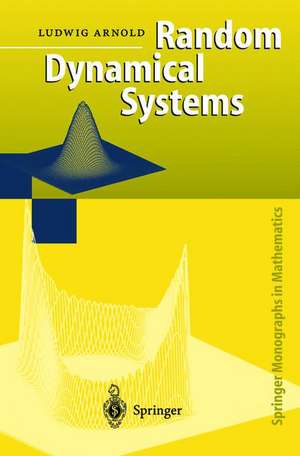
Random Dynamical Systems: Springer Monographs in Mathematics
Autor Ludwig Arnolden Limba Engleză Hardback – 19 aug 1998
Analizând bazele de date academice și literatura de specialitate din seria Springer Monographs in Mathematics, descoperim în Random Dynamical Systems o lucrare de referință care sintetizează două domenii majore ale matematicii: teoria probabilităților și sistemele dinamice. Ludwig Arnold propune aici o viziune unificată, demonstrând cum simbioza dintre teoria ergodică și sistemele dinamice netede (topologice) generează un program de cercetare distinct, capabil să rezolve probleme ce nu pot fi abordate separat. Considerăm că această monografie, structurată riguros în patru secțiuni principale, reprezintă maturizarea teoretică a conceptelor pe care autorul le-a explorat anterior în Dynamical Systems, unde punea accent pe aplicațiile în ecuații diferențiale ordinare și cu derivate parțiale. Structura volumului reflectă o progresie logică de la fundamente la aplicații avansate. Primele capitole definesc generatorii și măsurile invariante, pregătind terenul pentru nucleul teoretic al cărții: Teoria Ergodică Multiplicativă (MET). Aceasta este tratată extensiv, de la spațiul euclidian la varietăți și grupuri liniare generale. Ultima parte a cărții se concentrează pe sistemele dinamice netede, abordând teme complexe precum formele normale și teoria bifurcației în context stocastic. Acoperă aceeași arie tematică precum Topological Dynamics of Random Dynamical Systems de Nguyen Dinh Cong, dar cu o abordare mult mai tehnică și analitică, migrând de la perspectiva pur topologică spre o analiză riguroasă a măsurii și a structurilor diferențiabile. Spre deosebire de Ergodic Theory of Random Transformations de Yuri Kifer, care se limitează adesea la transformări cu o măsură invariantă comună, lucrarea lui Arnold extinde cadrul către sisteme unde factorul de conservare a măsurii interacționează dinamic cu zgomotul (noise), oferind instrumente matematice pentru modelarea fenomenelor aleatorii complexe. Este o resursă fundamentală pentru cercetătorii care solicită un fundament teoretic solid în studiul sistemelor dinamice sub influența perturbațiilor stocastice.
Din seria Springer Monographs in Mathematics
- 18%
 Preț: 947.92 lei
 - 20%
 Preț: 656.33 lei
 - 17%
 Preț: 591.81 lei
 - 18%
 Preț: 1008.68 lei
 - 18%
 Preț: 1004.09 lei
 - 15%
 Preț: 670.80 lei
 -
 Preț: 437.04 lei
 - 18%
 Preț: 1451.24 lei
 -
 Preț: 408.29 lei
 - 15%
 Preț: 667.74 lei
 -
 Preț: 411.61 lei
 -
 Preț: 405.36 lei
 -
 Preț: 407.89 lei
 - 18%
 Preț: 817.79 lei
 - 18%
 Preț: 1280.82 lei
 - 15%
 Preț: 514.29 lei
 - 18%
 Preț: 828.30 lei
 - 18%
 Preț: 950.75 lei
 - 15%
 Preț: 677.75 lei
 - 15%
 Preț: 486.27 lei
 - 15%
 Preț: 667.47 lei
 - 15%
 Preț: 659.45 lei
 - 18%
 Preț: 824.96 lei
 -
 Preț: 399.46 lei
 - 18%
 Preț: 996.04 lei
 - 15%
 Preț: 668.60 lei
 - 15%
 Preț: 671.43 lei
 - 15%
 Preț: 669.50 lei
 - 15%
 Preț: 599.00 lei
 - 15%
 Preț: 667.47 lei
 - 15%
 Preț: 671.56 lei
 - 18%
 Preț: 939.80 lei
 - 15%
 Preț: 673.39 lei
 - 18%
 Preț: 937.71 lei
 - 18%
 Preț: 935.01 lei
 - 18%
 Preț: 920.90 lei
 - 15%
 Preț: 679.94 lei
 - 15%
 Preț: 687.80 lei
 - 15%
 Preț: 671.39 lei
 -
 Preț: 399.14 lei
 - 15%
 Preț: 729.48 lei
 - 18%
 Preț: 1288.17 lei
 - 18%
 Preț: 1069.40 lei
 -
 Preț: 429.87 lei
 - 18%
 Preț: 988.46 lei
 - 18%
 Preț: 997.15 lei
 -
 Preț: 402.25 lei
 - 18%
 Preț: 924.14 lei
 - 15%
 Preț: 674.92 lei
Preț: 827.90 lei
Preț vechi: 1009.63 lei
-18%
Carte tipărită la comandă
Livrare economică 26 noiembrie-10 decembrie
Specificații
ISBN-10: 3540637583
Pagini: 612
Ilustrații: XV, 586 p.
Dimensiuni: 160 x 241 x 39 mm
Greutate: 1.02 kg
Ediția:1998
Editura: Springer
Colecția Springer Monographs in Mathematics
Seria Springer Monographs in Mathematics
Locul publicării:Berlin, Heidelberg, Germany
V-ar putea interesa
-
 Differential Equations Workbook for DummiesSteven HolznerPreț: 123.85 lei
 -
 Control Theory for Partial Differential EquationsIrena Lasiecka-11%Preț: 573.16 lei644.00 lei
 -
 Advanced Mathematics for ApplicationsAndrea Prosperetti-11%Preț: 543.09 lei610.21 lei
 -
 Chaos and Coarse Graining in Statistical MechanicsPatrizia Castiglione-14%Preț: 948.67 lei1103.11 lei
 -
 Statistical Methods for Stochastic Differential EquationsMathieu Kessler-18%Preț: 934.82 lei1140.03 lei
 -
 Asymptotic Chaos Expansions in FinanceDavid NicolayPreț: 389.52 lei
 -
 -15%Preț: 661.07 lei777.73 lei
 -
 -18%Preț: 1241.29 lei1513.76 lei
 -
 -18%Preț: 1236.53 lei1507.97 lei
 -
 Preț: 457.65 lei
 -
 Bifurcation Theory of Functional Differential EquationsShangjiang Guo-15%Preț: 669.81 lei788.01 lei
 -
 A Qualitative Approach to Inverse Scattering TheoryFioralba Cakoni-15%Preț: 670.25 lei788.53 lei
 -
 Applied Singular Integral EquationsB. N. Mandal-15%Preț: 588.71 lei692.60 lei
 -
 Discrete Dynamical ModelsErnesto Salinelli-41%Preț: 233.56 lei393.38 lei
 -
 Analysis and Topology in Nonlinear Differential EquationsDjairo G. de Figueiredo-15%Preț: 679.69 lei799.63 lei
 -
 Variational Methods in Nonlinear Field EquationsVieri BenciPreț: 398.29 lei
 -
 Preț: 415.92 lei
 -
 -15%Preț: 713.16 lei839.02 lei
 -
 Direct Methods in the Theory of Elliptic EquationsJindrich Necas-18%Preț: 734.85 lei896.16 lei
Public țintă
ResearchDe ce să citești această carte
Recomandăm această lucrare cercetătorilor în matematică și fizică teoretică datorită modului exhaustiv în care tratează sistemele dinamice stocastice. Cititorul câștigă acces la o sinteză unică între teoria ergodică și dinamica netedă, esențială pentru înțelegerea comportamentului pe termen lung al sistemelor complexe. Este un instrument indispensabil pentru cei care doresc să stăpânească Teorema Ergodică Multiplicativă și aplicațiile sale în teoria bifurcației.
Descriere scurtă
Cuprins
Recenzii
DMV Jahresbericht, 103. Band, Heft 2, July 2001