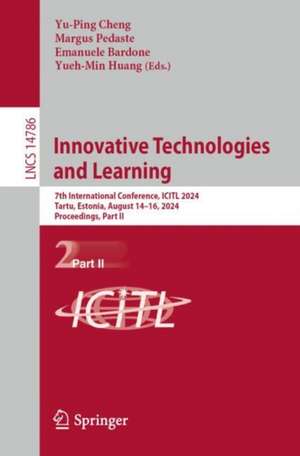
Innovative Technologies and Learning: Lecture Notes in Computer Science, cartea 14786
Editat de Yu-Ping Cheng, Margus Pedaste, Emanuele Bardone, Yueh-Min Huangen Limba Engleză Paperback – 21 iul 2024
The 60 full papers included in this book were carefully reviewed and selected from 131 submissions. They were organized in topical sections as follows:
Part One : Artificial Intelligence in Education; Computational Thinking in Education; Design and Framework of Learning Systems and Pedagogies to Innovative Technologies and Learning.
Part Two : STEM/STEAM Education; VR/AR/MR/XR in Education; and Application and Design of Generative Artificial Intelligence in Education.
Din seria Lecture Notes in Computer Science
- 20%
 Preț: 558.53 lei
 - 20%
 Preț: 571.88 lei
 - 20%
 Preț: 675.83 lei
 - 20%
 Preț: 1020.28 lei
 - 20%
 Preț: 851.78 lei
 - 20%
 Preț: 560.93 lei
 - 20%
 Preț: 633.70 lei
 - 20%
 Preț: 731.82 lei
 - 20%
 Preț: 1359.66 lei
 - 20%
 Preț: 620.33 lei
 - 20%
 Preț: 733.68 lei
 - 18%
 Preț: 945.44 lei
 - 15%
 Preț: 558.12 lei
 - 20%
 Preț: 793.92 lei
 - 20%
 Preț: 560.93 lei
 - 20%
 Preț: 748.63 lei
 - 20%
 Preț: 562.49 lei
 - 20%
 Preț: 1246.46 lei
 - 20%
 Preț: 449.81 lei
 - 20%
 Preț: 606.22 lei
 - 20%
 Preț: 620.33 lei
 - 20%
 Preț: 562.49 lei
 - 20%
 Preț: 560.93 lei
 - 20%
 Preț: 313.10 lei
 - 20%
 Preț: 828.44 lei
 - 20%
 Preț: 560.93 lei
 - 20%
 Preț: 314.86 lei
 - 20%
 Preț: 1033.45 lei
 - 20%
 Preț: 563.29 lei
 - 20%
 Preț: 733.68 lei
 - 20%
 Preț: 1137.10 lei
 - 20%
 Preț: 735.28 lei
 - 20%
 Preț: 1079.23 lei
 - 20%
 Preț: 584.42 lei
 - 20%
 Preț: 854.16 lei
 - 15%
 Preț: 672.87 lei
 - 20%
 Preț: 1032.47 lei
 - 20%
 Preț: 617.17 lei
 - 20%
 Preț: 1022.15 lei
 - 20%
 Preț: 984.64 lei
 - 20%
 Preț: 556.96 lei
 - 20%
 Preț: 402.28 lei
 - 20%
 Preț: 316.28 lei
 - 20%
 Preț: 663.69 lei
 - 20%
 Preț: 320.24 lei
 - 20%
 Preț: 343.12 lei
 - 20%
 Preț: 313.87 lei
Preț: 471.05 lei
Puncte Express: 707
Carte tipărită la comandă
Livrare economică 07-21 decembrie
Livrare prin curier în România Termenul estimat este afișat lângă disponibilitate.
Transport gratuit pentru acest produs Plată online sau ramburs, în funcție de opțiunile comenzii.
Retur gratuit în 14 zile Comandă securizată și suport în română.
Specificații
ISBN-13: 9783031658839
ISBN-10: 3031658833
Pagini: 280
Ilustrații: X, 340 p.
Dimensiuni: 155 x 235 x 16 mm
Greutate: 0.43 kg
Ediția:2024
Editura: Springer
Colecția Lecture Notes in Computer Science
Seria Lecture Notes in Computer Science
Locul publicării:Cham, Switzerland
ISBN-10: 3031658833
Pagini: 280
Ilustrații: X, 340 p.
Dimensiuni: 155 x 235 x 16 mm
Greutate: 0.43 kg
Ediția:2024
Editura: Springer
Colecția Lecture Notes in Computer Science
Seria Lecture Notes in Computer Science
Locul publicării:Cham, Switzerland
V-ar putea interesa
-
 Transforming Teaching with Generative AINick GasparPreț: 279.82 lei
 -
 Generative AI in Higher Education: The ChatGPT EffectCecilia Ka Yuk ChanPreț: 345.85 lei
 -
 -8%Preț: 565.30 lei614.45 lei
 -
 -8%Preț: 435.99 lei473.89 lei
 -
 -20%Preț: 823.96 lei1029.96 lei
 -
 The Bloomsbury Handbook of Language Learning and TechnologyProfessor Regine Hampel-48%Preț: 713.77 lei1367.43 lei
 -
 -33%Preț: 616.33 lei915.67 lei
 -
 Reflective Teaching in Higher EducationPaul Ashwin-13%Preț: 275.14 lei317.75 lei
 -
 GenAI in Higher Education: Redefining Teaching and LearningDr Sam Illingworth-22%Preț: 195.38 lei250.94 lei
 -
 -10%Preț: 111.36 lei123.15 lei
 -
 -9%Preț: 1524.23 lei1674.98 lei
 -
 Brave New WordsSalman KhanPreț: 92.67 lei
 -
 Preț: 77.59 lei
 -
 Preț: 377.67 lei
 -
 -20%Preț: 339.32 lei424.14 lei
 -
 Learning Technology for Education ChallengesLorna Uden-18%Preț: 719.34 lei877.23 lei
 -
 Generative Intelligence and Intelligent Tutoring SystemsAngelo Sifaleras-15%Preț: 485.44 lei571.10 lei
 -
 -20%Preț: 911.37 lei1139.20 lei
 -
 Integrative STEM and STEAM Education for Real-Life LearningDavid J. Shernoff-18%Preț: 983.79 lei1199.74 lei
 -
 Emerging Technologies for EducationZuzana Kubincová-20%Preț: 509.25 lei636.55 lei
Cuprins
.- STEM/STEAM Education.
.- The Relationship between Research Productivity and Teaching Effectiveness.
.- Teaching Postgraduate Students User Experience Evaluation Through Eye Tracking Technology: An Experiential Learning Approach.
.- Exploring the Impact of Digital Building Blocks on Spatial Self-Efficacy in Adults of Different Genders.
.- A study on elementary school students in the middle grades using mBot robot cars explore local communities in an interdisciplinary curriculum.
.- Play My Math: Second development cycle of an EdTech tool supporting the teaching and learning of fractions through music in algebraic notation.
.- Virtual Game on Everyday Statistics.
.- VR/AR/MR/XR in Education.
.- Immersive Learning Environments: Fostering Self-Directed Learning in Junior High School Students through Virtual Tours.
.- Designing an AR e-book to support STEAM education.
.- Applying the POEC Teaching Strategy to Virtual Reality Teaching Activities: A Case Study.
.- The Empirical Research on the Impact of Applying VR Technology to Students' Skill Learning in Machining Processing Courses on Questionnaire Evaluation.
.- Creating a virtual and physical learning environment for business management students - integrating AR and STEM teaching strategies.
.- Effects of an Augmented Reality University Drug Prevention Board Game on University Students' Gaming Anxiety and Flow Experience.
.- Exploring Virtual Collaboration Platforms for Product Design Courses: A Preliminary Evaluation Study.
.- The impact of feedback mechanism in VR learning environment.
.- Application and Design of Generative Artificial Intelligence in Education.
.- Students’ Perceptions of Study Efficacy, Effectiveness, and Efficiency: Effects of Voice assistant Use.
.- Bridging Literature and Code: Empowering Students to Explore Digital Humanities through Generative AI.
.- Enhancing Python Learning through Retrieval-Augmented Generation: A Theoretical and Applied Innovation in Generative AI Education.
.- Use of taxonomy in planning teaching activities in higher education.
.- The Impact of Integrating AI Chatbots and Microlearning into Flipped Classrooms: Enhancing Students' Motivation and Higher-Order Thinking Skills.
.- GAI-assisted personal discussion process analysis.
.- Enhancing Engagement and Motivation in English Writing through AI: The Impact of ChatGPT-Supported Collaborative Learning.
.- Designing Social Robots for Learning: HRI Participatory Design Workshop.
.- Investigating the driving factors of the use of generative AI among college students.
.- AI in Teacher Education: Introductory Training for PreService Teachers involving Microsoft Copilot.
.- Bridging STEM Education and Ubiquitous Learning: A Case Study on Developing a LINE Chatbot with Google's Gemini for Virtual Peer Collaboration.
.- Leveraging OpenAI API for Developing a Monopoly Game-Inspired Educational Tool Fostering Collaborative Learning and Self-Efficacy.
.- The Relationship between Research Productivity and Teaching Effectiveness.
.- Teaching Postgraduate Students User Experience Evaluation Through Eye Tracking Technology: An Experiential Learning Approach.
.- Exploring the Impact of Digital Building Blocks on Spatial Self-Efficacy in Adults of Different Genders.
.- A study on elementary school students in the middle grades using mBot robot cars explore local communities in an interdisciplinary curriculum.
.- Play My Math: Second development cycle of an EdTech tool supporting the teaching and learning of fractions through music in algebraic notation.
.- Virtual Game on Everyday Statistics.
.- VR/AR/MR/XR in Education.
.- Immersive Learning Environments: Fostering Self-Directed Learning in Junior High School Students through Virtual Tours.
.- Designing an AR e-book to support STEAM education.
.- Applying the POEC Teaching Strategy to Virtual Reality Teaching Activities: A Case Study.
.- The Empirical Research on the Impact of Applying VR Technology to Students' Skill Learning in Machining Processing Courses on Questionnaire Evaluation.
.- Creating a virtual and physical learning environment for business management students - integrating AR and STEM teaching strategies.
.- Effects of an Augmented Reality University Drug Prevention Board Game on University Students' Gaming Anxiety and Flow Experience.
.- Exploring Virtual Collaboration Platforms for Product Design Courses: A Preliminary Evaluation Study.
.- The impact of feedback mechanism in VR learning environment.
.- Application and Design of Generative Artificial Intelligence in Education.
.- Students’ Perceptions of Study Efficacy, Effectiveness, and Efficiency: Effects of Voice assistant Use.
.- Bridging Literature and Code: Empowering Students to Explore Digital Humanities through Generative AI.
.- Enhancing Python Learning through Retrieval-Augmented Generation: A Theoretical and Applied Innovation in Generative AI Education.
.- Use of taxonomy in planning teaching activities in higher education.
.- The Impact of Integrating AI Chatbots and Microlearning into Flipped Classrooms: Enhancing Students' Motivation and Higher-Order Thinking Skills.
.- GAI-assisted personal discussion process analysis.
.- Enhancing Engagement and Motivation in English Writing through AI: The Impact of ChatGPT-Supported Collaborative Learning.
.- Designing Social Robots for Learning: HRI Participatory Design Workshop.
.- Investigating the driving factors of the use of generative AI among college students.
.- AI in Teacher Education: Introductory Training for PreService Teachers involving Microsoft Copilot.
.- Bridging STEM Education and Ubiquitous Learning: A Case Study on Developing a LINE Chatbot with Google's Gemini for Virtual Peer Collaboration.
.- Leveraging OpenAI API for Developing a Monopoly Game-Inspired Educational Tool Fostering Collaborative Learning and Self-Efficacy.