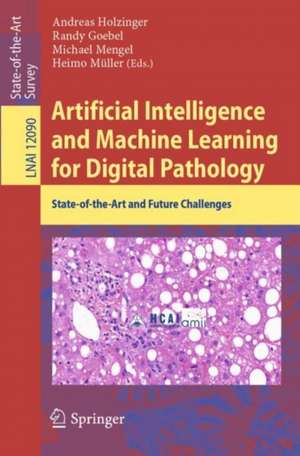
Artificial Intelligence and Machine Learning for Digital Pathology: Lecture Notes in Computer Science, cartea 12090
Editat de Andreas Holzinger, Randy Goebel, Michael Mengel, Heimo Mülleren Limba Engleză Paperback – 21 iun 2020
Notăm cu interes faptul că Artificial Intelligence and Machine Learning for Digital Pathology este susținut de resurse tehnice riguroase, incluzând metodologii pentru implementarea sistemului OBDEX – Open Block Data Exchange System și protocoale de management al calității în biobănci. Subliniem că acest volum, publicat în prestigioasa serie Lecture Notes in Computer Science de către Springer, nu se rezumă la prezentarea performanțelor algoritmice, ci prioritizează necesitatea ca expertul uman să poată verifica și trasa deciziile luate de sistemele de învățare profundă (Deep Learning).
Structura volumului reflectă o progresie logică de la așteptările teoretice ale AI în patologie către aplicații clinice specifice, cum ar fi detectarea retinopatiei diabetice sau predicția statusului receptorilor de estrogen din imagini hematoxilină-eozină. În contextul operei editorului Andreas Holzinger, lucrarea reprezintă o rafinare a temelor explorate în xxAI - Beyond Explainable AI și Machine Learning for Health Informatics, mutând focusul de la informatica medicală generală către rigoarea necesară în patologia digitală, unde „cutia neagră” a algoritmilor trebuie deschisă pentru a satisface criteriile de reglementare.
Complementar volumului Artificial Intelligence in Pathology de Chhavi Chauhan, care oferă o bază teoretică și principii fundamentale, lucrarea de față acoperă zona critică a infrastructurii de date și a managementului biobăncilor. În timp ce Digital Pathology de Meera Hameed se concentrează pe implementarea practică în laboratorul clinic și scanarea de mare volum, volumul editat de Holzinger și colegii săi investighează în profunzime calitatea meta-datelor și modelarea proceselor patologice pentru o integrare etică a AI. Putem afirma că volumul este o resursă tehnică esențială pentru înțelegerea modului în care seturile de date „fit-for-purpose” transformă diagnosticul digital.
Din seria Lecture Notes in Computer Science
- 20%
 Preț: 558.53 lei
 - 20%
 Preț: 571.88 lei
 - 20%
 Preț: 675.83 lei
 - 20%
 Preț: 1020.28 lei
 - 20%
 Preț: 851.78 lei
 - 20%
 Preț: 560.93 lei
 - 20%
 Preț: 633.70 lei
 - 20%
 Preț: 731.82 lei
 - 20%
 Preț: 1359.66 lei
 - 20%
 Preț: 620.33 lei
 - 20%
 Preț: 733.68 lei
 - 18%
 Preț: 945.44 lei
 - 15%
 Preț: 558.12 lei
 - 20%
 Preț: 793.92 lei
 - 20%
 Preț: 560.93 lei
 - 20%
 Preț: 748.63 lei
 - 20%
 Preț: 562.49 lei
 - 20%
 Preț: 1246.46 lei
 - 20%
 Preț: 449.81 lei
 - 20%
 Preț: 606.22 lei
 - 20%
 Preț: 620.33 lei
 - 20%
 Preț: 562.49 lei
 - 20%
 Preț: 560.93 lei
 - 20%
 Preț: 313.10 lei
 - 20%
 Preț: 828.44 lei
 - 20%
 Preț: 560.93 lei
 - 20%
 Preț: 314.86 lei
 - 20%
 Preț: 1033.45 lei
 - 20%
 Preț: 563.29 lei
 - 20%
 Preț: 733.68 lei
 - 20%
 Preț: 1137.10 lei
 - 20%
 Preț: 735.28 lei
 - 20%
 Preț: 1079.23 lei
 - 20%
 Preț: 584.42 lei
 - 20%
 Preț: 854.16 lei
 - 15%
 Preț: 672.87 lei
 - 20%
 Preț: 1032.47 lei
 - 20%
 Preț: 617.17 lei
 - 20%
 Preț: 1022.15 lei
 - 20%
 Preț: 984.64 lei
 - 20%
 Preț: 556.96 lei
 - 20%
 Preț: 402.28 lei
 - 20%
 Preț: 316.28 lei
 - 20%
 Preț: 663.69 lei
 - 20%
 Preț: 320.24 lei
 - 20%
 Preț: 343.12 lei
 - 20%
 Preț: 313.87 lei
Preț: 571.89 lei
Preț vechi: 714.87 lei
-20%
Carte disponibilă
Livrare economică 17 noiembrie-01 decembrie
Specificații
ISBN-10: 3030504018
Pagini: 356
Ilustrații: XII, 341 p. 95 illus., 84 illus. in color.
Dimensiuni: 155 x 235 x 20 mm
Greutate: 0.54 kg
Ediția:1st ed. 2020
Editura: Springer
Colecția Lecture Notes in Computer Science
Seria Lecture Notes in Computer Science
Locul publicării:Cham, Switzerland
V-ar putea interesa
-
 The Age of AI in the Life SciencesBoard On Life SciencesPreț: 130.48 lei
 -
 -27%Preț: 509.35 lei700.62 lei
 -
 -27%Preț: 432.76 lei591.08 lei
 -
 DermatopathologyDirk M. Elston-5%Preț: 887.86 lei934.59 lei
 -
 -27%Preț: 482.75 lei663.46 lei
 -
 Legal Medicine: Health Care Law and Medical EthicsAmerican College of Legal Medicine-29%Preț: 1283.09 lei1796.47 lei
 -
 -38%Preț: 398.93 lei646.62 lei
 -
 Artificial Intelligence Strategies for Early Intervention in NeurodegenerationVictor Hugo Costa de Albuquerque-24%Preț: 909.05 lei1201.28 lei
 -
 AI-Driven Innovations in Healthcare: Best Practices and Case StudiesJames R. Langabeer, PhD-5%Preț: 400.44 lei421.52 lei
 -
 Generative AI: Unlocking the Next Chapter in HealthcareRohit Mahajan-5%Preț: 293.73 lei309.19 lei
 -
 Data & AI ImperativeLillian Pierson-20%Preț: 177.50 lei221.88 lei
 -
 Precision Cancer MedicineBharat Jasani-5%Preț: 805.67 lei848.07 lei
 -
 Clinical Applications of Artificial Intelligence in Real-World DataFolkert W. Asselbergs-5%Preț: 756.43 lei796.25 lei
 -
 Advances in Intelligent Disease Diagnosis and TreatmentChee-Peng Lim-20%Preț: 1329.49 lei1661.87 lei
 -
 -20%Preț: 1207.79 lei1509.74 lei
 -
 -5%Preț: 1332.39 lei1402.52 lei
 -
 -5%Preț: 1481.73 lei1559.72 lei
 -
 Computing and Machine LearningJagdish Chand Bansal-20%Preț: 1408.28 lei1760.35 lei
 -
 -23%Preț: 169.81 lei221.52 lei
De ce să citești această carte
Această lucrare se adresează cercetătorilor și profesioniștilor din domeniul sănătății care doresc să treacă dincolo de simplele predicții AI către sisteme medicale explicabile și verificabile. Cititorul câștigă o perspectivă tehnică asupra rolului biobăncilor și al calității datelor în antrenarea modelelor de învățare automată. Este o recomandare concretă pentru cei care proiectează fluxuri de lucru în patologia digitală și au nevoie de soluții pentru transparență algoritmică.
Cuprins
Textul de pe ultima copertă
Moreover, big data is required for training, covering a wide spectrum of a variety of human diseases in different organ systems. These data sets must meet top-quality and regulatory criteria and must be well annotated for ML at patient-, sample-, and image-level. Here biobanks play a central and future role in providing large collections of high-quality, well-annotated samples and data. The main challenges are finding biobanks containing ‘‘fit-for-purpose’’ samples, providing quality related meta-data, gaining access to standardized medical data and annotations, and mass scanning of whole slides including efficient data management solutions.