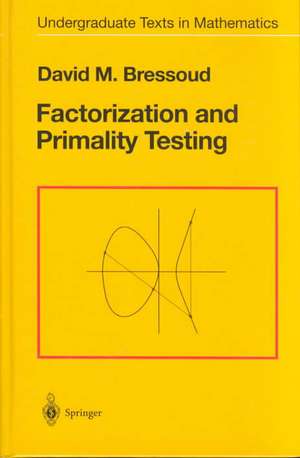
Factorization and Primality Testing
Autor David M. Bressouden Limba Engleză Hardback – 2 oct 1989
Preț: 507.08 lei
Puncte Express: 761
Carte tipărită la comandă
Livrare economică 30 noiembrie-14 decembrie
Livrare prin curier în România Termenul estimat este afișat lângă disponibilitate.
Transport gratuit pentru acest produs Plată online sau ramburs, în funcție de opțiunile comenzii.
Retur gratuit în 14 zile Comandă securizată și suport în română.
Specificații
ISBN-13: 9780387970400
ISBN-10: 0387970401
Pagini: 260
Ilustrații: XIV, 240 p.
Dimensiuni: 160 x 241 x 20 mm
Greutate: 0.51 kg
Ediția:1989
Editura: Springer
Locul publicării:New York, NY, United States
ISBN-10: 0387970401
Pagini: 260
Ilustrații: XIV, 240 p.
Dimensiuni: 160 x 241 x 20 mm
Greutate: 0.51 kg
Ediția:1989
Editura: Springer
Locul publicării:New York, NY, United States
V-ar putea interesa
-
 p-Adic Methods and Their ApplicationsAndrew J. Baker-31%Preț: 557.21 lei807.57 lei
 -
 Numbers: A Very Short IntroductionPeter M. Higgins-20%Preț: 57.15 lei71.12 lei
 -
 Number Theory PBorwein-9%Preț: 1201.14 lei1319.93 lei
 -
 -18%Preț: 783.70 lei955.73 lei
 -
 A Classical Introduction to Modern Number TheoryKenneth Ireland-15%Preț: 536.60 lei631.29 lei
 -
 A Course in p-adic AnalysisAlain M. RobertPreț: 501.09 lei
 -
 Modular Functions and Dirichlet Series in Number TheoryTom M. ApostolPreț: 452.85 lei
 -
 Introduction to Cyclotomic FieldsLawrence C. Washington-15%Preț: 559.70 lei658.46 lei
 -
 Fermat's Last TheoremSimon SinghPreț: 79.65 lei
 -
 Introduction to Modern Number TheoryYu I. Manin-18%Preț: 1050.62 lei1281.24 lei
 -
 Intersections of Hirzebruch-Zagier Divisors and CM CyclesBenjamin HowardPreț: 348.48 lei
Public țintă
GraduateCuprins
1 Unique Factorization and the Euclidean Algorithm.- 1.1 A theorem of Euclid and some of its consequences.- 1.2 The Fundamental Theorem of Arithmetic.- 1.3 The Euclidean Algorithm.- 1.4 The Euclidean Algorithm in practice.- 1.5 Continued fractions, a first glance.- 1.6 Exercises.- 2 Primes and Perfect Numbers.- 2.1 The Number of Primes.- 2.2 The Sieve of Eratosthenes.- 2.3 Trial Division.- 2.4 Perfect Numbers.- 2.5 Mersenne Primes.- 2.6 Exercises.- 3 Fermat, Euler, and Pseudoprimes.- 3.1 Fermat’s Observation.- 3.2 Pseudoprimes.- 3.3 Fast Exponentiation.- 3.4 A Theorem of Euler.- 3.5 Proof of Fermat’s Observation.- 3.6 Implications for Perfect Numbers.- 3.7 Exercises.- 4 The RSA Public Key Crypto-System.- 4.1 The Basic Idea.- 4.2 An Example.- 4.3 The Chinese Remainder Theorem.- 4.4 What if the Moduli are not Relatively Prime?.- 4.5 Properties of Euler’s ø Function.- Exercises.- 5 Factorization Techniques from Fermat to Today.- 5.1 Fermat’s Algorithm.- 5.2 Kraitchik’s Improvement.- 5.3 Pollard Rho.- 5.4 Pollard p — 1.- 5.5 Some Musings.- 5.6 Exercises.- 6 Strong Pseudoprimes and Quadratic Residues.- 6.1 The Strong Pseudoprime Test.- 6.2 Refining Fermat’s Observation.- 6.3 No “Strong” Carmichael Numbers.- 6.4 Exercises.- 7 Quadratic Reciprocity.- 7.1 The Legendre Symbol.- 7.2 The Legendre symbol for small bases.- 7.3 Quadratic Reciprocity.- 7.4 The Jacobi Symbol.- 7.5 Computing the Legendre Symbol.- 7.6 Exercises.- 8 The Quadratic Sieve.- 8.1 Dixon’s Algorithm.- 8.2 Pomerance’s Improvement.- 8.3 Solving Quadratic Congruences.- 8.4 Sieving.- 8.5 Gaussian Elimination.- 8.6 Large Primes and Multiple Polynomials.- 8.7 Exercises.- 9 Primitive Roots and a Test for Primality.- 9.1 Orders and Primitive Roots.- 9.2 Properties of Primitive Roots.- 9.3Primitive Roots for Prime Moduli.- 9.4 A Test for Primality.- 9.5 More on Primality Testing.- 9.6 The Rest of Gauss’ Theorem.- 9.7 Exercises.- 10 Continued Fractions.- 10.1 Approximating the Square Root of 2.- 10.2 The Bháscara-Brouncker Algorithm.- 10.3 The Bháscara-Brouncker Algorithm Explained.- 10.4 Solutions Really Exist.- 10.5 Exercises.- 11 Continued Fractions Continued, Applications.- 11.1 CFRAC.- 11.2 Some Observations on the Bháscara-Brouncker Algorithm.- 11.3 Proofs of the Observations.- 11.4 Primality Testing with Continued Fractions.- 11.5 The Lucas-Lehmer Algorithm Explained.- 11.6 Exercises.- 12 Lucas Sequences.- 12.1 Basic Definitions.- 12.2 Divisibility Properties.- 12.3 Lucas’ Primality Test.- 12.4 Computing the V’s.- 12.5 Exercises.- 13 Groups and Elliptic Curves.- 13.1 Groups.- 13.2 A General Approach to Primality Tests.- 13.3 A General Approach to Factorization.- 13.4 Elliptic Curves.- 13.5 Elliptic Curves Modulo p.- 13.6 Exercises.- 14 Applications of Elliptic Curves.- 14.1 Computation on Elliptic Curves.- 14.2 Factorization with Elliptic Curves.- 14.3 Primality Testing.- 14.4 Quadratic Forms.- 14.5 The Power Residue Symbol.- 14.6 Exercises.- The Primes Below 5000.